



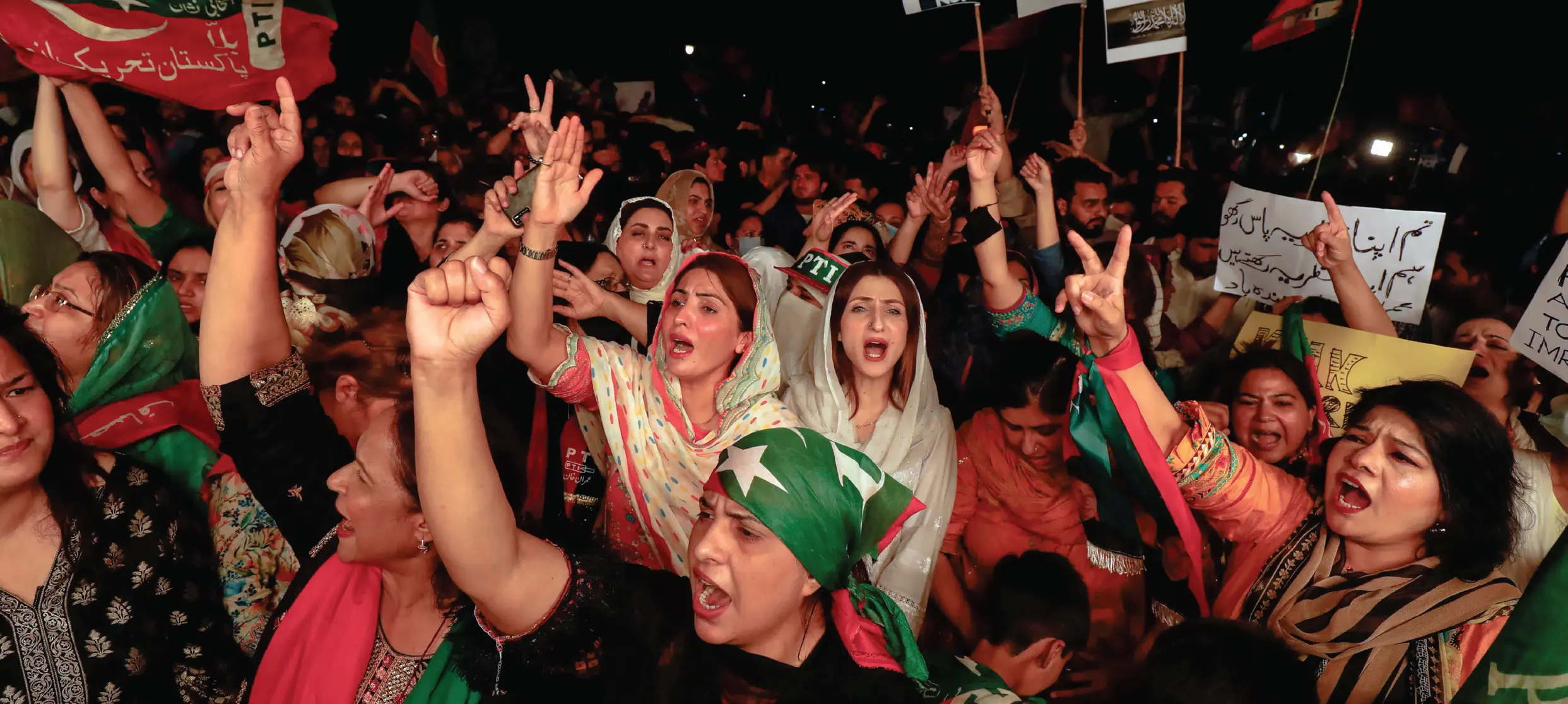
In Pakistan, the February 2024 elections generated an academic discussion in the wake of the surprising success of the PTI-supported independent candidates in Khyber Pakhtunkhwa and Punjab and the large number of purported votes polled by them in Karachi despite the daunting odds. Two senior columnists wrote in Dawn that the PTI received a vote against the persecution of its leadership during the past many months.
Some others have opined that populism and Imran Khan’s cult following lured the voters, while others have termed PTI’s success a vote against the establishment. All these opinions have shreds of truth. Owing to space constraints, we leave all other opinions aside and examine only populism in this piece.
The question of populism and cult following in the context of Pakistani politics warrants deeper analysis. Has South Asian politics been free from populism and cult following? This question has remained unanswered since the decolonization of the Sub-continent. K.M Gandhi was elevated to the status of Mahatma; the Nehrus became identified with the Indian National Congress and free India; Muhammad Ali Jinnah received the title of Quaid-e-Azam; the Bandaranaike and Jaywardhenes ruled Sri Lanka for decades on a wave of a cult following; Bhuttos in Pakistan have become legends. The politics of all these dynasties had strong traits of populism and cult following.
The life of KM Gandhi was shortened by his assassin, Nathuram Godse. However, Nehrus have remained relevant in Indian politics since the passing away of Jawaharlal Nehru. His daughter, Indra Gandhi, rose to the pinnacle of power in 1965 after the sudden demise of Lal Bahadur Shastri and ruled India until 1984. She proved to be the most ruthless Prime Minister, dissecting Pakistan into two halves and striking a debilitating blow to the Sikh separatist movement by flushing out Sikh militants violently from the Golden Temple at the risk of her own security.
Her Sikh bodyguard assassinated her. Her political mantle was inherited by her son, Rajiv Gandhi, who also was killed in a bomb blast by a Tamil militant. Rajiv Gandhi’s widow, Sonia Gandhi, could have taken over as Prime Minister, but in the broader interest of her country, she preferred to saddle the economist and retired bureaucrat, Manmohan Singh, with power, keeping in view the precarious condition of the country’s economy. Manmohan Singh had two terms with her unstinted support from 2004 to 2014. The Indian National Congress is currently led by Rajiv Gandhi’s son, Rahul Gandhi. However, the popularity of the Nehrus has witnessed a steep decline because of a wave of Hindu Rashtra created by Prime Minister Narendra Modi.
The iron lady of Sri Lanka, Sirimavo Bandaranaike, ruled her country from 1960- 2000, intermittently serving two terms each as Prime Minister and Chief Executive. Before retiring from politics, she served as Prime Minister from 1994 to 2000 under the second Presidency of her daughter Chandrika Kumaratunga. Ms. Kumaratunga had two terms as Chief Executive due mainly to the cult following of her family. The successors of the Bandaranaike in Sri Lanka had their cult following.
Quaid-e-Azam Muhammad Ali Jinnah lost his battle against tuberculosis in September 1948. Nevertheless, his sister, Fatima Jinnah, remained a political force to be reckoned with. She lost in her bid to dislodge General Ayub Khan to usher the country into democratic and representative governance in 1964. Interestingly, she won the overwhelming majority of the middle-class-dominated Basic Democrats in former East Pakistan but could not outperform her opponent in West Pakistan, swayed by landlords and sajadahnashins. Soon after this debacle, she passed away in July 1967.
Following his expulsion from the cabinet by his mentor General Ayub Khan, Zulfikar Ali Bhutto formed his political party, Pakistan People’s Party, in November 1967 with the help of the country’s left-wingers and feudal politicians including G.A. Rahim, Dr. Mubashar, Mahmood Qasuri, Hanif Ramay, Muhammad Rashid Shaikh, Dr. Ghulam Hussain, Malik Mairaj Khalid, Ghulam Mustafa Khar, Sardar Farooq Leghari, Talpur brothers and Jatois. He had already cultivated a substantial following for himself in his youth through his populist style of politics. His party took no time to overshadow the old political parties in West Pakistan.


The author is a former member of the Foreign Service of Pakistan and has served as Ambassador for seven years.
Leave a Reply