

International
Nine-Dash Red Line
Tensions in the South China Sea continue to rise and thus remain a hotbed for a potential conflict.

The South China Sea is an emerging hotspot of conflict in Asia. China claims a large body of water and is in dispute with several Southeast Asian nations and big powers like the U.S. This complicated case is based on historical evidence and contains economic and political concerns that significantly impact the stability of the regional and international legal framework. The position of the South China Sea does not end with being a business route to trade. It is perhaps one of the wealthiest zones in fish supplies and possibly boasts of underexplored oil and natural gas deposits. There are estimated to be about 1.1 billion barrels of oil and gas resources, including 190 trillion cubic feet of natural gas. It is for these resources that the region has become the epicentre of the territorial dispute among the neighbouring countries that started in the 1970s.
China is at the center of the dispute, claiming almost the entire area of the South China Sea using the “nine-dash line.” Since 2013, China has continued to take large tranches of territories in the South China Sea and build up military structures in the territories of the Paracel and Spratly Islands.
These actions have included creating artificial islands and extending existing ones, establishing military infrastructures such as islands, ports, and airstrips, and deploying military power, which might consist of fighter jets, cruise missiles, and radar. China has been actively changing the existing situation in the region, and its actions cause concern for other countries in the region and the international community.
Several other countries of Southeast Asia, including Brunei, Indonesia, Malaysia, the Philippines, Vietnam, and Taiwan, are in dispute with China over its expansive claims, resulting in increased diplomatic tensions and sometimes physical confrontation among the claimant states.
In 2016, the Philippines filed an international legal case against China at the Permanent Court of Arbitration based in the Hague. The court’s verdict was majorly positive, deciding in favour of the Philippines and denying China the right to historical possession of resources in the South China Sea. However, China does not accept the court’s jurisdiction or its decision and continues to argue that it has sovereign rights over the given territories.
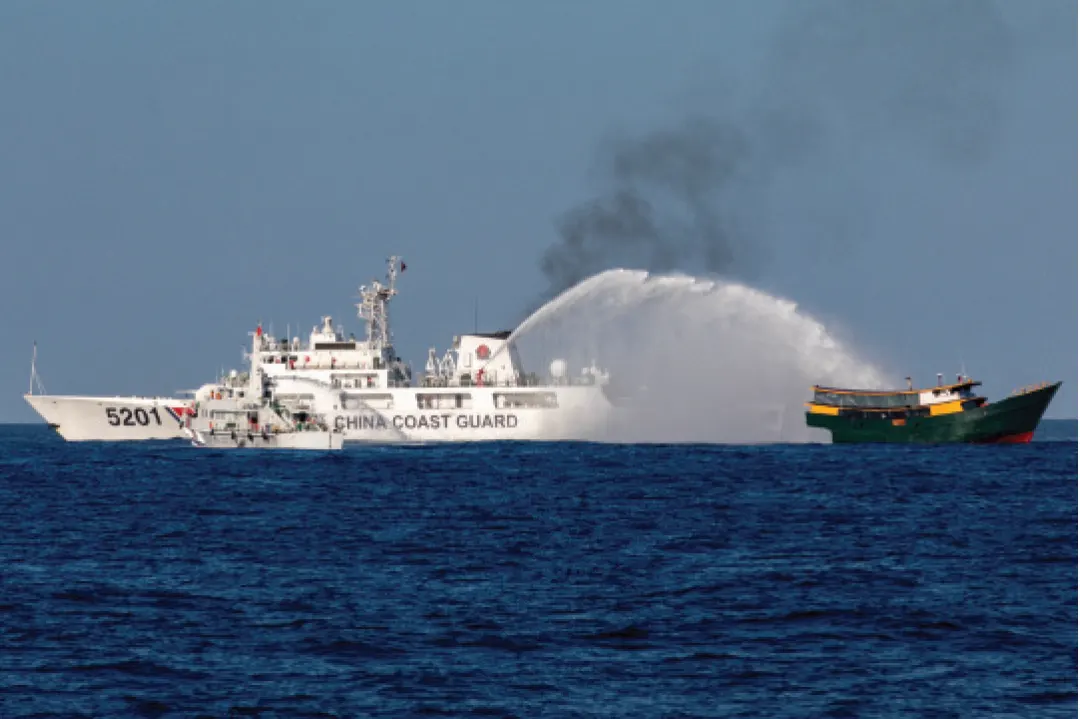
The Philippines has emerged as central to the disputes in the South China Sea, especially under the current regime of President Ferdinand Marcos Jr., elected in June 2022. Unlike his predecessor, Rodrigo Duterte, Marcos has assumed a more aggressive line in the face-off against China. The most sensitive feature of the conflict between the Philippines and China is the Second Thomas Shoal on Spratly Island. This area is located in the Philippines’ 200-mile Economic Exclusive Zone. It has been the scene of an extraordinary situation since 1999 when the Philippines deliberately ran aground naval vessel Sierra Madre with the purpose of territorial staking. It has recently become rather tense compared to many years ago; China has been a bit more assertive in how they try to remove the Philippine presence in the region. There have been documented reports on the part of the Chinese Coast Guard to intimidate Philippine resupply reinforcements to the BRP Sierra Madre. In June 2023, a Chinese boat and a Philippine supply ship were said to have been involved in an accident at the Second Thomas Shoal. These occurrences have left many people with question marks over their heads, especially concerning apprehension or touch-button crises, which may lead to a full-blown conflict.
There is, of course, much at stake for the United States in the South China Sea: its primary interests can be summed up by reference to freedom of navigation and the protection of its sea lines of communication, or ‘SLOCs.’ The U.S. has threatened China by exercising its unfettered right of passage and providing assistance to the Southeast Asian partners. In March 2024, U.S. Secretary of Defence Lloyd Austin stressed the strengthening of relations of the United States with the Philippines under the 1951 Mutual Defence Treaty. Regarding the treaty’s scope signed between the two countries, Austin emphasised that it refers to both countries’ armed forces, public vessels, and aircraft in the South China Sea. This declaration escalates the eventuality of a conflict, as it provides surety of the U.S. involvement, particularly in case of an attack on the Philippine forces in the said waters.
The Philippines has emerged as central to the disputes in the South China Sea, especially under the current regime of President Ferdinand Marcos Jr.
The Philippines has also enhanced bilateral relationships with neighbours in the Indo-Pacific area. Under Marcos’s presidency, the Philippines entered into new arrangements concerning the extension of access to the bases, joint training exercises, and the sale of arms from America. Japan has also raised its visibility in this regard by offering weapons manufacturing to the Philippines and Vietnam to improve their capacity to safeguard the oceans.
Tensions between the two superpowers have boosted the proliferation of arms in Southeast Asia. Indonesia and Vietnam, for instance, have raised their defence spending by more than 600 percent in recent years. This new arms race, stimulated by increasing exports from the major players and increasing concern among Southeast Asia’s states, increases the chances of possible fatal encounters or mishaps. The global political environment makes it even more complex, including relations between the U.S. and China and given domestic circumstances in different countries.
The forthcoming election in the USA might influence the region since presidential candidates may offer different strategies concerning China and adopt measures to support friends and partners in the area. However, with the escalating tensions, there have been some rare efforts towards reducing tensions. This year, China granted the Philippines a “provisional agreement” to deliver supplies needed by Philippine sailors and crew aboard the BRP Sierra Madre. It also involved the creation of a presidential hotline, which both nations could use to communicate during major maritime emergencies. However, it has to be noted that the efficiency of the measures remains to be seen, taking into consideration previous experience and contentious disputes.
If these conflicts are not settled diplomatically, they may pose potential threats to the existing maritime conflict laws and lead to further destabilisation of the arms race. Mastro, the regional conflict specialist, also observes China’s position relative to the SCS is even weaker than its position concerning Taiwan. If the U.S. increases its police presence in the sea and improves relations with other regional players and makes it clear China is unwilling to allow Beijing to continue with its actions peacefully, then it would be forced to re-evaluate its position. While some tensions are subdued, those in the South China Sea continue to rise and thus remain a hotbed for a potential conflict.
Those mentioned above are some factors of territorial disputes, scarcity, and strategic locations, all of which make it easy for the conflict to persist without a comprehensive solution. Thus, the major powers, such as China and the United States, together with their counterparts in the regions, will play a significant role in de-escalation or otherwise of the disputes.![]()

The writer has done his Masters in Defence and Strategic Studies. He can be reached at daniyaltalat2013@gmail.com
Asking For A Miracle!
Neither Carrots Nor Sticks
Tackling Trump 2.0
All Strangers in the End
President NBP Highlights Path Forward for Pakistan’s Financial Sector
Seminar on “China at 75” Held at Chinese Consulate, Karachi
From Pakistan to the World
First Aramco-Branded Retail Station Launched in Pakistan
Babar Azam becomes second highest run scorer in T20I
Toyota Corolla Cross Offers Exclusive Promotions
Direct Pak-Bangladesh shipping route marks ties revival
KMC to impose fines on individuals for littering on roads
40th SPELT International Conference ends on an optimistic note
Nepal exports electricity to Bangladesh via the Indian power grid
China’s foreign minister calls for resumption of direct flights from India
BOP Exchange inaugurates its branch in Lahore
Sanctions for Russian disinformation linked to Kate rumours


Leave a Reply