


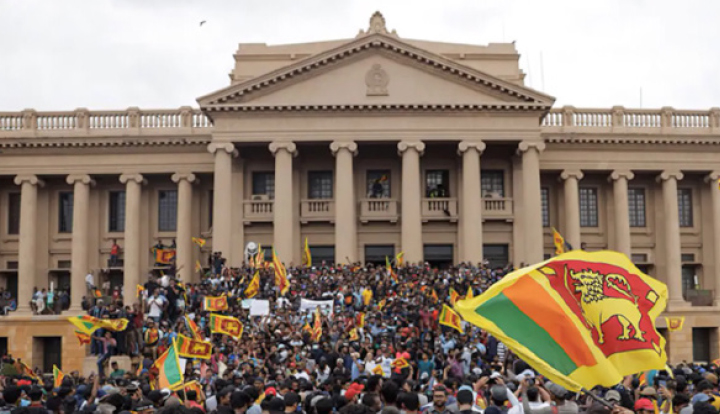
The fast-changing dynamic in the growing polarization of the global order is the defining feature of the year 2022. I reckon I speak for the majority that our initial expectation was of relative normalcy after wading through those two pandemic-riddled years. However, ever since Russia invaded Ukraine in February, the world has been on a constant rollercoaster - jostling from one crisis to another in succession. Without a doubt, this year would go down as a historic anomaly on multiple dimensions - probably even giving the year 2020 a run for its money. But it is chilling to realize that the sheer scale of global instability has rendered the collective world relatively desensitized. A stark manifestation of this reality is the widespread indifference towards Sri Lanka - a country once touted as an economic paragon in developing South Asia but now rapidly fading into oblivion
Only months ago, Sri Lanka was the talk of the town. Its brewing political crisis was the fulcrum of headlines across the globe. The populist uprising against the ousted President Gotabaya Rajapaksa and his family-embedded cabinet was a hot-button topic. And the announcement of Sri Lanka’s sovereign debt default - on its entirety of external debt of circa $51 billion - was a focal point among economists to highlight the risks of aggressive policy tightening in the United States. Yet, after Sri Lanka declared bankruptcy, hardly any advanced economy stepped forward to extend a helping hand. Counter-intuitively, the $2.9 billion bailout loan is still awaiting final approval from the International Monetary Fund (IMF) board. To date, India has provided assistance to the tune of $4 billion in fuel supplies and credit lines, while China has pledged emergency support of approximately 500 million yuan - roughly $74 million. Is it enough to survive, let alone stabilize the debilitated economy from a socioeconomic catastrophe? Not even close!
The queues lining outside the petrol pumps in Colombo have reduced down to a fraction of the absolute worst experienced this summer. But while the crisis is out of mainstream coverage, Sri Lanka is unfortunately not out of the stranglehold of its economic misery. Despite a recent reduction in fuel prices, petrol is still twice as costly as last year; diesel is almost four times the amount it cost in December 2021. Public transport has returned to routine operation. But fares have doubled due to a shortage of fuel. According to the estimates posited by the Central Bank of Sri Lanka (CBSL), Colombo Consumer Price Index (CCPI) measured inflation reached 66% in October and food inflation sustained at over 85% on a year-on-year basis. Experts believe inflation is far higher than official data suggests.
A blend of irresponsible government policies, aftershocks of the pandemic, and the roiling global energy and food markets have pushed Sri Lanka to the point that its usable foreign currency reserves amount to a mere $300 million - down by 96% from $7.6 billion reported in 2019. Thus, the incumbent government, under the fragile leadership of President Ranil Wickremesinghe, is forced to strictly ration fuel imports in favour of food and medicinal supplies. Speaking at a panel discussion at the Abu Dhabi International Petroleum Exhibition and Conference, Kanchana Wijesekera, Sri Lanka’s Minister of Power and Energy, wistfully voiced his concerns: “It has been a tough ten months for Sri Lanka. We are still seeking financial assistance from oil-producing countries, [but] have not secured any aid, apart from an existing deal with India.”
It is a shameful awakening for the world absorbed in a geopolitical tussle, fretting over European energy security when countries in Asia are suffering. Ironically, Asian countries then get browbeaten for approaching Russia and China for assistance. How is this fair?
 True, reforms are the need of the hour, and political scrutiny is pivotal to consolidating the fraying socioeconomic fabric of Sri Lanka. But economic restrictions could spark social unrest again after months of receding tensions. Hence, to strive for stability, global creditors should cooperate with China to collectively wean Sri Lanka off its crippling debt cycle. The focus should be to avail refinancing options or deferral in repayments instead of pushing for loan restructuring. Moreover, humanitarian recourse is imperative to stave off a burgeoning food crisis.

The writer holds a Bachelor’s degree from the Institute of Business Administration (IBA), Karachi. He can be reached at szainabbasrizvi.14122@khi.iba.edu.pk
Leave a Reply