



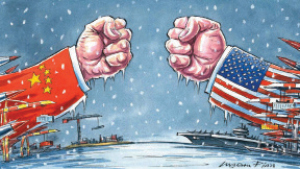
 Though the gradual rise of China as the world’s superpower is no more a piece of news now, the pattern on which this phenomenal development is seemingly based has something interesting to tell. More than a rags-to-riches story attributed to a nation’s decades-long hard work and consistent labour, China’s rise is also one of those paradigm shifts that is rapidly taking place as an act of divine determinism, which is subject to unseen forces and lies well beyond human control.
The United States is making every effort to retain its global supremacy over the rest of the world. However, the on-going chain of events and the current vicissitudes of times are not placed on the American side. As the recent developments suggest, the emergence of China as the world’s new superpower is bound to take place despite all odds and invincible challenges.
As things currently stand, the United Nations is a global association of nations that is seemingly controlled by hegemonic forces. However, the UN lexicon does not carry a word like ‘superpower.’ This dichotomy corroborates the fact that some realities are too conspicuous to be ignored, but still some people with their heads buried in the sand tend to stay oblivious to their surroundings.
After the breakup of the Soviet Union in 1989, for instance, the world was left with a single superpower, the United States of America. At that time, the rise of the ‘American Century’ was the most popular buzzword in the international community. The eventful advent of the 21st century was overwhelmed by the U.S. aggression consistently unleashed in the form of its hegemonic moves in different parts of the world. At that moment, however, a paradigm shift was slowly but steadily taking place with China, moving to the centre stage of the world order.
In 2013, the launch of China’s ‘One Belt, One Road’ programme, later re-named as the Belt and Road Initiative (BRI), was indeed a wake-up call for the global community. Even so, the BRI development was seen by many nations as being just another infrastructure project that was more ambitious than realistic.
But that was just the tip of the iceberg, since China has had everything up its sleeve to dethrone the U.S. from its top dog status in all aspects, e.g. economic growth, financial stability, global influence, technological advancement, etc. And things soon unfolded when the last 5 years of the present decade witnessed a direct confrontation between China and the US, as the latter was struggling to grip its hold on matters to reaffirm its superpower credentials.
Meanwhile, the global outbreak of the Coronavirus pandemic, referred to as the mother of all crises, emerged as a breaking point in world politics. With the U.S. tried hard to recover from the ravages of deadly pandemic, China successfully managed to accumulate weight and influence in the global economy by growing its foreign investment relationship with other nations.
Doing so, it has acquired resources as well as used its military might to secure land for building its huge BRI infrastructure. In May 2021, for instance, China’s People’s Liberation Army used its power to claim the Galwan River Valley of the Ladakh region situated near the Line of Actual Control between India and China. This was part of the move to safeguard the entire route of the China-Pakistan Economic Corridor (CPEC), the flagship project of BRI that covers more than 68 countries, targets about 65 per cent of the world’s population and covers 40 per cent of the global GDP. Until now, more than 125 countries have signed BRI cooperation documents and other than India, all South Asian countries have joined the BRI programme.

Happiness
“P professor gave a balloon to every student, who had to inflate it, write their name on it and throw it in the hallway. The professor then mixed all the balloons. The students were then given 5 minutes to find their own balloon. Despite a hectic search, no one found their balloon.
At that point, the professor told the students to take the first balloon that they found and hand it to the person whose name was written on it. Within 5 minutes, everyone had their own balloon.
The professor said to the students: “These balloons are like happiness. We will never find it if everyone is looking for their own. But if we care about other people’s happiness, we’ll find ours too.”