



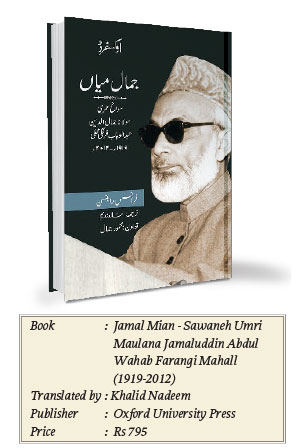
 Professor Francis Robinson, a British historian, has written several books on the subject of Islam in South Asia. His book ‘Ulama of Farangi Mahall and Islamic Culture in South Asia’ is his most seminal work. Published in 2020, the book ‘Jamal Mian: The Life of Maulana Jamaluddin Abdul Wahab of Farangi Mahall, 1919-2012’ by Francis Robinson has now been translated into Urdu by Khalid Nadeem.
Jamal Mian was the scion of a well-respected, scholarly family of Farangi Mahall, originally known as ‘Frank’s Palace’. Farangi Mahall, a palatial building complex in Lucknow, was owned by a French merchant during the period of Mughal Emperor Aurangzeb (1618-1707). After the departure of French traders from India, Aurangzeb gifted the palace to the four sons of Mullah Bin Qutubuddin Shaheed. Farangi Mahall was later turned into one of the leading Muslim madrassas of India which introduced rational sciences in Islamic education and also became a central place for Muslim scholarship.
A pass-out from the Farangi Mahall, Maulana Abdul Bari, who was the father of Jamal Mian, was a prolific author and a notable scholar of the early 20th century. He was a leading supporter of the pan-Islamist Khilafat Movement led by Maulana Shaukat Ali and Maulana Mohammad Ali Jauhar, who were close associates of Maulana Bari and recognized him as their spiritual mentor. A die-hard advocate of Muslim-Hindu unity, Maulana Bari was visited by prominent Hindu leaders like Mahatma Gandhi, Motilal Nehru, and Sarojini Naidu.
Born in 1819, Jamal Mian was a 7-year-old kid when Maulana Bari died in 1926. Holding the inherited mantle of Farangi Mahall, Jamal Mian completed the four levels of madrassa education and entered politics at the age of 18 when he was precipitately asked by Muhammad Ali Jinnah to address the 25th session of the All-India Muslim League in Lucknow in 1937.
Boasting of an envious educational background with an unremitting exposure to the elite political figures of British India, Jamal Mian was a polymath in oriental languages, a past master in firebrand oration, and well-adept in campaigning and political fund-raising, the most sought-after attributes coveted by the Muslim League leadership. Since his joining the Muslim League in 1937, Jamal Mian, despite running his own business, remained an active political leader and played a leading role in the success of the 1946 elections and the subsequent creation of Pakistan in 1947, a watershed moment for the Muslims of India. Jamal Mian was no exception.
More than an account of a Muslim scholar with international repute and reach, Jamal Mian’s biography is a bittersweet portrayal of a cosmopolitan cleric, who throws principles overboard in pursuit of worldly gains. A suave Sufi than a principled priest, Jamal Mian’s public speaking skills coupled with his public relations prowess earned him a place among the powers that were, whether in India, Pakistan, or abroad.
If human history is a web of lies purposefully woven to veil the truth, this biography aptly fits the bill. Based on diaries and letters written to Jamal Mian by leading personalities of his era, the book affords a unilateral account of his life since the author could not find those letters written and answered by Jamal Mian.
Poles apart from orthodox Muslim clerics, Jamal Mian, the recipient of the Sitara-I-Imtiaz in 1999, appears to be a cleric of the elite, who revels in listening to Qawwali, organizing urs, and visiting holy shrines, in place of sacrificing his self-interests for a non-personal cause. Running with the hare and hunting with the hound, the likes of Jamal Mian are hardly remembered in golden letters.
Quite a liberal religious scholar yet an uninitiated businessman, as the book suggests, Jamal Mian was devoid of a committed ideology with the Muslim ummah in general and with Pakistan in particular, and in his later years, he remained more focused on his family, fortune, and Farangi Mahall above everything else.
Pakistan was not his choice but compulsion as he was more grieved by losing the ownership of Farangi Mahall than the blood-stained Partition of India or the dismemberment of East Pakistan in 1971. However, his journey from being an ostracised Indian to becoming a compulsive Pakistani is different from those of the migration tales fraught with blood, bruise and burn.
Leave a Reply