



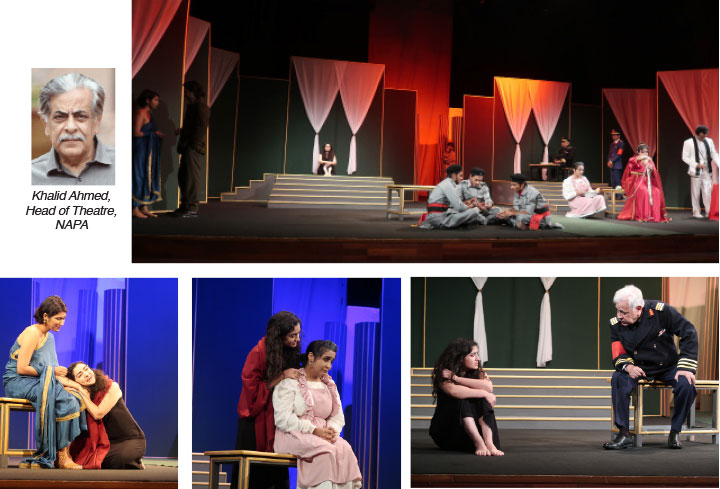
Khalid Ahmed, seasoned theatre actor and director and head of the NAPA Theatre Arts Department went through the labour of translating and then directing and producing the play Antigone, which was performed at NAPA. The cast included students, faculty and alumni of NAPA.
Jean Anouilh wrote the play Antigone based on a tragedy inspired by a Greek mythology play of the same name (Antigone by Sophocles) in the 5th century BC.
The Jean Anouilh play Antigone was written in 1944 during the height of Nazi occupation of France. His interpretation of the Sophocles tragedy became a symbol for underground freedom fighters who saw the heroine’s defiance in the play as a rebel’s call to patriotism.
Jean Anouilh’s Antigone in English is often distinguished from its antecedent by being pronounced in its original French form, approximately (On-tee-GONN).
The character of Antigone took on the role of the French Resistance and Creon took on the role of the Vichy Government, symbolising the power struggle present in France at the time - the parallels to the French Resistance and the Nazi occupation are clear. In an allegorical way, the play is openly critical about collaboration with the Nazis.
Just as in the myth and original play, the action follows the battle for Thebes in which both of Antigone’s brothers have been killed. Creon, now king, has decreed that while Antigone’s brother Eteocle should be given the usual respectful burial and Polynices must be left as carrion for scavengers. Antigone chooses to attempt to bury Polynices, and is brought before Creon as a prisoner. Creon attempts to overlook the offence, perhaps because Antigone is engaged to his son Haemon, but she refuses to be denied the responsibility for her actions.
Jean Anouilh was a French playwright living in German-occupied France during World War II. He wrote Antigone in 1942, though the play was originally censored due to its anti-authority message. The play was not staged in Paris until 1944, shortly before Paris’ liberation.
Khalid Ahmed has worked hard to bring the classic play to life. NAPA deserves all the commendation for reigniting the flavour of classic theatre productions in today’s fast-paced world where people don’t have time to watch even a fast-moving comedy
Leave a Reply