With beauty and diversity as its hallmarks, Azerbaijan is a land of tradition and modernity.
BySenator (r) Javed Jabbar | August 2022
A group of 19 volunteer development activists from across Pakistan including 3 full-time professionals, and 5 accompanying persons, associated with the public service organization named Strengthening Participatory Organization (SPO, www.spopk.org) visited Azerbaijan on a study tour 2nd - 6th July 2022. This writer was fortunately one of the volunteer-participants and like most of the rest, visited this distinctive country for the first time.
In spite of – or perhaps because of ! – the diversity of persons, professions, provinces, perceptions, our group became a single family, full of good cheer and shared enjoyment – of the 3-star, reasonably comfortable hotel we stayed in, of the journeys, the long walks, the cuisine, the whole, hectic, packed experience. 4 British Pakistanis , 2 parents, 2 children , earlier scheduled to join the group from the start , were able to join just after midway because their flight plan from London stranded them in Warsaw due to cancelled flights. Nevertheless , they too added to the merry crowd .
Located on the west coast of the Caspian Sea, about 2250 kms from Pakistan, a three and a half hour PIA flight from Lahore brought us to Baku, the windy, breezy capital. Originally said to derive its name’s association with fire through the area having hosted the ancient faith of Zoroastrianism centuries before Christ, a more modern link of Azerbaijan with the flame is when oil was virtually first discovered near Baku and harnessed for use in 1901.This old city is visibly contemporary while new structures retain a fine, time-tested limestone look. Streams of cars, with rarely a sight of a motorbike ply smooth, well-constructed roads. Hotels, restaurants, bars are aplenty – with not a single sight of alcoholic excess ! Yet there is excess of another kind, one of the best: The utter cleanliness of streets, free of litter and garbage, a strictly observed code of collectively practiced public hygiene.
Love for Pakistan:
At certain points, three flags are displayed in a row: Azerbaijan, Turkey and Pakistan. This Eurasian nation with an intrinsic affinity with Turkey, also acknowledges with sincere warmth the fact that Pakistan has always given unstinted, robust diplomatic support at the United Nations and elsewhere to Azerbaijan’s rightful stand on the Nagorno-Karabakh issue with Armenia. Specially in the 2020 Second Karabakh War. Pakistan has given vital expert military support for de-mining operations to make liberated areas of Karabakh secure and safe.
So friendly and welcoming are the people that the generally limited comprehension and use of the English language --- despite many shop signs being in English ---
is the only awkward obstacle to fluent verbal communication with Pakistani visitors . Specialists and those with higher education are English-proficient.
A secular Muslim country:
Perhaps the most striking feature of Azerbaijan, with a population of 10 million which is 97 per cent Muslim – and about 80 per cent Shia – is that the religious faith of an individual and the nation is given the optimal respect: of privacy and dignity. No ostentatious sights or sounds of faith or sect intrude on the eye and the ear. The azaan’s solemnity is heard but gently so, and not repetitively. Mosques are visible but not unduly numerous. There is a Constitutional commitment to secularism, the creed in which every faith deserves equal respect and by which the beliefs and practices of one faith cannot be imposed as being superior to another. Here is a truly Muslim society – pluralist, respectful, inclusive – without making a hue and cry about being of one particular faith. This becomes all the more notable because a southern neighbour is predominantly Shia Iran which is a theocratic republic shaped by sect and religion.
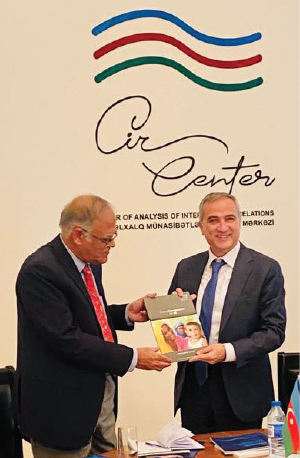
As Chairperson of SPO, the writer presents a copy of the latest annual report of SPO to the Chairman of AIR, former Ambassador Dr Farid Shafiyev.
Hilly, scenic Qabala:
On Sunday 3rd July, with our charming guide Elnara Aliyeva and the adept, amiable coach driver Naseeb Noor , we set out for a 4-hour drive to Qabala, earlier known as Ghabala. Perched about 2600 feet up in the southern Caucasian mountain range, the site’s history begins around the 4th century BC. It features as part of the 2500-year-old Silk Route and has a heritage of arts and crafts while also hosting an annual international music festival in the 21st century. After a brief visit to the scenic lake, the ride by chair-lift up steep, misty, green slopes brought us to rainy wetness and cold – for a swift descent to hot coffee and snacks. The passage to this pleasant retreat takes one through large, sweeping, light brown, cropped-clean vistas of farm fields and then, through densely wooded shades of hazel nut, chestnut, beech and pine trees.
Martyrs’ Monument:
Most of 4th July was spent on walking through a few principal sites in Baku. Aptly, first to the Monument of the Martyrs, with portraits and names of the dozens who shed their blood defending their country against surprise attacks by Armenia as well as in all-out declared wars, past and recent. Culminating in an eternal flame on a terrace overlooking the Caspian Sea with a panoramic view of Baku, the coastline, boats and leisure places. Three towering skyscrapers inventively designed to represent flames light up at 8 pm every night with glittering, fast-changing shades and patterns. In the engaging , bustling Nizami Street area , the wall of the unusual Museum Of Literature is adorned with the portraits of the country’s eminent past poets and writers.
An elegantly designed mosque in Baku symbolizes the quiet dignity – not loud intrusion – with which religious faith is practiced in Azerbaijan.
Meetings with civil society:
Earlier that day, Mr. Surkhay Shukurov, Executive Director, International Dialogue for Environmental Action (IDEA), a leading NGO, and the country’s sole civil society member of the International Union for Conservation of Nature (IUCN) kindly agreed to visit our hotel to brief the group on IDEA’s work. An energetic gentleman with previous experience in the Foreign Affairs Ministry, Mr. Shukorov provided a detailed as well as far-ranging summary of his country’s principal ecological concerns affected by both climate and social change.
Benefitting from the 70 years, 1920-1990, during which Azerbaijan was a Soviet republic, there is high literacy due to enforced compulsory schooling of 11 years and fairly accessible public health care. Abundant oil resources that generate about 80 per cent of revenue have fostered financial strength but also rich elites, and pollution of the Caspian Sea – in which sturgeon fish produce the pricey export of caviar. They are joined in their vulnerability by species like bison and the very rare Caucasian leopard even as the arid nature of the country causes sea water to move upstream of dried-up rivers, upsetting Nature’s delicate balance. An influx of about one million Internally Displaced Persons from the conflicts with Armenia has compounded pressures on a dominantly urbanized demography. Agriculture remains the principal user of scarce water, not often efficiently used. As NGOs begin to form and partner with the state, IDEA itself collaborates productively with the Ministry of Natural Resources – to help plant about six million trees of species carefully chosen to harmonize with the soil and to, among other subjects, assist in the formulation of a balanced land-use policy.
The geopolitical context:
On 5th July, the day began with a visit to the Centre for Analysis of International Relations (AIR), a research forum and think tank supported by the government, housed in elegant, stately premises and led by distinguished former Ambassador, Chairman Dr. Farid Shafiyev, assisted by a team that includes Mr. Vasif Huseynov.
Though only a few years in existence, AIR has quickly established a credible reputation through investigative scholarship and study. Its periodic journal “Caucasus strategic perspectives” presents multiple commentaries and essays whose titles reflect the breadth and depth of content: The Post-War situation in the Caucasus region; The 44-Day War – A Failure or an Opportunity for EU?; Azerbaijan’s Soft Balancing vis-à-vis Russia; Role of Turkey in the Post-War South Caucasus; Iran’s Challenged Position...”. In his concise, candid remarks as also in responses to questions, Dr. Farid Shafiyev gave us an overview of both internal and external realities. Stressing the practical, clear cut commitment to secular values, he said that, for example, while hijaab is not permitted in schools – but allowed in universities – child students are informed about Islam and other principal religions. No extremes in faith, verbal or physical are acceptable. He cited two recent instances when clerics from one major Sunni and one major Shia country were expelled. Women are actively encouraged to participate in public life: the present Vice President and the Speaker of the National Assembly are women leaders.
Sketching the historical framework, he recounted how, before the USSR era, Azerbaijanis were described as alien Tartars, how the Soviets moved large numbers of Armenians, Germans and others into the country to try to tilt the non-Muslim, non-Turkic composition. Which, however, reasserted itself. Azerbaijan retains its deep bonds with Turkic and Muslim roots. He said that, having won the 2020 war, Azerbaijan now wants to ensure that the peace is also won as decisively. He acknowledged the close relationship with Pakistan and stated his own country’s support on Kashmir and on condemnation of the persecution of Indian Muslims. The country has to navigate complex geopolitical conditions, balancing relations with Iran and Russia while remaining alert about Armenia and Georgia.
There is the view that Azerbaijan has an authoritarian political power structure: the present President, Ilham Aliyev, is the son of the preceding Head of State, Heydar Aliyev and controversies mark freedom of expression and the media. Our visit’s framework did not cover exchanges on these subjects which require separate attention. Perhaps next time! Because Pakistan’s raucous, political dynastic conditions in which the civil-military dimension remains a central issue would surely also be of interest to our precious friends in Azerbaijan.
At the AIR think tank in Baku: L. to R: Mazhar Akram, Syed Abid Rizvi, Mehreen Haroon, Tufail Khan, Shabnam Jabbar, Javed Jabbar, Favad Soomro, Mahnaz Shaikh, Chairman of AIR, Dr Farid Shafiyev, Yasir Ali, Zeenat Achakzai, Parveen Akhtar, Aaref Farooqui, Faiza Mir, Arifa Mazhar, Anjum Zia, Taj Baluch, AIR scholar Vasif Huseynov and two AIR scholars.
Caring for children:
As the visiting group also has a keen interest in social welfare and children’s rights, the next stop was the SOS Children’s Village in Baku. Readers may be aware that a SOS Village comprises 15 houses, each of them a “home” for 10 girls and boys who are natural or social orphans, with a woman – a single person, or a widow, or a divorcee – who becomes their mother. By providing abandoned children with safety, security, education, and a “mother’s “ love and care (and later) skills-development, the SOS approach enables despair to be replaced with hope and self-confidence.
While the original model of SOS is practiced in essence in many third world countries , several countries like Azerbaijan are undergoing a shift of roles after new legislative changes defining child care standards in the country. It was interesting to note the amalgamation of SOS Baku’s role in aligning with government policies so as to be an active partner with the government in providing innovative and carefully-deliberated solutions for family strengthening and child care in the region.
Presently operating in 132 countries around the world, and in Pakistan in all provinces and regions after being founded in 1975 by Mrs. Souriya Anwar, the SOS network facilitated a refreshing interaction with the mothers and charming children of the Baku Village and with their management team capably led by Mr. Zakir Sultanov, supported by his enthusiastic team. Neatly planted trees and well-maintained structures, and most of all, the eyes, expressions, voices of the residents, both children and adults portrayed a Village that conforms to strictly prescribed codes for child protection and development.
Through walking tours and visits to shopping plazas and restaurants, we discovered colours and textures, old palaces, bazaars, towers – and a “Multan Caravanserai” – currently being renovated but built centuries earlier for overland merchants from southern Punjab who ventured there to sell and buy. So the Pakistan-Azerbaijani relationship began well before the 20th century!
A Board in Baku:
Inside the hotel’s meeting room on the visit’s second last day,we returned to Pakistan when we convened our Board of Directors’ quarterly meeting . SPO works in all provinces and regions in capacity-building of grassroots communities, advocacy of rights and responsibilities, education, health care , environment and cultural heritage . Our programme goals , performance targets and internal audit aspects were reviewed in detail -- while avoiding micromanagement and interference in administrative matters, ably overseen by our woman CEO . We also exchanged views on our shared experience of a fascinating country.
Contemporary Baku: three skyscrapers uniquely shaped like frozen flames glitter with lights every evening.
An architectural masterpiece:
A befitting finishing touch was a couple of hours spent in the wondrous space outside and inside the Heydar Aliyev Cultural Centre. Named after the country’s president, 1993-2003, who became Head of State at a critical, uncertain phase and established stability and security, the Centre is an architectural masterpiece designed by the late Iraqi-British genius Ms. Zaha Hadid. Comprising folds and undulations that arise from Islamic and Azeri traditions and representing the waves and eternal movement of the nearby sea, the interiors feature a white marble seamless staircase that makes you feel as if you are stepping up and through a cloud – to enter galleries of splendid art, music and sculpture, a scintillating treat for the senses.
Today, in 2022, despite the low level of trade, Pakistani – mainly tourist – travel to this friendly country numbers tens of thousands every year. 600 to 700 Pakistani students also pursue education in Baku.
The country’s GDP per capita as reported by the World Bank in 2021 at $5384/- is almost four times larger than our own at about $/1537-. Ranked far higher than Pakistan in the Human Development Index – respectively, 88 in 189 countries, and 154 in 189, as of 2019 – Azerbaijan is a refreshing, remarkable country to visit.
Post-script: Pakistanis intending to visit there are advised to select their travel agent with extra care and due diligence: our group successfully completed its visit on schedule – despite unwarranted surprises, courtesy our travel agent. The study group comprised : Members , SPO BoD : Ms. Parveen Akhtar, Dr. Taj Baloch, Dr. Tufail Mohammad Khan, Ms. Faiza Mir, Syed Abid Rizvi, Mr. Favad Soomro, Mrs. Zeenat Yaqoob Yousufzai, Dr. Anjum Zia, Mrs. Mahnaz Fareed Sheikh, Vice Chairperson, this writer as Chairperson, Mrs. Arifa Mazhar, Chief Executive, Mr. Aaref Farooqui, Company Secretary, Mr. Yasir Ali, Manager Finance, Accompanying Persons: Dr Nighat Durrani , Dr. Sheheryar Khan, Dr. Aima Khan, Dr. Maria Khan, Mr. Munzir Elahi, Mrs. Mehreen Haroon, ,Mrs. Shabnam Jabbar, ,Mr. Mazhar Akram, Prior to emplaning for Baku , the group benefited from an informative , valuable interaction online with the former Ambassador of Pakistan to Azerbaijan, Dr Saeed Khan Mohmand introduced to us through the kind courtesy of Mr Shah Faisal Kakar, Director-General, Central Asia and ECO, Foreign Office in Islamabad . The group made no contact with the Embassy of Pakistan in Baku because , after a prior exchange of emails with the Embassy, there was no follow-up or interest taken by this Embassy to inquire further or support the visit --- which , in any case, proved to be most educative and enjoyable. Colleagues Dr Tufail Khan , Mrs Mahnaz Shaikh , Dr Anjum Zia , Ms Arifa Mazhar ,Messrs Syed Abid Rizvi , Favad Soomro and Munzir Elahi contributed valuable suggestions-- and images -- to ensure accuracy and comprehensiveness of some aspects of this essay’s content .







 The writer is a former Senator and Federal Minister, author, film-maker and policy analyst. www.javedjabbar.net
Leave a Reply