



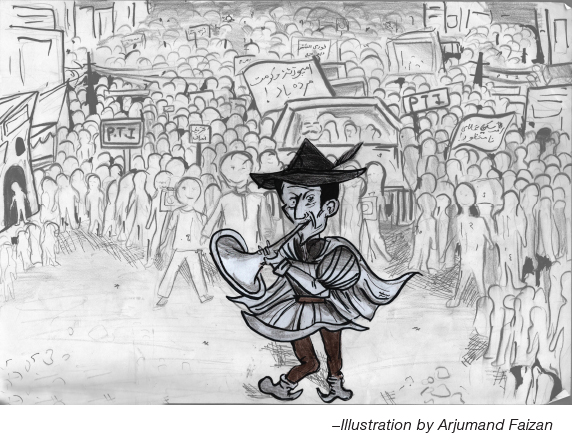
Since independence, the governance and economy of Pakistan have repeatedly been in rough waters - encumbered in rising debt, surging inflation and widening current-account deficit. That poor state of governance distorts the potential for socio-economic growth and enhancing poverty is now conventional wisdom. Pakistan’s policy challenge is therefore, to break this viscous cycle and achieve a level of structure of economic growth and efficient governance that can promptly reduce poverty and rising inequality in the country.
One of the major impediments to enhancing participatory and good governance has been the disproportionate exercise and unacceptable levels of influence of elite pressure groups and lobbies over collective functions of the state and manipulation of decision-making processes to secure undue benefits for themselves. Lack of education, asset ownership, land ownership and politically strong family affiliations, political power, military power, historically discriminated social groups, etc., have all contributed to elite control of government resources for the benefit of a select few at the cost of others.
This multi-dimensional phenomenon has demonstrated itself in Pakistan right from the beginning. Being a new state carved out of a larger entity, with no experience or established governance system in place, it was natural for its educated elite to partner with powerful groups in society, like the landlords, industrialists, businessmen, bureaucracy and the military to take hold of the new state and make it functional. These early anomalies in the governance structure can be accepted and explained as a result of unavoidable circumstances. However, the problem emerged when what should have been a temporary arrangement to be replaced with a democratic dispensation with clear division of power and responsibility, became the established norm.
The unfortunate deaths of the founding fathers in the early years complicated the situation further, with not only governance but also the economic and ideological orientation of the country. Failed attempts to agree on a governance and development model and a workable constitution, led to military takeover early in the formative years which continued at regular intervals not allowing democracy to mature and take roots or for the people to learn the attributes and rights and duties of citizenship and value of participatory or accountable governance.
This state of flux and uncertainty encouraged the self-centered elite groups to strengthen their hold on policy formulation which landed Pakistan in the clutches of governance crisis accentuated by inefficient deployment of resources, crippling debt burden, unbridgeable social divisions, arbitrary enforcement of laws, and personalized decision-making and sadly questionable integrity of all pillars of state. It would, however, be wrong to apportion the blame of this collective failure on any particular institution or government. This is a collective failure of the nation resulting from 75 years of poor governance, wrong interruptions of the democratic process and criminal disregard of the interests and welfare of the common people.
In the 1960s, Pakistan was slated to be the next Asian tiger or the Singapore of South Asia. It had all the prerequisites - perfect location, a large talented and resilient population, a hardworking labour force, unexplored natural resources and a modern outlook on life. The country saw spurts of economic development and good governance during its formative stages. Some of this could be attributed to the 5-Year Development Plans instituted by the first Prime Minister Liaquat Ali Khan and assiduously followed by Ayub Khan.
Pakistan, however, cannot lose sight of the fact that this initial era of rapid industrialization and development, particularly under Ayub Khan, entailed large and repeated loans from international financial institutions and progress was achieved by concentrating wealth in the hands of a few large landlords and industrialists further cementing the culture of elite capture. The logic was that once a certain level of development was achieved, wealth would trickle down and eventually benefit all. This sadly never happened and the cartel of the elite further strengthened, penetrating all institutions and sectors of the state, including the political parties. Today Pakistan ranks as a recipient of the largest number of loan facilities and there seems to be no end in sight for breaking the shackles of this external dependency.
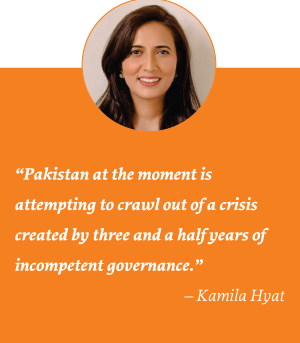 Nevertheless, no matter how bleak the current situation may be and irrespective of the political and economic crises Pakistan continues to experience, it has come a long way since its creation in 1947 and it would be wrong to write it off or categories it as, “the sick man of Asia” as was said in a recent India article. Frequent political instability, two major wars with India, loss of East Pakistan, continuous tension on the eastern border, major political and military destabilizing developments in Afghanistan, hosting over five million refugees over forty years, sanctions by the West first on account of nuclear tests and later on account of terrorism spiraling, Pakistan down from being a non-NATO ally to the most sanctioned country, brave and successful fight against terrorism, devastating natural disasters and other issues have all contributed to stunting socio-economic development. Absence of consensus in the country on long-term development strategy and repeated change of course have also contributed to the economic and societal woes.


The writer is a former ambassador. She covers a variety of issues including political, strategic, economic, environmental and a whole range of social and developmental topics. She can be reached at naghmanahashmi40@gmail.com
Leave a Reply