



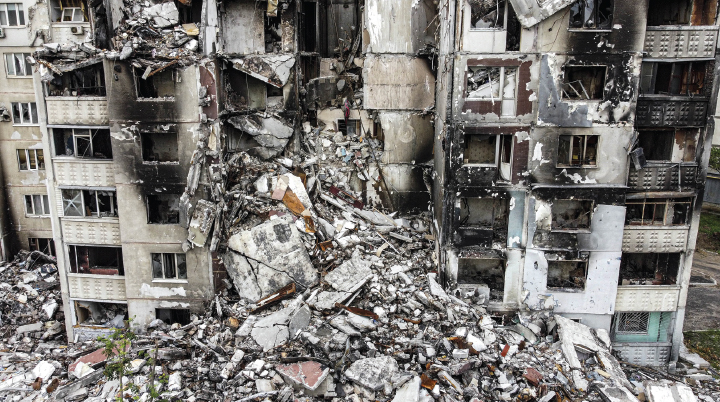
Over 100 days of Russian expedition in Ukraine may not have accrued the desired outcomes for the campaigners, yet it is revealing to some palpable lessons. The Russian invasion of Ukraine is being waged in a new era of technology which is playing an important role. Rather than being merely a battleground it has now become an observatory for political and social scientists who are minutely studying this on-going saga to draw pertinent lessons not only for the war but also for the future.
Both sides are making extensive use of technology and that’s expected in any war in this century. It is being utilised both in a hard and soft manner and has, in fact, become a technological contest between Russia and the West, which is aiding Ukraine in competition with Russia. Employment of drones, long range artillery, space, cyber and information tools are specifically the hallmark of this on-going conflict. The important thing to observe is that although there are apparently only two belligerent sides fighting this war yet almost the whole world is directly or indirectly involved. Can we safely conclude that any future war in the world will now be a world war as it may not be the devastation but the effects and ripples that are felt in every corner of the world?
Analysts hold the view that the Russians had initially been careful but later used their massive firepower to decimate Ukrainians’ will which they haven’t been able to accomplish. The war reignited the ideological tussle with its arch-rival, the West, which supported Ukraine. This conflict, in fact, seems to be more between the West and Russia while Ukraine is suffering as a proxy. Russian technological expertise is thus pitched against the West and a Cold War scenario is once again in sight with memories of the Russian invasion of Afghanistan. The West’s strategy is similar to that employed during the Afghan war of the 80s when the US and allies abetted Afghan freedom fighters with whatever help and support they could. The US and UK have vowed to supply to Ukraine the advanced artillery systems against which the Russians have been wary. They have, in fact, warned the West not to equip Ukraine with the kind of arsenal which will invite Russian wrath.
The Russians were careful in the beginning avoiding collateral damage and applied disruptive technology to subdue the Ukrainians’ will. But that must have afforded Ukrainians time to reorganise themselves and train their volunteers. As the resistance grew so did the intensification of Russian firepower. Analysts now conclude that Russian military might was perhaps wrongly estimated by the West. It is important to remember here that the fear of the adversary is naturally hyped by humans and all possible measures are therefore considered to confront it, whenever the time arrives. This estimation if tangibly made can save a lot of resources for the better use of mankind.
The international systems mandated to maintain peace and tranquillity in the world have proven to be once again weak here. As soon as the Russian invasion was commenced, the major stakeholders of international systems commenced their efforts to sanction Russia for its belligerent act and resolutions were tabled in UNGA as well as UNSC. However, with Russian veto power, these were of seldom use.
 This has also been a war of economics. The world’s economy has been affected severely as a result of this campaign and food shortages are expected in different parts of the world, especially in Africa. Although, reportedly, the Russians are exporting Ukrainian wheat confiscated during the advance, yet regular wheat trade has been badly damaged. As for the energy supply, the Russians have asked its customers to trade in ruble (basic monetary unit of Russia) which has caused a furore among the Americans who must be foreseeing devaluation of the USD. Also every now and then Russians threaten to cut off energy supplies to Europe though it will hurt their own economy as well. According to analysts, it evens out the financial calculations for them. The Western sanctions have cut off Russian banks from the global financial systems, half of their foreign currency reserves are frozen and export of sensitive technology as well as key services to Russia have stopped. This is at the moment not deterring Russia which has also banned imports, raising value of ruble on temporary basis.


The writer is associated with the Institute of Regional Studies, Islamabad. She has interest in international politics and South Asian security dynamics and can be reached at reema.asim81@gmail.com
Leave a Reply