



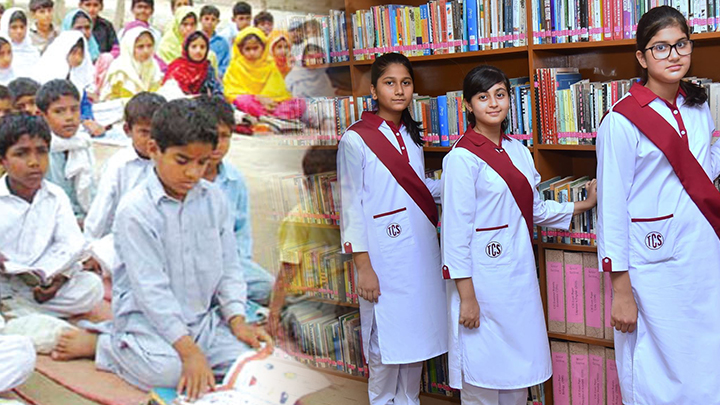
Education lays the foundation of a prosperous and virtuous society. The tenets of a cultured population were quite apparent in the early ages of Pakistan. However, as economic growth and westernisation climbed the ladder of our priorities, Pakistan lost its way leading to an educated society. Today, an estimated 22.8 million children aged 5-16 are out-of-school; many are ensnared in the untimely hardships of child labor and child marriages. However, before we critique the latent lack of literacy in the younger generation, let us first evaluate what education means in all its subjectiveness.
In the societal fabric of Pakistan, growth in education somehow reflects via the increase of the number of schools - or the modern facilities offered by the institution. This faulty narrative stems from the fact that many parents deem education as a parallel to western culture (speaking English, watching American TV shows, etc.). The problem is exacerbated when parents start treating education as a routine rather than a matter of grave developmental importance - ultimately turning their children either into English-speaking dropouts or simply dropouts. Assuming such was the case, let us evaluate the correlation between the two variables. According to Pakistan Economic Survey 2018-19, the total English-medium primary/secondary schools grew by 6.6% at the national level. The survey also suggests that the number of teachers therein also increased by 2.9% during the same period. However, during that span of time, the national literacy rate dropped by 2%. It isn’t surprising that despite the implied growth of supposed ideal educational facilities, Pakistan still remains the country with the world’s second-highest number of out-of-school children - 44% of the population in the age group 5-16.
The primary facet of educational deficiency in Pakistan is the segregation of education between poor and elite. While government schools offer educational services in the country, they are undoubtedly outmatched by their private counterparts providing (or I should say auctioning) education to the fortunate upper-class. According to Punjab Education Sector Reforms Program (PESRP) statistics, the province faces a shortage of an estimated 51,443 teachers in multiple categories of elementary, primary, and secondary levels. Recently, the Sindh Education Secretary admitted that roughly 6,866 public schools in Sindh were forced into closure last year due to a shortage of teaching staff; about 7,974 schools are operating under unviable conditions. Meanwhile, private schools are teeming with faculty as admission fee tags are inflating beyond measure. Given such a dismal show of management at the state level and utter lack of regulation at the private, it is no wonder that more than half of the population of Pakistan is illiterate.
According to Reuters’ “Pakistan Labour Force Survey 2014-15,” more than 12.5 million minors were involved in child labor in Pakistan. According to a 2013 UNICEF report, roughly 21% of underage girls were forced into marriage in Pakistan. With a poverty rate of about 25% and an average low-income Pakistani earning less than $2/day amid soaring inflationary pressure, one could hardly blame the children (or the parents) for sidelining education to put food on the table or to endeavor a perilous path to early childbirth. With a less-than-subtle downfall of public schools and the prohibitive costs of private institutions (on average 90 times more expensive than state-run schools), it seems that the problem is indelible. However, despite being a chronic issue, it is still not pit-bottom for the revival of education in Pakistan.
The government of Pakistan (and provincial regimes) ought to stake more than merely 2.8% of the total GDP to the educational sector. I believe that despite a modest infrastructure, teachers should be the primary resource of focus with respect to investment. Facilitation of workshops and quality training coupled with a sufficing pay scale for teachers would drive the system in a meaningful and sustainable manner. While steps towards a unified curriculum are well-intended, I am afraid that is not even the tip of an equitable educational system envisioned by the father of our nation. Equity in education would not be guaranteed by a uniform curriculum or more schools or more teachers. Nor would it be fruitful to simply ban child labor and outlaw early marriages without offering ample welfare means to the economically struggling families. But a sustainable revival of education could only be achieved by gradually eradicating socio-cultural barriers alongside economic disparities to ultimately overcome educational deprivation. Simply put, the sooner we (as a nation) start treating education as a right rather than a privilege, the sooner we could bid adieu to these grim days of illiteracy. 

The writer is a retired Dean of Faculty of Department of Education at the University of Karachi. He can be reached at syedaleyhaiderrizvi@gmail.com
Leave a Reply