



Amir Khan Muttaqi, Afghanistan’s acting Foreign Minister’s recent visit to Iran has gathered sympathies on the frozen funds of Afghanistan. It is the inclusion of another vote on the humanitarian basis for releasing these static funds. Iran’s Foreign Minister Hossein Amir-Abdollahian praised Afghans’ bravery and said no foreign power can rule and occupy Afghanistan. He was of the view that foreign sanctions on the Taliban resulted in paralyzing Afghanistan’s banking sector that quickened the country’s economic collapse.
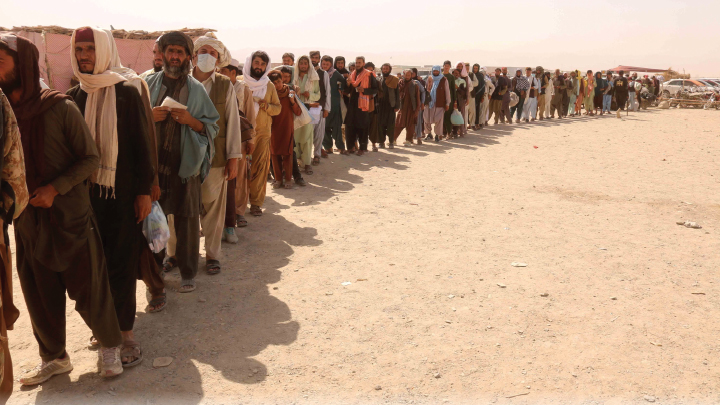
According to the United Nations, about 90% of Afghan people that make about 38 million are in dire need of humanitarian aid, as they don’t have access to adequate food. The United Nations has appealed to the global community for about US$5 billion in international funding to meet the growing level of needs in Afghanistan. In this regard, the United States has offered $308 million aid.
In the recent summit of the Organization of Islamic Cooperation (OIC), Saudi Arabia agreed to provide $265 million, while Pakistan would provide $30 million to Afghanistan through the Islamic Development Bank (IDB). The international community is also providing medicines, food, and health supplies to the Afghan people.
Currently, Pakistan is the only country in the world that is showing its full support to Afghanistan. Calling for immediate financial assistance to Afghanistan, Pakistan is also grappling with an internal economic crisis. Prior to the U.S. exit from Afghanistan, 40% of the country’s GDP was based on international assistance, making about 80% of its total budget. According to Ahmad Wali Haqmal who is now the spokesperson for Afghanistan’s Ministry of Finance, “for the first time in the last two decades, we made a budget that is not dependent on foreign aid and that is a very big achievement for us”.
Extending a helping hand to Afghanistan’s government, Prime Minister of Pakistan, Imran Khan has directed the Pakistani authorities to find ways to save Afghanistan from humanitarian and economic crises. To help out the ailing Afghan economy, PM Imran Khan is also willing to send trained and qualified manpower to the war-torn country in the fields of information technology, minerals mining, accounting, railways, media, and pharmaceuticals.
Thus, Pakistan’s role is being seen as supportive to its neighboring country for stability and peace in the region. Islamabad recently sent Moeed Yusuf, the National Security Adviser, to Afghanistan to revive the pending projects of gas, power, and railways. The national-level coordination mechanism has also been developed between the two countries for the facilitation at the border crossing points.
 On the economic and political fronts, Afghanistan is facing a seesaw situation. The US and the international community have created problems by not recognizing the Taliban government and are blocking aid access to the government. Positively, secondary-level education has returned in 15 provinces, but a lot of restrictions have been unluckily imposed by the Taliban government. For instance, Afghan women are not allowed to travel alone for a long distance, with multiple employment restrictions put on women in different fields. Recently, shopkeepers were instructed to remove the faces of female mannequins. Thus, Afghan women are once again facing restrictions on education, employment, and physical movement.


The writer is a PhD from Universiti Tun Hussein Onn Malaysia (UTHM). She is an award-winning columnist, researcher, and Adjunct Asst. Prof. at Riphah International University, Islamabad. She can be reached at saira.asad2011@gmail.com
Leave a Reply