



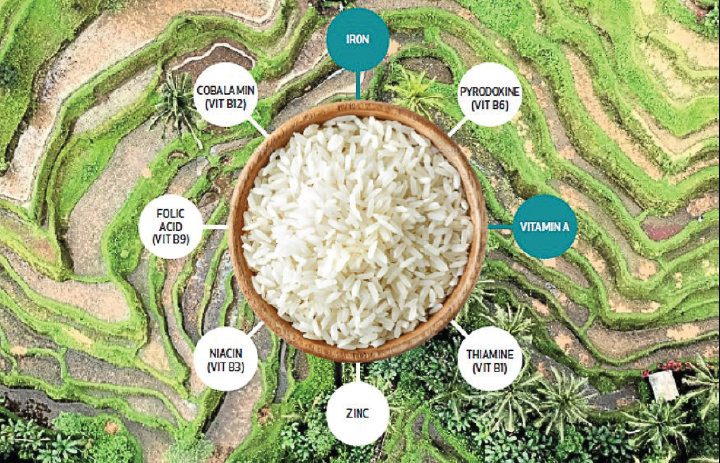
Iron deficiency, as described by World Health Organisation (WHO), continues to be one of the most severe and significant nutritional deficiencies. It affects people belonging to all age groups, from infants to the old. However, it is more common in women and children. Pregnant women especially become deficient in iron because of pregnancy and inadequate intake of iron. Children become iron-deficient because they are born to mothers who themselves suffer from iron-deficiency.
Iron-deficiency is a serious issue. As per a report of WHO, iron-deficiency anaemia affects about 1.62 billion people all over the world every year. According to an independent research report, one-fifth of women suffer from it live in Pakistan only. As regards neighbouring countries, the figures are also disappointing. In India alone, about 53% women belonging to age group 14-49 years and 58% children are deficient in iron.
Against this backdrop, in India, Prime Minister Narendara Modi initiated a scheme in 2019-20, which aims to fight iron deficiency through Iron-Fortified Rice (IFR). The Indian government has planned on providing its population with IFR over the next three years or so in order to fight iron deficiency anaemia — they chose rice because it is consumed by about 70 per cent of India’s population. Here a question arises: is rice fortification the right way to battle iron deficiency? Before answering this question, let’s see what rice fortification is.
Rice fortification is a method through which elemental iron is added to rice artificially. It is done with the help of fortification technology in three ways: extruding, coating and dusting, of which extruding is a relatively effective method. By extruding, the rice is ground; mixed with powdery iron and then extruded into rice once again. Unlike the other two methods, there is minimal risk of iron being washed away during the washing of rice before cooking.
Undoubtedly, the staple fortification method can prove helpful in fighting iron deficiency as it is a cost-effective method --- in India, per kg cost of iron fortification has been estimated at about 65 to 75 paisa. Besides, it is also a WHO recommended method which says “Fortification of rice with iron is recommended as a public health strategy to improve the iron status of populations, in settings where rice is a staple food.”
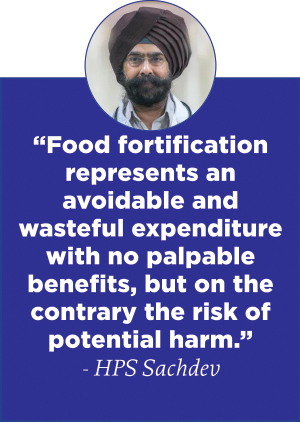
However, there are some drawbacks. It is aimed at providing elemental iron to people who are deficient in it. No doubt this will help those who are suffering from iron deficiency. But, as argued by health professionals and experts, this will pose a serious challenge to the health of people who already have sufficient stores of it in their bodies.
An article published in Down To Earth, a fortnightly print and online magazine based in India, said that a team consisting of 18 Indian health experts raised concerns about the government’s strategy to fight iron deficiency through food fortification. In an article published in the American Journal of Clinical Nutrition in July 2021, it was argued that consumption of excess iron can prove very detrimental to people generally. Particularly, if pregnant women consume this excessively, it would adversely affect them as well as development of the fetus.
 The human body excretes a hormone which regulates the level of iron in the body. It releases hepcidin which controls the absorption of iron and prevents the body from storing it in excess. However, medical experts suggest that there are some situations when iron overload or irontoxicity can happen. If the body has iron overload, it stores it mainly in organs such as liver, heart and pancreas, to which it can do considerable damage. Plus, it is also linked with diabetes.


The writer is a freelance contributor based in Larkana. He can be reached at sjatoi831@gmail.com.
Leave a Reply