



Pakistan has made a great start on the road to geo-economy by putting the genie of geopolitics to rest. In fact, Islamabad has been provided with a new window of opportunity to establish bilateral or trilateral ties with ASEAN member countries in a variety of sectors, including economy, trade and commerce, joint ventures, science and technology, Artificial Intelligence (AI), digitalization, ICT, infrastructural development, banking and finance, FDIs, education, and culture.
In Pakistan’s foreign policy, East Asia remains a faraway area. It has devolved into a pointless, ineffective, and forgotten effort. Pakistan, despite its economic liberalization, has been unable to reap the benefits of the ASEAN miracle. This tendency must be reversed in a big way. Pakistan’s East Asian diplomacy is quite deficient. The clamour for an FDA with ASEAN isn’t new, but it hasn’t materialized yet. There has been no high-level political dialogue with ASEAN in recent years. South Korea, Japan, and Australia have been mostly neglected by Islamabad.
 With the fall of Kabul, Afghanistan is the recent take in the market and nothing can be more successful than regional connectivity. Afghanistan is known as the “Heart of Asia,” as it connects several regions of the continent, including Central Asia via Tajikistan, Turkmenistan, and Uzbekistan, South Asia via Pakistan, and the Middle East via Iran. Afghanistan is a mineral-rich country with a lot of untapped potential. According to the United States Geological Survey, the country contains “60 million tons of copper, 2.2 million tons of iron ore, 1.4 million tons of rare earth elements such as lanthanum, cerium, and neodymium, and lodes of aluminum, gold, silver, zinc, mercury, and lithium.” The country has natural resources worth $3 trillion dollars. In order to improve its economic growth, Afghanistan needs regional connections for its mineral riches.
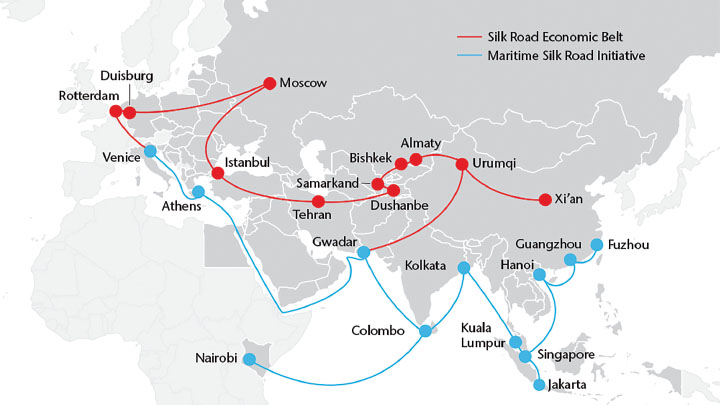
The Lapis Lazuli corridor, which would connect Afghanistan to Europe via Turkmenistan, Azerbaijan, Georgia, and Turkey, is one such effort in which the county is involved. The expansion of the China-Pakistan Economic Corridor (CPEC) might enable Afghanistan to join the Belt and Road Initiative (BRI). Pakistan may be able to access Central Asian energy markets through Afghanistan. In particular, Pakistan may exploit Afghanistan as a commercial and energy resource route to Europe via Central Asia.
 Furthermore, energy infrastructure projects to link regions are on-going: for example, the Central Asia-South Asia (CASA-1000) Electricity Transmission project will send excess hydroelectric power from Central Asia to countries in South Asia, while the Turkmenistan-Afghanistan-Pakistan-India (TAPI) gas connectivity project will strengthen trade and operate throughout the region. The Central Asia Regional Economic Cooperation (CAREC) Program is a larger initiative, spearheaded by eleven nations spanning Central, South, and East Asia, including Afghanistan and Pakistan, to promote development.


The writer is a freelance contributor, pursuing M.Phil in Political Science from the Government College University, Lahore. He can be reached at aasad6889@gmail.com
Leave a Reply