



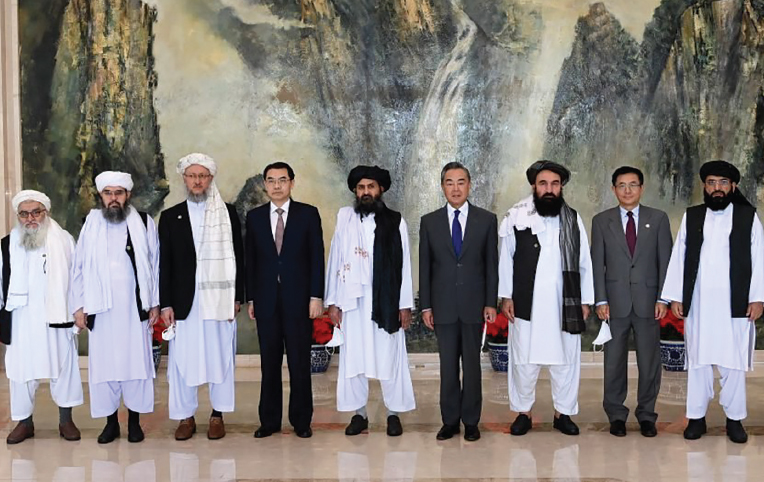
It was not easy to tell whether the British foreign minister said it in satire or wanted to complain about the US withdrawal from Afghanistan, when he said that the US should not consider itself a superpower anymore. Prior to the Afghanistan moment, American conduct during the Covid-19 pandemic was also interpreted as a sign of the diminishing global power’s retreat against rising China. Apparently, now the US and its allies have left Afghanistan more crippled economically and politically than before .
As per US official statements, the threat of terrorism still prevails in the form of IS-K, TTP and Al-Qaida. The Afghan National Army evaporated so quickly that it seemed as if they never existed, rulers managed to flee abroad swiftly and the so-called resistance force based in Panjshir could not prove any of its verbosity. Eventually, the withdrawal ended within the specified timeline and the US, along with its allies, made all attempts to portray the evacuation as a mission of success. The unjustified success stories overshadowed the deep damages caused to Afghan socio-political dynamic over te years
There is no one left behind whom the Afghans can hold accountable for the disaster stretching over two decades. Precious lives lost, the economy destroyed, people losing their limbs and families displaced, the sword of terror still hangs over their heads. The Western media has now taken to raising questions about the past conduct of the Taliban but forgets to point fingers on the highly objectionable performance of the US, its allies and the Ghani regime.
The Western countries and their media exaggerates concerns about women’s liberties and human rights though these are nothing more than a method to pressurize the Taliban and deter them from their evolving quest to gain recognition for their interim government. Pakistan, being the most affected neighbour, desires genuine and expeditious restoration of peace in Afghanistan but that does not seem not possible without having real stakeholders on board from the Afghan side.
In the past, much of Pakistan’s sincere efforts could not improve the brotherly bi-lateral environment primarily due to manipulative elevation of the wrong persons to the helm of affairs and India’s dirty games. The weak and divided regime mostly spent its energies on self-survival and grabbing of power from contesting rivals. As evident from Doha agreement last year and even the US could not rely on the Ashraf Ghani regime to strike any workable way forward with the Taliban for the future governance mechanism in Afghanistan. With this shaky state of affairs, the US went for a withdrawal in a hasty manner whereas its broad structure was perceived almost 18 months back while signing the Doha agreement.
 Security concerns emanating from Afghanistan have long been disturbing Pakistan on many accounts. The hosting of more than three million refugees during the past four decades has given birth to multiple socio-economic challenges in Pakistan. The cross-border movement of terrorists with impunity was the biggest security threat haunting the masses and national institutions in Pakistan. A full-scale war was fought with hardcore terrorist organizations, with support from spoiler elements with their base camps on Afghan soil, against the well-trained professional armed forces of Pakistan.


The writer is a retired army officer with special interest in national security, domestic politics, regional issues and international affairs. He can be reached at sikandarnoorani@yahoo.com
Leave a Reply