



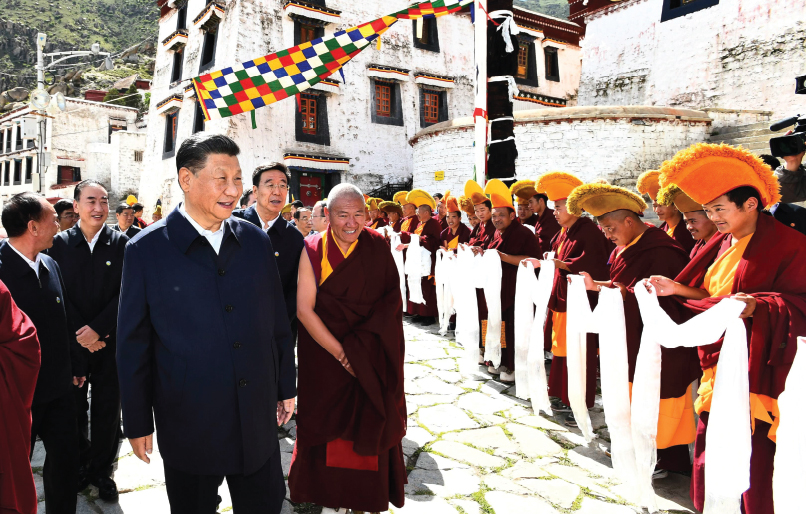
In an unexpected move, China’s President Xi Jinping arrived in the Tibet Autonomous Region in July. The event marked a watershed moment as no presidential visit from China has been made to the politically sensitive region since 1990. During his official tour, Xi Jinping visited the Drepung monastery in Tibet’s capital Lhasa and the public square near Potala Palace, the former residence of the exiled Dalai Lama. The president also paid a visit to Nyingchi to inspect the upper stream of the Bramaputra River where China is building a contentious dam.
The surprise visit, which commemorated the 70th anniversary of the so-called ‘peaceful liberation of Tibet’, raised speculations that have been fuelled by a long history of strife. It is difficult to forget the fact that China has rejected Tibet’s government-in-exile. What’s more, China harbours suspicions about the Dalai Lama’s separatist tendencies and ostensibly wants to be part of the process of selecting Tibet’s next spiritual leader.
Be that as it may, Xi Jinping’s unannounced trip to Tibet sounded alarm bells for China’s neighbours. The visit sparked concern in New Delhi as it came at a time when China and India are embroiled in a military standoff in eastern Ladakh. In addition, the power corridors in Nepal - a country that also shares a border with Tibet - were also rattled by the Chinese president’s visit.
Nepal hosts a large population of Tibetan refugees who fled Tibet after China quelled an uprising in 1959. As a result, the status of Tibet exerts a strong influence on Nepal’s relations with China.
At the outset, Nepal’s relationship with China has been predicated upon a blanket acceptance of a ‘One China policy’. If a treaty signed in 1956 between both countries is to serve as a gauge, Kathmandu recognizes Tibet as a part of China. Any conflicts within the region are, therefore, considered China’s internal affair.
 Nepal hasn’t shied away from quashing any resistance on its soil against China by Tibetan refugees. For decades, a conscientious attempt has been made to reassure Chinese leaders who make official visits to Nepal about the country’s unswerving commitment to the ‘One China policy’. These assurances have been used as bartering chips as they allow Nepal to obtain Beijing’s support in preserving its own sovereignty and territorial integrity.


The writer is a journalist and author. He analyses international issues and can be reached at tahakehar2@gmail.com
Leave a Reply