



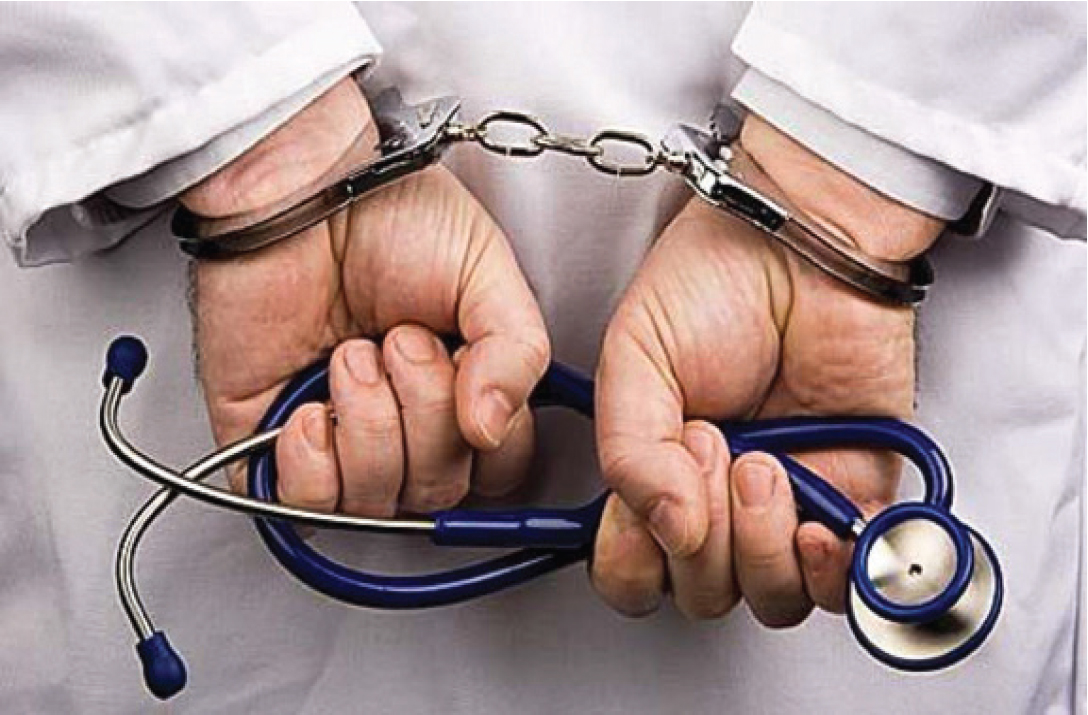
Doctors have always been considered an essential section of society. Without them, a healthy society may not be possible. In fact, they emerged as Messiahs during the Covid-19 outbreak. On the frontline, doctors diligently managed heavy workloads by putting in extra working hours, and at times, when there was a lack of protective equipment, many doctors put their lives on the line to carry out their duties. Their services to humanity can truly never be repaid. Hence, it is difficult for many people to imagine such humanitarians as anything but Messiahs. However in some cases, incidents like malpractices, negligence and personality issues can easily turn these Messiahs into murderers and draculas.
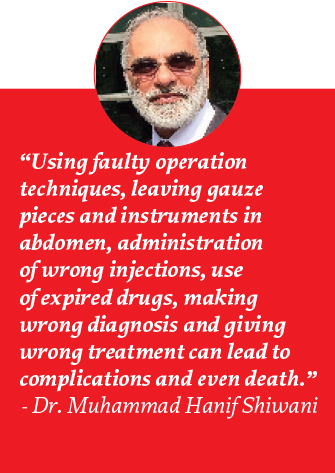
Medical malpractice can be understood as a doctor’s deviation from ethically acceptable standards of practice and/or patient care that causes harm to the patient. Medical negligence refers to illegal behaviour or improper treatment by the doctor that results in injury or death of a patient. Cases of medical malpractice or negligence include doctor’s giving wrong diagnoses, applying wrong treatment, flawed surgery, leaving equipment inside the abdomen during surgery, wrong prescriptions, etc.
An article published in a renowned medical journal stated that in the USA 45,000 to 98,000 deaths every year were attributed to medical malpractice and in the UK, between 2004-05, £502.9 million were paid in respect of clinical negligence. Even in Pakistan, an alarming amount of cases of medical malpractice are coming to light. Heart-wrenching cases of medical malpractice often catch the nation off-guard. A case that comes to mind is that of Neshwa’s, a nine-month-old girl who was taken to a hospital in Sindh with complaints of diarrhea and was sent to eternal slumber allegedly due to improper treatment.
Another case is of the three-year-old Imanae Malik, who was taken to a hospital in Lahore for the treatment of a burn wound. She was laid to rest after she was administered multiple injections that proved to be fatal. In Pakistan, no statistics regarding medical malpractice are available on a national level, but according to a story in Dawn in 2019, in Pakistan, 40.7 per 1000 births end as stillbirths or deaths on the first day. Pakistan has the highest rate of stillbirths or first-day deaths and is followed by Nigeria (32.7), Sierra Leone (30.8), Somalia (29.7), Guinea-Bissau (29.4), and Afghanistan (29.0). Moreover, Pakistan has the fourth-highest rate of pre-term birth after India. If that’s not enough, the antibiotic prescription in Pakistan crosses the average global prescription by 20 percent and benzodiazepine abuse is as high as 85 percent.
 Another interesting fact to ponder upon is that of “Medical Narcissism”. Introduced by John Banja in his book, Medical Errors and Medical Narcissism, ‘Medical narcissism’ refers to a medical professional’s attempt to preserve their self-esteem, which compromises their tendency to disclose their medical error to patients. Such doctors are often found using euphemistic language and advantageous comparisons to distort the gravity of their mistakes. They also end up displacing or diffusing their responsibility towards the patient. They classify their mistakes as isolated events which cause them to rationalize the mistake instead of accepting and learning from it.



The writer is a psychologist and covers issues related to human rights, feminism, education and mental health. She can be reached at zehrar00@gmail.com.
Leave a Reply