


At the beginning of the century, certain super powers have been emboldening by regional patrons to manifest their sublime purposes, leading to human disaster and bloodshed of innocent souls. The Doha accord between the United States and the die-hard Taliban is now leading us to a new beginning.
The advanced technology, the state-of-art military equipment, and the spending of billion-dollar on the warfare, in the end, failed. The departure of the United States would be a blessing in disguise for hapless Afghanistan: it seems after the withdrawal, the move would plunge into a particular power struggle, a civil war amongst the various groups operating in Afghanistan. A peaceful Afghanistan is essential for the future of South Asia as well as Central Asia. Sooner or later, peace is imminent. Meanwhile, the world is once again confused between the unique geopolitical rivals - China vs. America. The transformation of the authority, power and influence from the white masses of the West to the yellowish faces of the East is seemingly an untoward mystery of the 21st century: We shall pay any price, bear any burden, meet any hardship, support any friend, and oppose any foe to assure the survival and the protection of our liberty.
Pakistan aims to bring peace to assure the survival of peaceful Afghanistan and to bring liberty to the war-torn people. In addition, since Afghanistan have been plundered and looted by foreign occupations, the fact constrains Pakistan to have social and economic relations with Central Asia. The Central Asia is located at the heart of the Asian continent and stretches from the Caspian Sea to the western border of China, surrounded on the north by Russia and on the south by Iran, China and Afghanistan. The Central Asian states are replete with such natural resources as oil and gas in Kazakhstan, Turkmenistan and Uzbekistan, aluminum in Tajikistan, cotton in Tajikistan and gold in Kyrgyzstan. Despite all these, unfortunately, the Central Asia has ended up as a landlocked territory, which has not had access to warm waters. Since then, Pakistan has been striving for peaceful Afghanistan: it might have brought the Central Asian states to the warm waters of Gwadar.
Pakistan is a perfect country for Central Asia to have influential trade and diplomatic ties. Pakistan, in collaboration with central Asian states, would work for the prosperity of Asia and would also sustain the rudderless economy: After all, we share a common interest, seemingly, we also share the same religion, topography, customs, religious and social values to some extent.
The erstwhile dissenters have been striving to enhance the strides of new relations- Russia and Pakistan. Nevertheless, Pakistan was the frontline ally of the United States in the war against Soviet forces. The newly-formed Central Asian states came into existence because of Pakistan's resistance to Russia. Russian are in the favor of having diplomatic relations with Pakistan. Russian foreign minister's recent visit to Pakistan seems a step toward the thawing of the deadlock between the both countries. The newly-formed ties would work on military and energy cooperation, trade relations and the transfer of the Covid vaccine.
The world today is going from very peculiar circumstances, trying to more multipolar and less multilateral. Europe has no other choice than to ensure multi-polarity and to reconcile itself in both dimensions.
Over the last decades, we have seen the rapid transition of power around the globe. We went from the bipolar era- 1945 to 1989- to a multi-polar configuration from 1989 and 2008. After all, the world is going toward what we now called 'Complex Multi-polarity'.
The exponential rise of China in South Asia, the Middle East and in the Central Asia has perturbed the United States and has pushed them toward hostility. The newly-emerging Troika stemmed from the rowdy diplomacy of U.S. Ostensibly, it might have been possible to assure the presence of Iran in the upcoming decades: which would possibly make the Israelis cry on the shoulders of erstwhile Great America. As the old wisdom goes, “Man’s reason and spirit have often solved the seemingly unsolvable". The last decade had seen many dramatic shifts: when the Trump regime dramatically labeled China a strategic competitor. Assiduously, the animosity could have perpetuated with the Biden regime. The Trump's devoted considerable enthusiasm to defaming China, accusing Beijing of attempting to destroy liberty and freedom and dominate the world through territorial expansion and diplomatic oppression.
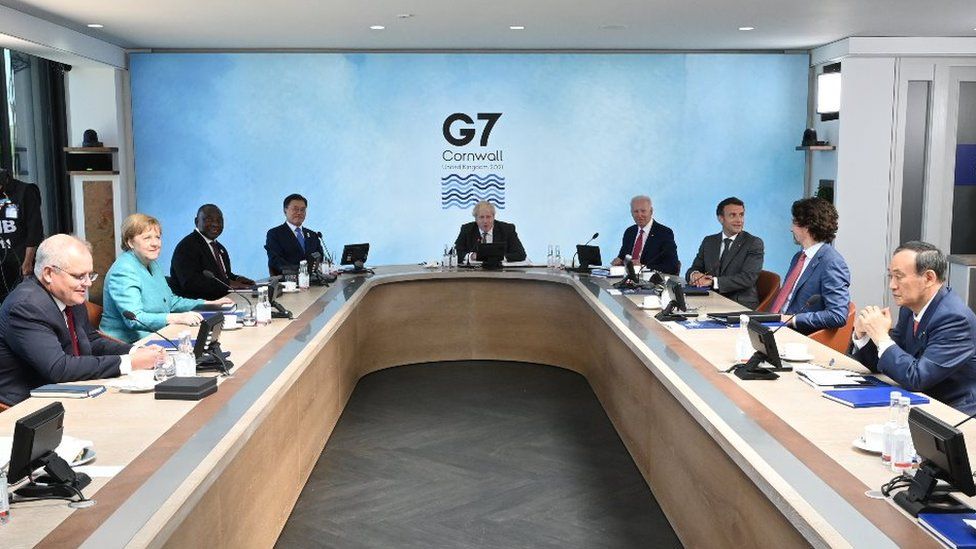
Subsequently, the undeniable hubris has come to an end: Russia's President Putin and his counterpart Joe Biden will hold a plenary meeting in Switzerland on 16 June, in the Geneva summit. The United States intends to restore the strength and stability of the region. The Americans are aspiring to run with the hare and hunt with the hounds as they have been watching the aggrandizing position of China. The meeting could have enhanced the strained ties between lingering foes. The European Union has adopted their own way to deal with the increasing influence and aggressiveness of China. In March this year, the Central and Eastern European have had adopted the 'Sinatra Doctrine. It is being seen as a counter to China's relentless rise in Europe. Nevertheless, this step has been taken with the assistance of the United States as everybody knows that European Union is the frontline ally of the United States.

The writer is an undergraduate student at Bahria University in Islamabad. He can be reached at nasirhuzaifa@yahoo.com
Good job. The article is very impressive. Keep it up.