

International
Pandemic and Politics
At a time when a military takeover in Myanmar has exacerbated the challenges posed by the pandemic, a solution-oriented approach will put the country on the road to recovery.

Military adventurism in Myanmar hasn’t always culminated in economic progress. If historical events are to serve as a gauge, the country’s economy was crippled by inept, ill-conceived policies when the armed forces ruled the country between 1962 and 2011.
From 1962 to 1988, the policies of the military junta were informed by a socialist vision. The prevalence of hierarchical decision-making and militaristic organizational norms dampened market competition and fractured the economy. In 1988, market liberalization gathered momentum as an outcome of protests over the dismal economic conditions in the country and fuelled the creation of crucial market institutions. Even so, this shift in Myanmar’s economic paradigm had its shortcomings as authoritarian norms continued to loom large and often hampered the decision-making process.
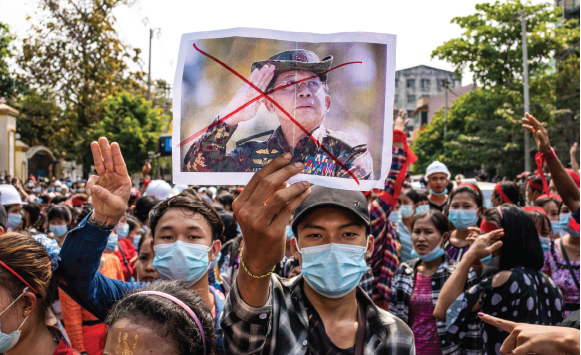
After a hiatus of a decade, military adventurism has once again dominated the political arena. In February 2021, the armed forces ousted a democratically-elected government led by the National League for Democracy and installed a military junta. Since then, widespread protests against the coup have escalated and concerned citizens have shirked their professional responsibilities in order to resist the takeover. As a result, a well-oiled economic system has screeched to a grinding halt. The developments witnessed under the authoritarian government are alarming as the people are paralyzing their own economy. However, there is another catalyst to the chaos that has swept through the country: the global pandemic.
As per an UNDP report, the dual impact of the military coup and COVID-19 is likely to push Myanmar to the brink of economic ruin. The dual effect of these disparate factors could plunge almost half of Myanmar’s population towards absolute poverty by 2022.
These trends are not entirely surprising, especially in light of an analysis conducted by the Central Statistical Organization of Myanmar, UNICEF and UNDP in November 2020. If the findings of this study are anything to go by, the pandemic could produce an economic crisis that could reduce the gains Myanmar has made in its fight against poverty. The analysis revealed that COVID-19 is likely to leave two million children in a state of poverty. These concerns have a firm basis in reality. By December 2020, over 80% of households in the country claimed that their incomes had witnessed a sizable reduction following the containment measure adopted to curtail the spread of Covid-19. So far, the pandemic has heightened Myanmar’s poverty rate from 24.8% to 36.1%.
The UNDP report merely reiterates a grim reality and highlights the gravity of the situation after the coup.

The UNDP’s findings are undoubtedly credible, even though sceptics may argue that they haven’t been substantiated by real-time data. Information gathered through household surveys and news reports, and published material issued by the World Bank and the Brookings Institution have been used to providing plausible estimates of the threats faced by vulnerable groups.
According to the UNDP report, women and children will find themselves at a disadvantage as poverty becomes endemic. Analysts believe this could have severe ramifications on women-led households, and affect the psychological health and educational prospects of children.
At this critical juncture, poverty has been triggered by the surge in food prices, loss of income, the gradual disintegration of the banking and healthcare sectors, and inadequacies in the country’s social security system. Shipping firms have temporarily become non-functional and seaborne trade has been significantly impacted. If the ongoing political crisis continues further, the situation is likely to worsen. A prolonged interruption in economic activities due to the vigorous resistance towards the military junta could propel the poverty rate to skyrocket to 48.2%.
Many observers have likened Myanmar’s current economic crisis to the problems that besieged the nation in 2005. Back then, the country was under military rule and was struggling to ensure its economic wellbeing. Since the country made a much-needed transition to democracy, a series of political and economic reforms had stemmed the rise of poverty. The UNDP report indicated that Myanmar’s poverty rate fell from 48.2% in 2005 to 24.8% in 2017. Even so, Myanmar was still categorized among impoverished nations in Asia and its economy was on the cusp of a downward spiral. Recent events have presented similar challenges in the country as urban and rural poverty remains a critical cause for concern.
The UNDP report is a strong indicator that the people of Myanmar must make a trade-off between the desire for democracy and the pressing need for economic survival. Instead of expecting the people to choose between pragmatism and active resistance, political actors must make a concerted attempt to ease tensions. Under the circumstances, a multi-party solution must be chalked out after consultations with the relevant stakeholders to help the country climb out of its existing political quagmires.
Efforts must be made to strike a peace deal that can put an end to street anarchy. In addition, immunisation drives must be intensified to overcome the setbacks witnessed in Myanmar’s response to COVID-19 after the coup. In the absence of an effective response, the country will continue to languish under the combined weight of politics and the pandemic. ![]()

The writer is a journalist and author. He analyses international issues and can be reached at tahakehar2@gmail.com


Leave a Reply