Chronologically, after independence, Pakistan’s first serious attempt to focus on local government occurred during the martial law regime of General Ayub Khan. Since then, different versions of local government have been introduced and experimented by elected and non-elected governments. Ironically, during the democratic period of 1988-99, four democratically elected government gained power, but none of them worked on the local government system. The next time that Pakistan’s experiment with devolution occurred was under General Pervez Musharraf. His devolutionary exercise was also a legitimizing strategy for his centralized rule, since it did not devolve power from the federal level to the provinces and instead focused on creating local governments on non-party basis. Yet the Local Government Ordinance (LGO) 2001 passed early in Musharraf’s tenure was quite ambitious in its scope. The LGO 2001 reserved a significant portion of local government seats (33%) for women, and to a lesser degree, for religious minorities and other marginalized communities i.e. peasants and labourers.
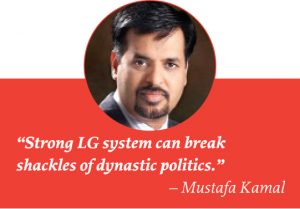 The passage of the 18th Amendment was a pronounced step forward for the continuation and protection of the local body system. Clause 140 A (1) of this amendment stipulated that “each province shall, by law, establish a local government system and devolve political, administrative and financial responsibility and authority to the elected representatives of the governments” and 140 A (2) states that elections to the local government shall be held by the Election Commission of Pakistan”. In addition, Article 132 of the Constitution ensures the participation of marginalized groups such as women, minorities, peasants and labourers in the local government elections.
Despite enactment of enough legislation pertaining to devolution of power, the local government system could not thrive in the country. Power intoxicated politicians in cahoots with bureaucratic juggernauts and created umpteen hurdles in the way of this system. The forces of status quo were not ready to surrender their power to the local representatives. One glaring example is that LG election in 2015 was conducted on the order of the Supreme Court. This speaks volumes of the attitude of state institutions towards local bodies.
Moreover, the local government law says that federal and provincial governments will legislate while development works would be done by the local governments. The situation on the ground is that MNAs, MPAs and Senators want to have their say in the development work. This tug of war results in an institutional clash. However, Prime Minister Imran Khan has vowed that he would not dole out development funds to MPAs and MNAs. This is undoubtedly a right step in the right direction. If it happens, there is a strong possibility that local government will start bearing fruit. Otherwise things will remain the same in the presence of parallel authorities and deeply entrenched bureaucratic echelons.
Besides, there is still only about 15 percent participation of women in the lower tier of the government whereas the law requires 33 percent. Women’s inclusion as per requirement therefore should be enhanced. There should be a mechanism of fair representation of labourers as well.
Another snag that hampers the performance of the local government system and hangs like a Sword of Damocles over it is the power of the chief minister of the province to dissolve the local government as per his whim. In exercise of this power, the local governments introduced by Pervez Musharraf were dissolved by the provincial governments. Such dictatorial powers of the chief minister severely impinge on the efficiency of the governance of local bodies and therefore should be revoked forthwith.
Notwithstanding the aforementioned impediments, the following antidotes may be prescribed for the efficient delivery of the third tier of government: first, neither the Constitution of Pakistan nor the Sindh Local Government Act, 2013 have stipulated any time for re-election of local bodies after completion of their term or as a result of early dissolution. That is why the Supreme Court has to intervene for election of the next term. This situation warrants timely legislation with respect to the timeframe in relevant legislative houses for the continuation of the system without any hiatus.
Second, the government should initiate capacity-building programs for the local representatives so that they can understand the rules of business and deliver up to the required touchstone. Though different NGOs organize capacity-building workshops yet, in view of the number of representatives who run into thousands, the government must also partner with private enterprise.
Third, the roles of the parliamentarians and elected councilors should be clearly demarcated as overlapping of these roles is a structural obstruction in smooth functioning of the local bodies. Federal as well as provincial legislators have nothing to do with the development funds. They are supposed to legislate on matters of grave importance and thereby protect basic human rights. In this regard, the initiative undertaken by the PTI government to plan and execute all development schemes through local representatives according to the needs of the local population is indubitably a laudable move.
Fourth, the government should create a federal level institution to oversee the devolution process. The National Reconstruction Bureau established by the Musharraf government as an independent federal institution to formulate LGO 2001 and oversee its implementation, was dissolved in 2011. A similar entity without undermining the principals of provincial autonomy provided by 18 Amendment, needs to be created.
Fifth, the process of devolving fiscal responsibility to local governments needs to be managed with caution. Financial devolution must be accompanied by financial oversight. It is thus important to supplement existing accountability mechanisms, using third party and citizen audits of the local governments.
Sixth and last, the current PTI government intends to introduce new local bodies where PTI has its governments through direct elections for tehsil and district heads. This runs contrary to the prevalent system in Punjab. Under this dispensation, PTI plans to elect the city mayor directly by the people as it is practised in the UK and Scandinavian countries. The Sindh government has shown its reluctance to any such innovation. Sanity therefore demands that before introduction of any new system, the consensus of the provinces must be sought, otherwise the situation will lead to center-province disharmony. 





Leave a Reply