



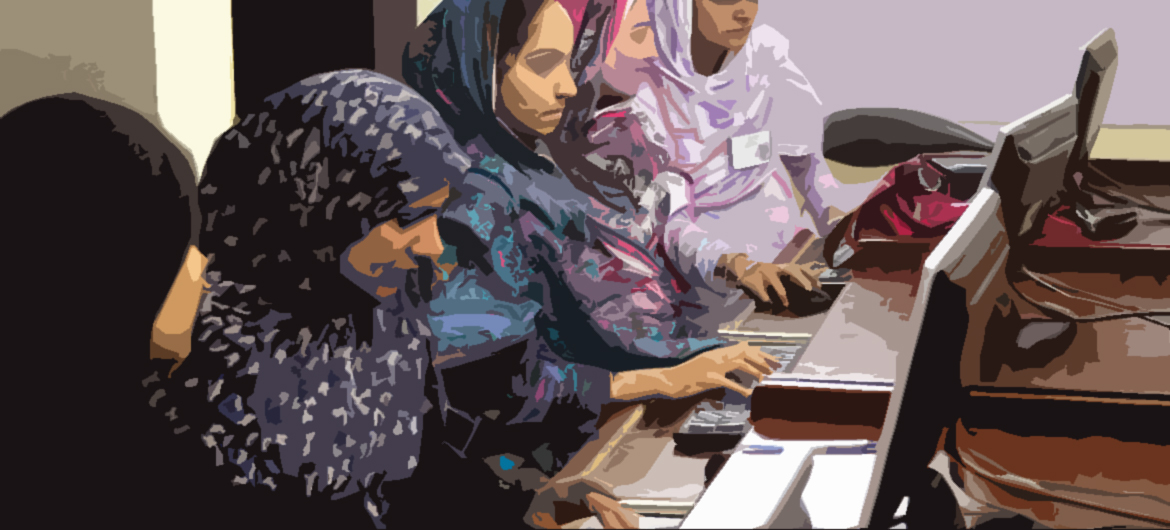
‘Women and Technology’ was seen as a repelling concept a few decades ago in the sub-continent. The acceptance for being an engineer, technologist, information technology (IT) person or a data scientist was a bit cruel for a girl. As the world is evolving, Pakistan is also taking the stance to bring women into every discipline. Pakistan is a resilient state and can build and grow as a nation for a prosperous future for men and women. Around 48.5% of the country’s population constitutes women, which is a large ratio that can greatly improve the economy of the state. Despite the large population of women, their potential and talent in science, technology, engineering and mathematics (STEM, ) is still not appreciated. Women are not at senior level in industries though the job market is saturated with women.
According to UNESCO statistics, only 15.4% of researchers belongs to science and technology in Pakistan while 39.9% are working on social sciences and humanities. There is a paradigm shift in the proportion of participation of women in technology. There are ample of reasons for excluding women from participating in the fields such as lack of education, lack of awareness, poverty, gender gap, political, cultural and societal peer pressure, etc. However, despite the parities, there is always light at the end of the tunnel. Quite a few initiatives have been taken to increase the number of opportunities for women and widen the scope of awareness.
The Pakistan Council for Science and Technology (PCST) has laid the ground for women in scientific field to stand and grow. PCST have set up a website to raise the status of women in science and technology. This website is mainly designed for maintaining the data base for research and policy in gender gaps. With the assistance of PCST, an active role can be played in strengthening and enhancing women’s recognition at the international level with respect to science and technology. On the other hand, according to the Higher Education Commission (HEC) annual report 2013-14, the enlistment of female students has increased manifolds.
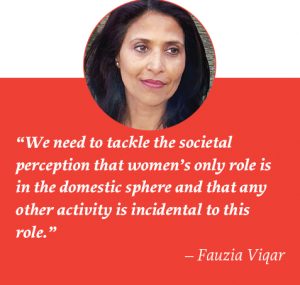 Another remarkable initiative for women to have a good command in computing skills is Pakistan Women in Computing (PWiC). It backs a vision to bring and promote Pakistan’s women in STEM and accelerate globally. PWiC has gathered a strong team all across the world and is working hard to bring out the best inPakistani women who are highly capable.

The writer is currently working at Nepra as Research Associate. She is pursuing her PhD in Engineering from the Asia Pacific University of Innovation and Technology, Kuala Lumpur. She can be reached at sana.mohsin11@gmail.com |
|
Cover Story
|
|
News Buzz
|
Update |
Leave a Reply