
Rewind
Chicken Or Egg?
Contrary to popular belief, newspapers were primarily launched to advertise new products and services, rather than inform and educate readers about political and social issues.

Arthashastra, an ancient Indian political treatise written by Chanakya, gives detail about the commencement of journalism in the subcontinent which dates back to sharing of intelligence-based information during the era of Chandragupta Maurya (321–297 BCE), the founder of the Maurya Dynasty in ancient India. During the reign of Mughal emperor Jalal-Al-Din Akbar from 1556 to 1605, a proper system for news-gathering and sharing was in place that was further improved in the era of Aurangzeb Alamgir, who ruled India from 1658 to 1707.
The interconnected relations between journalism and advertising can be best understood when it is seen in relation to the rise of the Industrial Age. For instance, the Peking Gazette of China was issued well before the advent of the industrial period. In Europe, the first newspaper was published in Germany in 1609, while newspapers and magazines were started in most European countries during the 17th and 18th centuries. Most newspapers across the world were started primarily as a business venture to advertise new products being produced on a mass scale after the onset of the Industrial Age. This goes against the widespread belief that newspapers were primarily aimed at disseminating information to create general awareness about political and social matters.
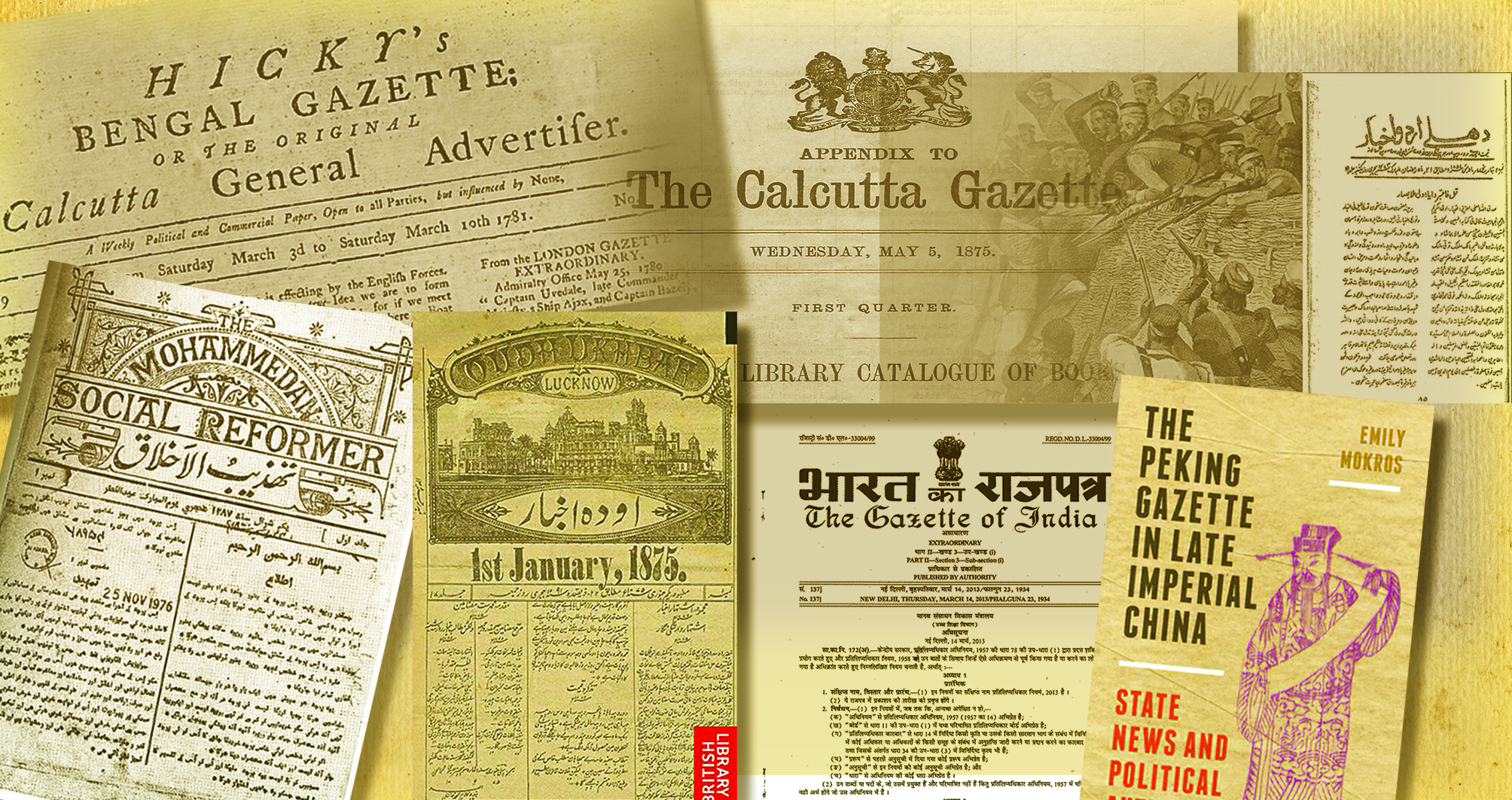
The first newspaper that came out in the subcontinent in the 1780s was ‘Hicky’s Bengal Gazette’ or ‘The Original Calcutta General Advertiser,’ allocating more space to advertisements than news. The masthead of Hicky’s Bengal Gazette read: ‘A weekly political and commercial paper, open to all parties, but influenced by none.’ Consequently, the printing press of the Gazette was soon sealed by the British government, since the newspaper was clandestinely criticizing the policies of the East India Company in its news stories and articles.
Following this lead, the rest of the newspapers that emerged later were more advertisers than newspapers. Owned and run by a couple of traders, the ‘India Gazette’, for instance, was more focused on printing ads than covering news. The ‘Bengal Hurkaru,’ the ‘Madras Courier,’ the ‘Asiatic Mirror and Commercial Advertiser,’ ‘The Calcutta Gazette and Oriental Advertiser’, later shortened as the ‘Calcutta Gazette,’ and many other papers appeared with a common suffix - ‘advertiser.’ Most papers comprised 4 pages, in which one page was dedicated to advertisements, while the first page always had an ad on it. In essence, all newspapers in the subcontinent unanimously carried forward the commercial objectives of the East India Company.
In 1864, W.S. Seton Karr, President of the Record Commission, published a book “Selections From Calcutta Gazette.” The book was a compilation of selected news items, advertisements, editorials, analytical pieces, articles, etc., which had appeared in the Calcutta Gazette and Oriental Advertiser from 1784 to 1788. The first part of the book comprised government announcements and public notices; the second part contained editorials, letters to the editor and poetry pieces, while the third and the last part was a selection of print advertisements. Having learned from the bitter experience of Hicky’s Bengal Gazette, the British government kept promulgating new acts and rules to steer the direction of newspapers. In that reference, the ‘Calcutta General’, published in 1818, stood out as a leading example of brave journalism.
Since Calcutta was the capital of the British government, the beginning of journalism in the subcontinent can also be traced to Calcutta and the publication of ‘Hicky’s Bengal Gazette’ and that too in the English language. By the same token, the English newspaper ‘Madras Courier’ was the first published in South India. The ‘Bombay Gazette’ appeared in 1790 and the ‘Cawnpore Advertiser’, published in 1822, was the first newspaper of North India.
Launched in 1864, the Deccan Times was the first newspaper in Hyderabad Deccan. The era of Urdu journalism started with the publication of the newspaper ‘Jam-I-Jahan Numa’ in 1822, almost 40 years after the birth of English journalism. Toeing the line of the English press, almost all Urdu newspapers, such as ‘Sayyad-Ul-Akbar’ (1837), ‘Delhi Urdu Akhbar (1836) and many others, were a replica of their English counterparts, both in terms of layout and journalistic approach.
However, Urdu newspapers had considerably fewer ads. From 1840 to 1857, Urdu newspapers were launched from other major cities of India as well. For instance, such newspapers as Mazhar-e-Haq, Karim-ul-Akhbar, Sadiq-ul-Akhbar and Qiran-us-Sadain were launched from Delhi; Sadarul Akhbar, Safeer-e-Agra Asadul Akhbar from Agra; Banaras Gazette and Aftab-e-Hind from Banaras; Tilism-e-Lucknow, Lucknow Akhbar and Sahar-e-Samri from Lucknow and Koh-e-Noor from Lahore.
During the uprising of 1857, Urdu newspapers, especially ‘Delhi Urdu Akhbar’, played a leading role in shaping public opinion against the British East India Company. Maulvi Muhammad Baqir, the editor of Delhi Urdu Akhbar, devoted the newspaper to publishing news, articles and editorials with reference to the 1857 Independence War only. He also published and distributed pamphlets to inject and revive the spirit of Jihad among the Indian Muslims. Above all, Maulvi Muhammad Baqir used his newspaper as a platform to rebut the anti-jihad poster advertisements that were pasted by British loyalists all over the walls in New Delhi. Maulvi Baqir also published his revolutionary thoughts and pro-jihad views in another Urdu journal.
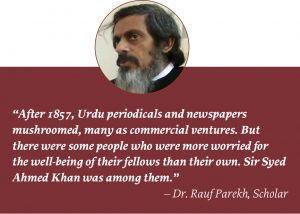
Compared to English newspapers, the first 30-year era of Urdu journalism was less commercial. In the beginning, Urdu newspapers had more news content and the news element was more prevalent till 1857, while most ads in Urdu newspapers used to be public announcements rather than product or service ads. Compared to its Urdu contemporaries, the newspaper ‘Koh-e-Noor’ had more advertisements. Following the example set by Maulvi Muhammad Baqir’s Delhi Urdu Akhbar, some Urdu newspapers and periodicals continued to feature content invoking religious, patriotic and nationalistic sentiments in the wake of the 1857 War of Independence. As time passed by, however, Urdu journalism started becoming more commercial and business-driven, putting religion, patriotism and nationalism on the back burner.
In historical terms, both English and Urdu newspapers, as a means for mass communication, were primarily launched as an advertising instrument and were initiated purely as commercial outlets. However, English newspapers carried more advertisements because they were few in numbers vis-a-vis the number of advertisers, comprising the decisive lot of British traders that were importing finished goods in large quantities from the European markets to sell them to the people of India. Print advertising was solely aimed at making made-in-Europe products more acceptable for potential Indian consumers.
Back to our original question, what came first, the chicken or the egg? As far as the motive behind the publication of newspapers is concerned, it was driven by the emerging need to advertise new products and services, rather than inform people about politics and social issues. ![]()
The writer holds a doctorate in Urdu Advertising and is associated with Spectrum Y&R Communication (Pvt) Ltd. as an Associate Creative Director. He can be reached at sharf15@gmail.com |
|
Cover Story
|
|
News Buzz
|
Update |


Leave a Reply