



Being Friends Again!

A paradigm shift is taking place in world politics and it is happening at a rapid pace. On the one hand, some Arab countries seem to be making a beeline and are recognizing the State of Israel – one by one. On the other, an imminent withdrawal of U.S. forces from Afghanistan, coupled with the noose tightening around Iran and Turkey with renewed imposition of economic sanctions on them, could unleash a new wave of challenges and surprises in global politics. Amidst all these unforeseen happenings that welcome the New Year, there is no reason why there could not be a diplomatic thaw between Pakistan and Bangladesh, the former West and East Pakistan. Riddled with blood and tears, the making of Bangladesh has had its own share of ups and downs for Pakistan too. Some political pundits believe that when civil war breaks out in a nation-state, the causes of the war and its underlying outcomes are construed differently by different segments in that state. For instance, the U.S. Civil War in the 1860s did not lead to the break up of the United States. However, different flags, different anthems, statues, and other content representing the losing side (the southern states) are still seen in the U.S.
It has been 49 years since the secession of Pakistan’s eastern wing and only West Pakistan being left as a country called Pakistan. Intriguingly, unlike the US Civil War, Pakistan’s original structure was dismantled. While the Indian Subcontinent broke into three pieces, the once largest Muslim country in the world broke into two. However, most political fact-finders and non-partisan historians cannot deny the fact that it was India which played a key role in inciting public fear and contempt for West Pakistan in the eastern wing and in ensuring the violence and separation in 1971. Many peace-loving and sound-minded people in Pakistan think the country owes an unconditional, state-level apology to the people of Bangladesh for the 1971 events. They believe the expressions of regret by Prime Minister Zulfikar Ali Bhutto in 1974 and later by President General Pervez Musharraf in 2002 are simply not enough to pacify the miffed sentiments of the Bangladeshi people. General Musharraf, during his historical visit to Bangladesh in July, 2002, went to the extent of saying: “Your brothers and sisters in Pakistan share the pain of the events in 1971. The excesses committed during the unfortunate period are regretted. Let us bury the past in the spirit of magnanimity. Let not the light of the future be dimmed.” If Musharraf’s words do not qualify for an earnest apology to Bangladesh, than what else could it expect from the head of state?
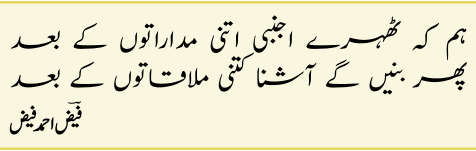
In 2021, Pakistan and Bangladesh must let sleeping dogs lie. They must now wake up to the importance of bilateral relations, mutually beneficial cooperation and regular exchanges in the fields of trade, arts, culture, education, media, civil society and sports. All memories of the bitter past can never be blotted out. It would, therefore, be worthwhile to move forward, as so rightly stated by Gen. Musharraf. After all, if such former deadly enemies as Germany and France can become friends, why can’t Bangladesh and Pakistan?

Syed Jawaid Iqbal
President & Editor in Chief