

International
Troubled Waters
The recent discovery of gas in the Eastern Mediterranean has
paved the way for notorious realpolitik in the region.

“Geography is destiny”, said Abraham Verghese, an American author, but the same geography can be a cause of international conflicts, civil unrest, or even disintegration of a state. Such is the case of Turkey which has an exotic tourism industry because of its cultural and religious history and apt location, but at the same time, its geography has embroiled the country in domestic strife and regional conflicts. It is not the first time in the last few years that Turkey has found itself at odds with its neighbours, whether it’s the former’s military operation in Syria, police action in Iraq, or military support to the Libyan government to fight its civil war. The most recent of these imbroglios is the newly discovered gas reserve in the Eastern Mediterranean and contesting claims of two immediate yet hostile neighbours: Turkey and Greece.
Both Turkey and Greece have been at odds for a long time over the delimitation of maritime and aerial boundaries, the Cyprus issue, the Refugees crisis, and recently, the disparate claims on oil reserves in the Eastern Mediterranean. However, these disagreements and contentions are not new as their genesis can be traced back to the Ottoman Empire, that ruled modern-day Greece, and to the World Wars in contemporary times. Different religions in both nations have exacerbated the situation. This was the same reason that Greek and Turkish minorities, in others’ countries, have always been persecuted and wronged. The Cyprus issue has also been a cause of discord between the two neighbouring nations, an island-state whose one-third area is under Turkish control; it is commonly known as Northern Cyprus while the rest is controlled by the Greek-supported Cypriot government. The recent discovery of gas reserves in the Eastern Mediterranean has not just brought the two countries at the brink of a military conflict, it has also reopened old wounds.
Turkey is already under scrutiny by the European Union for its role in Libya, Iraq, and Syria; by the USA for its aggressive foreign and domestic policy; and by Arab countries like Saudi Arabia, the UAE, and Egypt for its involvement in Libya and maritime encroachment in the Eastern Mediterranean. By the virtue of foreign powers and Tayyip Erdoğan’s cavalier foreign policy, Turkey seems alone and without any friends in the region. Turkey has one big Achilles heel and that is her dependence on other nations for energy needs. It imports 90% of its energy requirements taking the energy import bill to $46 billion. Hence, when gas reserves are found in the Eastern Mediterranean, Turkey’s stringent stance can be understood in the context of her energy needs. This has now become a matter of national security for Turkey. The situation is worsened by similar yet contesting claims of the Greek government.
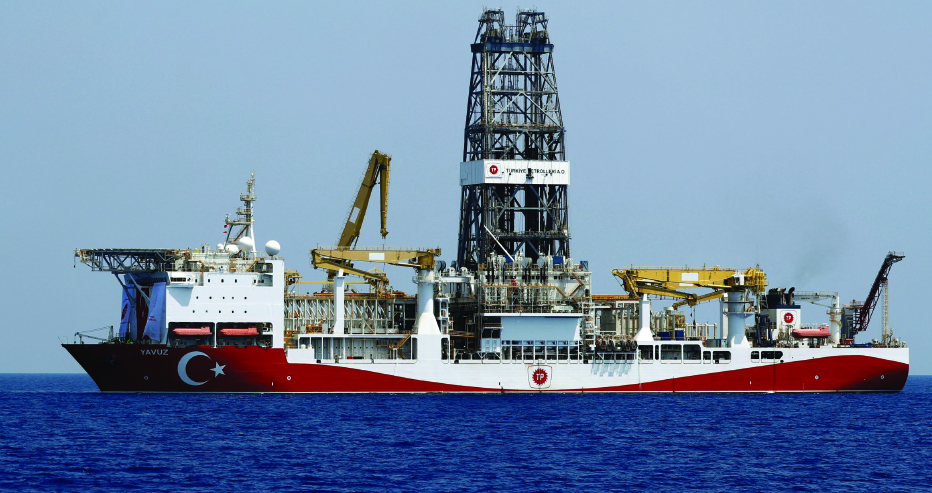
The recent discovery of gas in the Eastern Mediterranean has paved the way for notorious realpolitik and geopolitics. Turkey has discovered gas reserves on both the north and south of Cyprus. It was in August when Turkey’s exploration vessel ‘OruçReis’ found major reserves of gas in the south of Cyprus. Naturally, Cyprus, Greece, and the EU, all deemed it illegal and an offensive act. Turkey, more adamant than ever, is ready to protect its maritime boundaries and national interests in the troubled waters of the Eastern Mediterranean. To assert its position, Turkey even dispatched warships to the contested area and regular fly-pasts are being conducted in the air. But, Greece is not a bite that can be so easily chewed by Turkey. Greece and France, too, have dispatched their military vessels into the area.
The question is that what is the interest of France in this war of two neighbours. The simple answer would be geopolitics. Similarly, the UAE, that doesn’t even have its shores on the Mediterranean, is drilling there; again, the answer is geopolitics. Both these nations, along with Egypt and Saudi Arabia, are serving their interests which are averse to those of Turkey’s. Not just the waters of the Mediterranean, but the Libyan war, Turkish intervention in Syria, and Turk operations against the Kurds in Iraq, are some other areas where all these nations have a bitter view of Turkey.
Greece has its share of claims. Firstly, the main contention is on maritime boundary limitation. As per Article 3 of the United Nations Convention on Law of the Seas (UNCLOS), every country is allowed to delimit its “territorial sea up to a limit not exceeding 12 nautical miles (NM)” and, concomitant to that, iit airspace is measured as 12 NM. Yet, Greece is an anomaly in this case. Though Turkey does enjoy 12 NM of airspace, it has 6 NM of the maritime boundary as per its bilateral agreement with Greece. However, the tide is turning and Greece is abjuring its “passive foreign policy” - a term coined by Greek Prime Minister Kyriako Mitsotakis – and claiming the complete 12 NM for its maritime boundary. Turkey challenges this assertion. Another Greek claim which has heightened tensions between the two rivals is that Greece wants every island and islet on the Aegean Sea to have its territorial sea, a claim which has incensed Ankara. If that argument is considered valid, it leaves Turkey confined to the Gulf of Anatolia. Secondly, the issue is an interpretation of international law. Though Turkey is not a signatory of UNCLOS, it demands the 200 NM of an exclusive economic zone (EEZ) up to 200 NM after its sea bed, adducing the Continental Shelf Theory. However, Turkish claims are left tenuous because of its non-adherence to UNCLOS and EU’s support to Greece. Thirdly, Greece has an opposing view on Cyprus, which claims to be an independent nation whose one-third area is alleged to be illegally occupied by Turkey which it understandably denies.
Will all this lead to an active military conflict and what will be the nature of future relations between the two nations? War is contingent upon many factors and as Clausewitz, a famous military thinker said, war is always a continuation of politics and must rationally serve basic political objectives; hence, it is unlikely that both Greece and Turkey, the former under economic strain and the latter under foreign pressure, will resort to war. Membership of both the sides in the European Union also subsides any chances of war. Moreover, regional actors like Germany are already venturing to reduce tensions. Yet, in the contemporary, idiosyncratic times of hawkish and popular leaders, conflict at a limited level does not seem a distant possibility. Reaffirmation of the Greek government’s Hellenic motto “dominating the heights” and Turkey following the “wolf-warrior policy” of China, shows despondent signs for any rapprochement. The gratuitous involvement of France and the UAE can exacerbate the already-tense situation. The European Union’s unilateral support to Greece can be justified in the context of the regime’s requirements, but the EU’s arbitration is expedient in this context. Finally, it’s the UN or the United States that can play a positive role as an arbiter or mediator.![]()
The writer is a graduate of NUST Business School. He covers international relations, current affairs and Pakistan affairs. He can be reached at shaarifsameer@gmail.com |
|
Cover Story
|
|
Special Editorial Feature
|
|
News Buzz
|
Update |


Leave a Reply