Will the recent sexual abuse allegations against a Buddhist monk prove to be a turning point for Sri Lanka, or merely another scandal absorbed into silence?
ByDaniyal Talat | August 2026
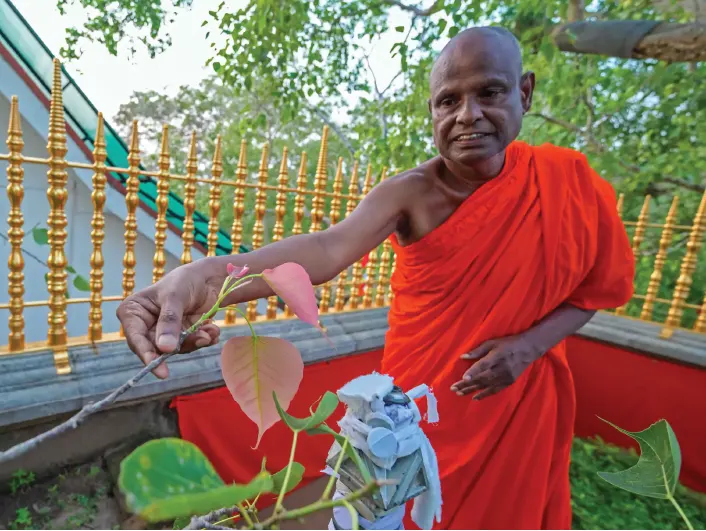
The recent allegations against a senior Buddhist monk accused of sexually abusing a minor have shaken Sri Lanka to its core. Rev. Pallegama Hemarathana, 71, chief priest of a highly venerated temple in Anuradhapura and custodian of a sacred Bodhi tree, was arrested in May 2026 over accusations that he abused a girl who was between 11 and 14 years old at the time, beginning in 2022, according to investigators.
Hemarathana has since been released on bail and denies the allegations. However, Sri Lanka’s Buddhist hierarchy took the rare step of formally suspending him from his custodial duties—an unusual disciplinary rebuke for a monk of his seniority.
The case is not isolated. According to Sri Lanka’s child protection authority, complaints alleging sexual abuse were filed against 285 Buddhist monks between May 2023 and May 2026. However, only 27 cases resulted in formal charges, and the agency does not track how many ultimately resulted in convictions. That scale, more than any single case, has turned a criminal investigation into a national reckoning that reopens difficult questions about the country’s most respected religious institution, the sangha, and whether its moral authority has been eroded by centuries of political entanglement, institutional privilege, and a persistent lack of accountability.
For many Sri Lankans, Buddhism is more than a religion; it is central to national identity. Monks are traditionally regarded as guardians of morality, educators, and spiritual guides, and their influence extends well beyond the temple into politics, education, and public life. That is precisely why allegations involving a monk of Hemarathana’s standing carry consequences far beyond the individual case—they undermine public confidence in an institution that has long enjoyed extraordinary and largely unquestioned social authority. Notably, many domestic outlets initially avoided covering the case at all, even as it drew international attention, because criticism of clergy in Sri Lanka is frequently read as an attack on Sinhalese Buddhist identity itself.
The Buddha’s teachings emphasise compassion, humility, discipline, and detachment from worldly desire. The Vinaya, the code governing monastic conduct, sets strict ethical standards, including expulsion for sexual misconduct. These rules were designed to preserve the sangha’s integrity and the public’s trust in it; misconduct was never meant to be concealed but to be investigated and addressed.
Yet Sri Lanka’s Buddhist establishment evolved, over many centuries, into something considerably more complex than a purely spiritual community. Temples accumulated vast landholdings, wealth, and political influence. Kings relied on monks to legitimise their rule; monks depended on royal patronage to sustain their institutions. That symbiosis, running from the Anuradhapura and Polonnaruwa periods onwards, turned parts of the sangha into political actors as much as religious ones—a dynamic the Mahavamsa chronicle itself helped cement by fusing Buddhist salvation history with Sinhala ethnic destiny.
Colonial rule and the nationalism it provoked deepened this fusion. During the struggle against colonial power, Buddhism became a symbol of resistance and national identity. This revival helped preserve tradition but also gave rise to Sinhala Buddhist nationalism, an ideology in which religion became inseparable from ethnicity. In the decades after independence, prominent clergy moved directly into politics, some sitting in Parliament and anchoring majoritarian movements that leaned on monastic endorsement for legitimacy. The effect, critics argue, was to pull parts of the institution away from universal Buddhist ethics and towards ethnic majoritarianism and political competition. Caste adds another layer largely absent from the sangha’s public image.
According to Sri Lanka’s child protection authority, complaints alleging sexual abuse were filed against 285 Buddhist monks between May 2023 and May 2026. However, only 27 cases resulted in formal charges, and the agency does not track how many ultimately resulted in convictions.
Though the Buddha explicitly rejected caste discrimination, caste distinctions took root in Sri Lanka’s monastic institutions over time. The major monastic fraternities—the Siyam, Amarapura, and Ramanna Nikayas—emerged historically along caste lines, with the dominant Siyam Nikaya restricting higher ordination largely to the Govigama, or landowning, caste. That exclusion prompted lower-caste Buddhists to establish rival ordination lineages in the eighteenth and nineteenth centuries. Reforms have chipped away at these divisions since, but traces persist in who holds authority within parts of the institution today.
This concentration of religious prestige, political weight, and economic resources creates conditions in which accountability struggles to function. When a monk wields the social power Hemarathana does, investigations can face delays, public pressure, or institutional reluctance—and any perception of preferential treatment corrodes trust not just in the sangha but also in the state institutions meant to enforce the law equally.
None of this should flatten into a broad indictment of Sri Lankan Buddhism. Thousands of monks devote their lives to education, humanitarian work, and meditation, and many have themselves called publicly for transparency and reform. The question the country now faces is not whether misconduct exists—it does in every religious tradition that exercises this degree of unaccountable authority—but whether Sri Lanka’s institutions, religious and secular alike, are capable of responding to it honestly. Reform-minded monks and rights groups argue the suspension itself is evidence that accountability can move, however slowly.
Sceptics counter that the Buddhist clergy’s political capital is now too integral to Sinhala nationalist politics for genuine self-policing to occur, and that the state has little incentive to force the issue when it depends in return on monastic legitimacy.
What happens next is still unwritten. It depends on whether Sri Lanka’s Attorney General files an indictment, whether the hundreds of other pending complaints move forward, and whether political leaders allow this case to set a precedent rather than quietly managing it as an isolated embarrassment.
Religious institutions worldwide have faced comparable reckonings, and the lesson from those is consistent: punishing individual offenders is not reform. Reform requires independent investigation, effective child-protection mechanisms, clear disciplinary procedures, and institutional transparency—protections that are fully consistent with, rather than a threat to, the ethical core of the Buddha’s teachings. Whether this becomes a turning point or simply another scandal absorbed into silence will say a great deal about which version of Sri Lankan Buddhism—the dhamma or the state apparatus built in its name—ultimately holds the greater claim on the country’s conscience.





Leave a Reply