



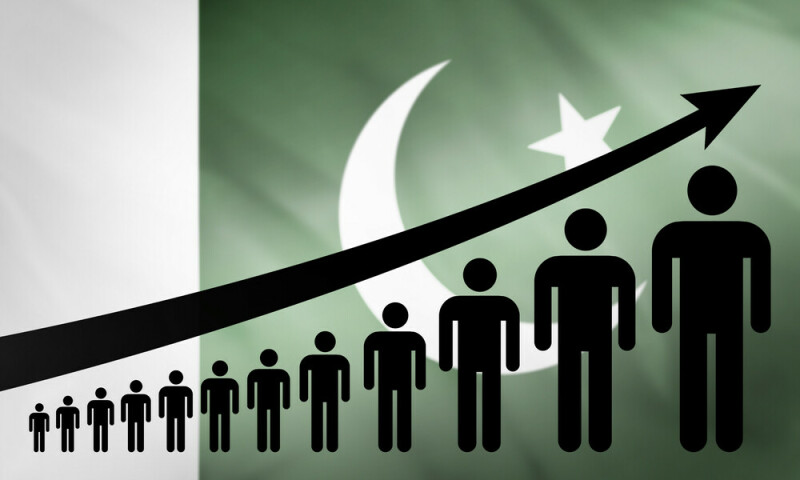
Adding 6.5 million people annually, Pakistan is hurtling towards a population of 400 million by 2050. Without a radical shift in policy and political will, the country risks a catastrophic economic and humanitarian collapse. Imagine a sovereign nation the size of New Zealand, requiring its own food, water, housing, and infrastructure, being dropped onto Pakistani soil every single year. Under any other circumstance, this would be classified as an invasion. It would prompt emergency National Security Committee meetings and an uproar in the Parliament. Yet, this influx is happening right now, not from across our borders, but from within. We are adding approximately 6.5 million people to our population annually. However, instead of an emergency response, there is only a haunting silence and policy paralysis.
Pakistan is sleepwalking towards an abyss that is no longer on the distant horizon, but right beneath our feet. As a medical professional and public administrator, I observe how the discourse among health experts has laid bare the terrifying math of our future. With a population exceeding 241.5 million, projected to hit 300 million by 2030 and a staggering 400 million by 2050, this is no longer just a governance crisis; it is an existential threat.
The Mathematical Reality
To grasp the severity of this trajectory, we must look beyond total numbers to the growth rate. Pakistan’s population is expanding at 2.6% annually. While it may sound like a marginal digit, its compounding effect is devastating.
Context is crucial: Bangladesh, once the more populous wing of united Pakistan, successfully stabilized its growth. India is approaching replacement levels. Iran previously set a world record for the fastest decline in fertility rates. Meanwhile, Pakistan remains a regional outlier, burdened with the highest fertility rate in South Asia at 3.6 children per woman. When a population grows faster than its economy, with Pakistan's GDP growth frequently hovering around or below 3%, the nation isn't just standing still; it is getting poorer by the hour. We are running on a treadmill that is accelerating just as our legs are giving out.
The Human Cost of Inaction
This crisis extends far beyond the abstract concept of "overpopulation"; it represents a silent tragedy for the nation's most vulnerable. Every year, 11,000 women in Pakistan die during childbirth, preventable deaths that leave behind shattered, orphaned families. Our infant mortality rate is equally harrowing, with 62 out of every 1,000 children dying before their first birthday. For those who survive, the reality is a demographic disaster rather than a dividend. Currently, 40% of children under five in Pakistan suffer from stunting. This condition is not merely about physical height; it represents stunted cognitive and brain development. We are raising a generation that will fundamentally struggle to compete in a digital, automated global economy, largely relegated instead to low-skilled labor.
Systemic Paralysis and Perverse Incentives
Perhaps the most shocking revelation is the sheer volume of unwanted pregnancies. Out of 12.8 million pregnancies annually, nearly 50% are unintended. This represents a systemic failure of the state. Six million women become pregnant each year simply because they lack access to contraception or the socio-economic agency to say no. This dynamic leads to approximately 3.8 million abortions annually, often performed in unsafe conditions by unqualified practitioners, further driving maternal mortality.
Administratively, we have long suffered from a structural divide. Basic Health Units (BHUs) historically ignored family planning, while the Population Welfare Department operated as an isolated, parallel entity. Furthermore, our National Finance Commission (NFC) Award formula creates a perverse incentive: provinces receive federal funds primarily based on population size. If a province successfully controls its growth, it loses its share of national revenue. Until we reform this to prioritize literacy, health indicators, and poverty alleviation over a mere "headcount," the political will to address this crisis will remain cold.

Leave a Reply