


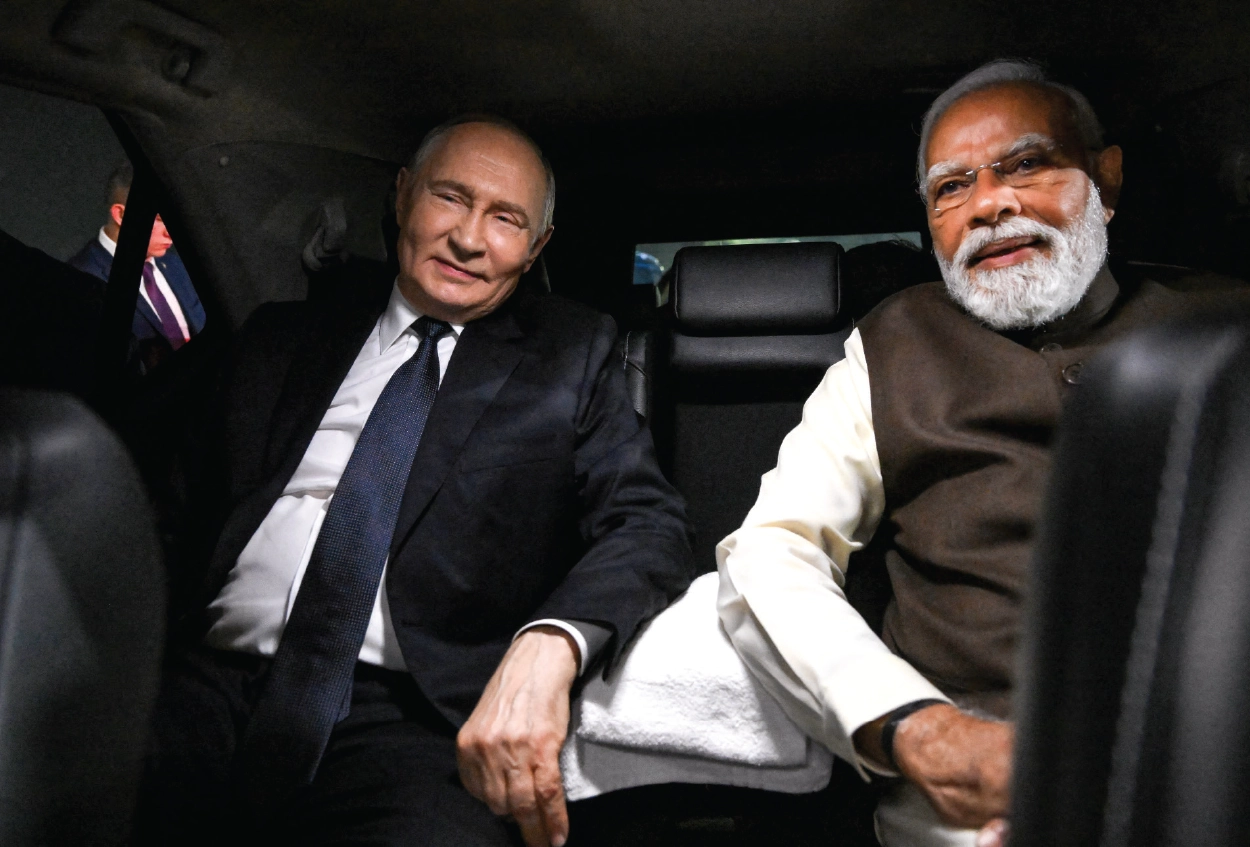
Russian President Vladimir Putin’s visit to New Delhi in the first week of the month marked yet another pivotal moment in the long and complex defence relationship between India and Russia. At the heart of the discussions lies India’s interest in acquiring next-generation platforms—most notably the Russian Su-57 fifth-generation fighter aircraft and the S-500 missile defence shield, one of the world’s most advanced air-defence systems. This comes at a time when Washington has been pressing New Delhi to scale down its defence procurement from Moscow, particularly after the evolving strategic closeness between India and the United States under the framework of the Indo-Pacific strategy.
While India and Russia describe their relationship as a “Special and Privileged Strategic Partnership”, New Delhi’s defence acquisitions over the past decade reveal a progressive diversification away from Moscow towards the United States, France, and Israel. However, the potential purchase of cutting-edge Russian hardware underlines a reality that has deep historical roots: India’s dependence on Russia for strategic military capability, especially high-end systems that Western nations are often unwilling or slow to transfer.
To understand the significance of this possible agreement—especially for Pakistan and the wider South Asian region—it is important to examine the historical context, the shifting geopolitical dynamics, and the reactions it may invite from Washington.
India’s defence relationship with the Soviet Union emerged strongly after the early 1960s. Following the Sino-Indian War of 1962 and the Western powers’ reluctance to meet India’s defence needs without political conditions, the Soviet Union became the primary supplier of arms to New Delhi. By the mid-1970s, more than 60–70% of India’s military inventory originated from Moscow.
The watershed came with the 1971 Indo-Soviet Treaty of Peace, Friendship and Cooperation, signed shortly before the Indo-Pakistan War. With Washington and Beijing tilting openly toward Pakistan, India’s reliance on the Soviet Union was solidified. Moscow’s military supplies, diplomatic backing, and naval presence in the Indian Ocean during the conflict became foundational pillars of the defence partnership.
Throughout the late Cold War, iconic systems such as the MiG-21, MiG-23, MiG-27, Su-30, and the T-72 and T-90 tanks entered Indian service. The Soviets also provided India with technologies that the West was unwilling to transfer, including submarine designs and missile technologies.
After the dissolution of the USSR, Russia inherited the defence relationship with India. In 2000, Putin’s visit to India resulted in the institutionalisation of an annual summit, affirming a long-term partnership. Co-development projects such as the BrahMos supersonic cruise missile and licensed production of the Su-30MKI reinforced the cooperation.
However, the 21st century also brought significant shifts. India began expanding defence ties with Israel, France, and eventually the United States. Washington’s willingness to sign foundational defence agreements—LEMOA, COMCASA, and BECA—paved the way for India to access advanced American platforms such as the P-8I maritime patrol aircraft, C-17 strategic lift aircraft, and Apache helicopters. By the 2010s, India was no longer overwhelmingly dependent on Russia.
Yet, certain Russian systems remained indispensable. The most notable example was the S-400 Triumf missile defence system, which India purchased despite strong US objections and the threat of CAATSA sanctions. This decision highlighted a recurring truth: whenever India faces a choice between strategic autonomy and American pressure, it tends to prefer autonomy.


Based in Lahore, the writer is a historian and a critical analyst. He can be reached at arslan9h@gmail.com
Very in depth write ups. 👍