



Caste has profoundly shaped Indian society for centuries, deeply influencing its social structures and political movements. However, its influence began to diminish after the partition of the Indian subcontinent, with a key shift occurring in how caste was officially recorded: unlike the comprehensive enumerations conducted by the British Raj between 1881 and 1931, post-partition India largely discontinued broad caste-based censuses. Instead, official counts became limited to Scheduled Castes (SC) and Scheduled Tribes (ST).
Thereafter, India came to be increasingly known for its secular social fabric and officially inclusive demographic practices. Nevertheless, the country has undergone a series of changes in its ethnic and national identities during the decade-long rule of the Narendra Modi-led Bharatiya Janata Party (BJP) and its pursuit of the long-standing agenda of saffronisation and Hindutva. The latest significant development under the regime is the proposed caste-based census.
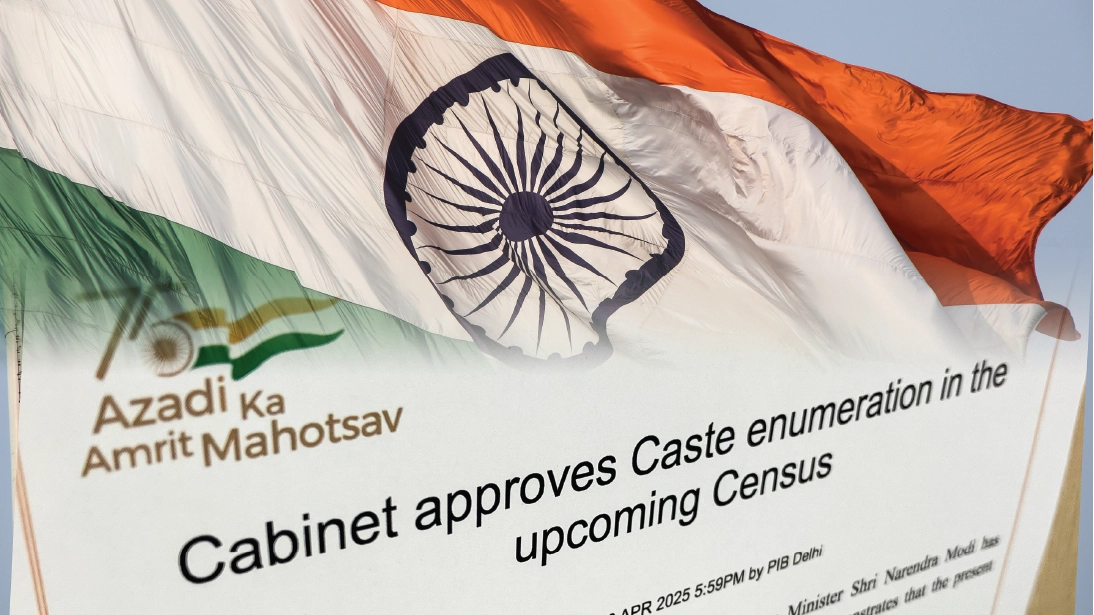
Indian Prime Minister Narendra Modi’s sudden push for a caste census, announced in April 2025, marks a surprising shift for the BJP, which has historically opposed caste-based enumeration. In a stark departure from his party’s traditional emphasis on unity and its opposition to caste-based politics, the proposed initiative is fueling widespread speculation about the historical shift and the potential implications of the move.
The push for a caste census amid the lack of updated, comprehensive caste data has sparked considerable debate. Proponents of renewed enumeration argue that its absence obscures the specific needs and challenges of various marginalized groups, making it difficult to formulate effective policies for their betterment. Conversely, opponents contend that collecting such data could re-entrench caste identities in national discourse, potentially exacerbating divisions rather than fostering a casteless society. Indian Prime Minister Narendra Modi’s sudden push for a caste census warrants an appraisal of the potential motivations behind it and the political context, timing, and potential implications.
In Indian politics, caste has long been a pivotal factor, with parties frequently leveraging it to galvanize voter support. However, under Prime Minister Modi’s leadership, the BJP has historically prioritized Hindu nationalism, often downplaying caste-based politics. This approach was evident as recently as 2021, when the Modi government argued before the Supreme Court that collecting caste data during the census would compromise data integrity and exacerbate social divisions. Given this backdrop, the government’s sudden decision in 2025 to include caste enumeration in the forthcoming national census represents a striking departure from the BJP’s traditional stance.
The timing of the recent caste census announcement appears to be a calculated political manoeuvre rather than a sudden commitment to social justice. Several factors support this interpretation.
Firstly, electoral pressure, particularly with the Bihar Assembly elections on the horizon, plays a significant role. In Bihar, where caste deeply influences voting patterns, Chief Minister Nitish Kumar had already overseen a state-level caste survey in 2022. Opposition parties, including the Indian National Congress (INC) and prominent leaders like Rahul Gandhi and Tejashwi Yadav, have consistently championed a nationwide caste census as a means to address social inequalities. By announcing the census, the government seems to be preempting the opposition’s narrative, aiming to neutralize a key talking point and prevent it from gaining further momentum in Bihar and other states.
 Secondly, coalition dynamics are a critical consideration. The ruling party relies on coalition partners, notably the Janata Dal (United) in Bihar, led by Nitish Kumar, to maintain its hold on power. A caste census had been a condition for the JD(U)’s continued support, making this decision crucial for governmental stability.


The writer, who is based in Kandhkot in Sindh, is a passionate freelance journalist. He can be reached at alihassanb.34@gmail.com.
Leave a Reply