


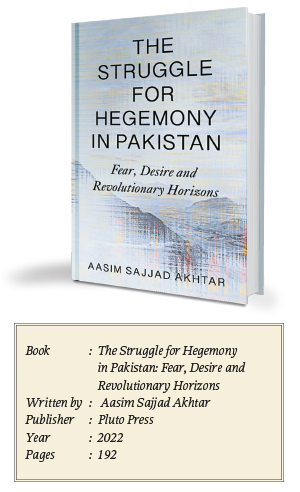
 Dr. Aasim Sajjad Akhtar’s The Struggle for Hegemony in Pakistan attempts to achieve two interrelated goals. First, he has presented an empirical and theoretical sketch of existing capitalism in Pakistan. What forms do global finance capitalism take in an exceedingly uneven social establishment that continues to bear the legacies of colonialism? What is the demographic structure of Pakistani society? How is contemporary hegemony reproduced in novel yet spectacular ways, particularly in the digital age? How are caste, patriarchal structure, ethnic-national oppression and other forms of identity inscribed onto the patronage-based power structure?
The author also mentions some building blocks for politics that can lead us towards somewhat communist horizon. How should we encourage a hegemonic alternative to politics based on fear and desire? Is it possibly thinkable to do so without having to interrogate intensely the changes in the fabric of politics? How do the contradictions of capitalism, such as imperialist wars, climate change and surplus populations, become the basis of an emancipatory collective subject rather than hate.
The book does not promise any answers to these questions. But what is deeply intriguing is the relation of force that come into play with the political subjectivity and the consciousness that will impact the contours of politics in the near future. While the book primarily focuses on Pakistan, it also offers insights into the peripheral South Asia and Africa. We have yet to see what the future holds and one needs to immerse oneself in popular struggles and maintain sanity, which seems like a feat unto itself. The task of transforming society is closely connected with the task of transforming oneself first. After reading this book, I am quite grateful to be able to wage an inner war as well as a collective struggle with my near and dear ones.
Although COVID-19 took the world by storm, practically, it only aggravated the interlocking political, economic, cultural, and environmental crises. It further cemented the survival-of-the-fittest mindset. Various regional movements, such as the Occupy Wall Street and the enduring Arab Spring, were triggered by the global financial crises. All of these factors hinted an alternate hegemony. A decade later, it is yet another humble reminder about the power of the trio - military, industry and media establishments, along with the political demagogues that simply magnified the contradictions of contemporary capitalism, completely not caring of the impact.
Although our progress is quite evident from the fact that the youth has gravitated towards critiquing ideas and political action, we are still not equipped to find the way through the hegemonic mainstream. The young population is a façade for resistance – to war, repression, exploitation, violence, ecological crises and privatization of public services – but genuine revolutionary politics remain absent amongst the younger populaces. Few would willingly identify themselves as revolutionaries, while they live in complacency, rendering it sufficient to be actively ‘participating’ on the social media rather than physically making an effort to bring about a change for the better. This obvious flaw in the very fabric of our nation makes this book all the more important in turbulent times such as these, while, at the same time, we contemplate the prospects of universal descent into utter barbarism. In such an environment, one is more likely to compete against each other than cooperate with each other, as and when major breakdown events take place.
Leave a Reply