



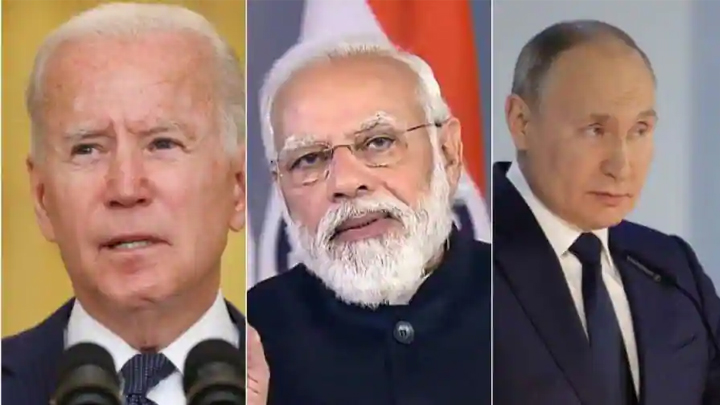
There has been global condemnation of Putin’s unilateral aggression against Ukraine. However, one country, that claims to be the biggest democracy in the world, has yet to issue an official statement against Moscow. India has also abstained from resolutions deploring Russia’s invasion of its neighbor.
India’s plain refusal to turn against Russia has surprised the US which was counting on the former’s unconditional support in the backdrop of consistently improving ties between the two countries. Some European leaders are also confused. For many years, Narendra Modi’s government has been diligently working towards improving relations with the West but when it was time to truly become part of the Western fold, India simply sat on the fence. For the US and its European allies, the philosophy of ‘With us or against us’ also applies in Ukraine. India has clearly shown that it is not with the them, so it must be with Putin.
Politicians insist that Indian’s abstentions from UN votes is a manifestation of its traditional policy of non-alignment with any super power. They also refer to the official Indian statements condemning any kind of violence, and the need for a diplomatic solution to the Ukrainian crisis. The US does not buy this explanation. It wants clear and precise condemnation of Russian action from India. Such a statement is not forthcoming.
The reason for this insolence is rooted deep in the past. Let us start from the beginning. India and Russia have been enjoying excellent relations since diplomatic ties were established right after India gained independence from the British. Over the following decades both have provided unconditional support to each other on a wide-range of international issues. India has never shied away from enjoying the perks of having a super power on its side which is a permanent member of the UN Security Council.
In 1955, Russia supported Indian sovereignty over the contested Kashmir valley. Since then, Moscow has repeatedly vetoed UN resolutions calling for international intervention in the valley. Russia never even once waivered from its pro-Indian stance throughout all these years. When India scrapped Article 370 in 2019 ending the special status of Kashmir, Moscow refused to condemn this action despite severe backlash from the rest of the global community. The next year, in 2020, China led another push for international intervention in Kashmir. It was again torpedoed by Russia.
Russian support for India is not confined to the UN only. They also share a long history of economic and defense cooperation. Moscow provided the technical expertise which was pivotal in establishing India’s domestic oil and gas industries. Russia played an important role in creating the Indian navy. It has provided all kinds of military hardware to India - from guns to aircraft carriers. Today, around 80% of India’s military arsenal is Russian-made.
During the past few years, the BJP government has sought to establish closer ties with the US and Europe in order to peruse a policy of strategic autonomy for its defense needs. But the policy-makers in New Delhi know that even if they stopped procuring weapons from Russia today, they will still require Russian ammunition and technical support for its existing weaponry for years to come.
The US has openly criticized India for not voting against Russia at the UN. It has also hinted towards penalizing India for its continued support for Moscow which is a direct consequence of its heavy reliance on Russian-made weapons. On its part, India also realizes that relying too much on Moscow could prove to be counter-productive in the long run. Indian politicians would like to add US-made weapons into their arsenal but they are too expensive and thus, out of reach.
Moreover, hardline Indian politicians have not yet fully coped with the loss of years of investment in Afghanistan. They blame the US for handing over the country to the Taliban in a platter. Last year, the US withdrew from Afghanistan in a hurry without even consulting its Indian allies. The lightning speed with which the country fell to the Taliban did not give a chance for damage assessment or control.Likewise, the US failed to issue official condemnation of alleged Chinese aggression along the border which resulted in a massacre of Indian soldiers.
Keeping all this in mind, it is not surprising to see India choosing to stand by Russia as it faces increasing international isolation. However, maintaining this stance will become more and more difficult as sanctions begin to bleed the Russian economy. Moreover, if Russia fails to score a decisive victory in Ukraine in the next few days, the pressure will continue to mount on India. Russia, on the other hand, may turn to China – India’s archenemy. Cordial relations between Beijing and Moscow will spell trouble for India which can see a significant decrease in arms purchases from Russia. The economic impact of the war will further squeeze India’s defense budgets rendering procurement of US-made weapons impossible.
Presently, India is walking a tightrope. Till now, it has managed to maintain its ties with both Russia and the West. However, soon it will be required to pick a side. That will be a very difficult decision with long-term consequences.

The writer is a freelancer and an investment banker based in Karachi. He can be reached at syedatifshamim@hotmail.com
Leave a Reply