


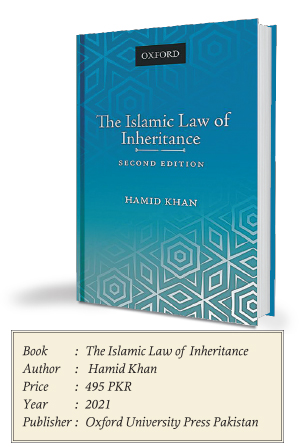
 At a quarter of the length of Hamid Khan’s tome on constitutional law, this particular book on Islamic inheritance might be less lengthy, but it is dense, though undoubtedly useful. Khan has done us a service in elucidating complex aspects for us. Anyone who wishes to have a fine reference guide to inheritance will find it worth his time. Khan’s first chapter is an introduction to what the precise meaning of shariah is as well as to the various schools of Islam. In addition to commenting on the Hanafi, Maliki, Shafaii, and Hanbali schools, he delineates the point at which the Ismailis broke away from other Shias. Khan’s endnotes to this chapter, and all the subsequent ones, are comprehensive. While his bibliography is short, his indexing is valuable, especially since many of the terms he expounds upon need referencing. Barring a couple of minor typos, the book is well-proofread.
The best way to approach this review is not to give a commentary on the constituents of its chapters, but rather to make note of some of the most pertinent terms that Hamid Khan makes accessible. He notes the differences between agnate heirs and cognate ones (the former relate to a male lineage and the latter to a female one) and on the difference between uterine heirs (those that share the same biological mother) and consanguine heirs (linked by means of patriarchal connection). This type of elucidation is vital for an appreciation of how Islamic laws of inheritance (especially Sunni) are laid out. Shia law gives less dominance to agnatic matters and is relatively simpler. Khan deals effectively with both types but his section on Sunni inheritances is more extensive. An intriguing point is that the Shias permit one to inherit from a non-Muslim; the Sunnis are stricter about this. Although a couple of actual cases Khan cites as examples do have a basis in this country, he also examines Islamic law of inheritance as it pertains to other nations.
Khan’s knowledge of the Quran, especially Surah Nisa, is commendable. I was truly impressed by the incisive nature in which he comments on the doctrines of Awl (Increase) and Radd (Return). He also expounds on matters such as those related to ascendants as well as descendants, such as true and false grandfathers and grandmothers. In the modern day and age, we sometimes forget that during the advent of Islam it was not uncommon for a son or daughter to predecease a parent.
Hamid Khan also delineates the difference between ‘Sharers’ and ‘Residuaries’ when it comes to division of inheritance. He underscores how much hiba (gift) can be bestowed out of one’s estate, and concludes with a section on wills. In aggregate, his groundwork is sound, even when it comes to what we might consider minor points such as how much hermaphrodites would stand to inherit (they are entitled to at least as much as a daughter, sometimes an amount midway between what a son gets and what a daughter receives).
I was struck by the fact that Khan also mentions Western law systems, such as the German and Swiss, in order to contrast their workings and implications with those of Islamic inheritance. For instance, in many Western instances the children of the deceased cannot inherit their shares of the estate as long as the deceased’s spouse is alive; hence, they can remain at the financial mercy of the surviving parent well into adulthood. Hamid Khan does a fine job of elucidating how progressive Islam truly is, comparatively speaking.
Leave a Reply