


Any discourse on Pak-Afghan relations requires a careful consideration of the cumulative impact of history, geopolitics and the ever-evolving ground realities. Plagued by latent hostilities, trust deficits and a never-ending blame game, bilateral ties between Pakistan and its war-afflicted Western neighbour have remained far from idyllic. At this stage, Pakistan’s decades-long entanglement in Afghanistan merits a critical examination that is up-to-date and cohesive.
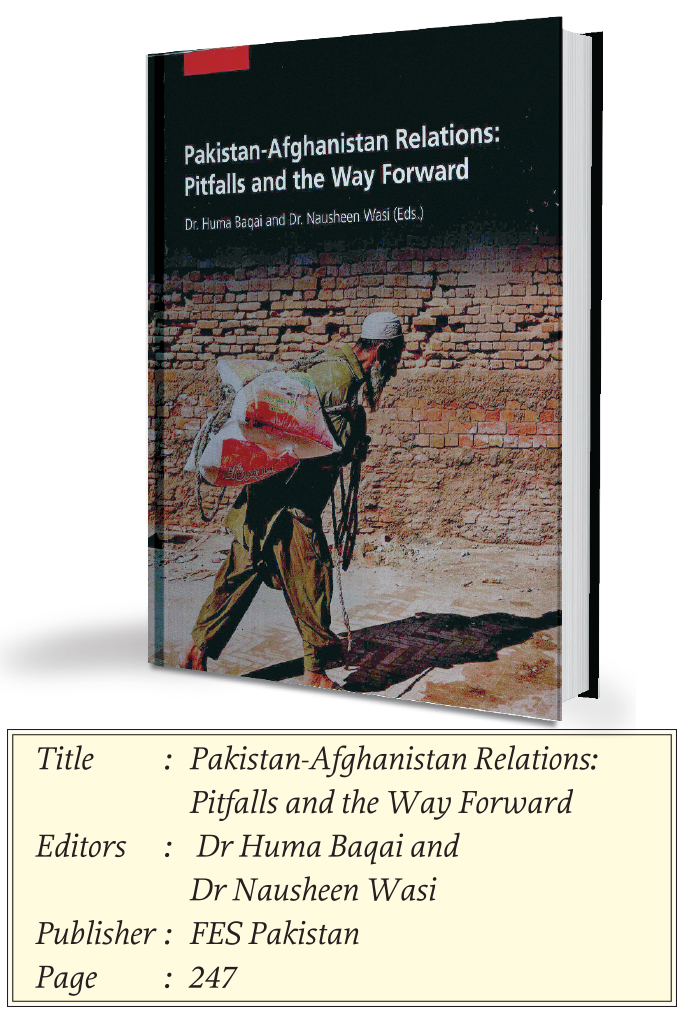
Viewed in this context, Pakistan-Afghanistan Relations: Pitfalls and the Way Forward comes through as a topical book as it spotlights the challenges and possibilities that have shaped bilateral relations. Edited by Dr Huma Baqai and Dr Nausheen Wasi, this compilation presents a rich miscellany of essays from academics, policymakers and opinion leaders that document the highs and lows of ties between both countries.
America’s exit and the subsequent takeover of Kabul by the Taliban has plunged Afghanistan into the mainstream news discourse for several months. However, the essays that are included in the compilation cannot be read as recurring meditations on the siege of Kabul. In their introductory note, the editors have cautioned readers against solely interpreting the text through the blinkers of the political transition in Afghanistan. “It has a more holistic approach,” they write, “[that is] geared towards achieving peace in Afghanistan...and suggesting a way forward that is indigenous and sustainable, rooted in lessons learnt.”
A striking feature of the book is its inherent objectivity. The editors’ decision to include a diverse menu of contributors who belong to seemingly different backgrounds has enriched the compilation. It is refreshing to see that the competing voices that inhabit the pages of this book exist in harmony. As a result, the book is spared from becoming an exceedingly divisive text. The contributors are averse to the idea that conflict should be seen as a first resort in Pak-Afghan ties. In a similar vein, they aren’t sympathetic to the decades of suffering endured by Afghanistan. On the strength of these facets alone, it is amply clear that the compilation resists the temptation to indulge in a blame game and focuses instead on the reconciliation process.
The essays in the compilation stand out for their strictly interdisciplinary focus. The contributors have drawn upon insights from history, economics, anthropology, politics and conflict management to appraise Pak-Afghan relations. Hameed Hakimi and Zalmai Nishat’s piece builds upon a historical perspective to reveal the extent to which mistrust and the excessive securitisation have fractured bilateral ties between Afghanistan and Pakistan. Fuelled by the spirit of neutrality, Bettina Robotka believes Pakistan-Afghanistan relations can improve once the historical baggage is lifted.
In a well-researched essay, Ali Maisam Nazary highlights the need for cultural integration, regionalism and the revival of moderate Islam as an antidote to the surging mistrust between both countries. Vaqar Ahmed uses a survey of firms based in Pakistan and Afghanistan to delineate the need for economic cooperation between both countries. Zahid Hussain’s informative, multifaceted piece examines Pak-Afghan relations from the prism of shifting geopolitical dynamics.
Baqai and Wasi’s compilation will appeal to students, scholars and journalists who are interested in broadening their understanding of Pakistan’s relations with Afghanistan. Though the text upholds strong academic credentials, it is mercifully free of jargon and remains immensely readable. Citations have been provided to direct readers towards material that can open the portals to an extensive array of information on the subject. The book also offers a chronology of events that have shaped the Afghan conflict over the last 20 years.
As an informative guide into one of the world’s most troubled regions, the book accounts for the friction between Pakistan and Afghanistan and the special circumstances that have brought them together. 
Leave a Reply