



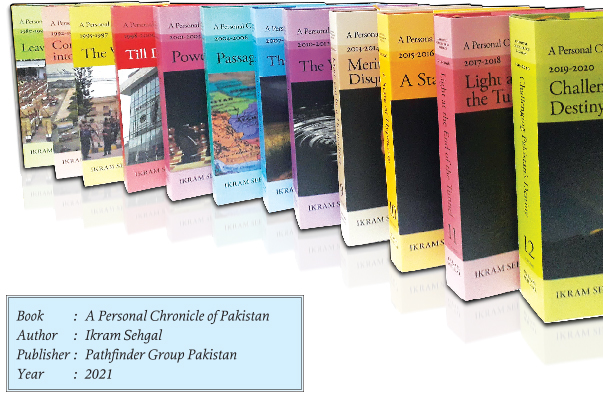
An officially recorded history always tends to differ with personal accounts that recount the same set of events, but in a way of their own. ‘A Personal Chronicle of Pakistan’ by Ikram Sehgal is indeed a voluminous personal account of the country’s history that chronicles in detail a list of known and obscure facts in a variety of categories about such key events and happenings, determining the future course of direction for the nation.
Consisting of over 7570 pages, the books are a collection of over 2,000 articles written by Sehgal for different media outlets. Equal to the size of a mini bookshelf, ‘A Personal Chronicle of Pakistan’ could frankly be referred to as the encyclopaedia of Pakistan’s history dated from 1980 to 2020. The book is a compilation of Sehgal’s 35-year-long written work in 12 volumes and is aimed at preserving the country’s history the way it must be written.
A former Pakistan Army officer, Ikram Sehgal is a defence and security expert, a businessman, a bilingual columnist in Urdu and English as well as a prolific author. A graduate of the Pakistan Military Academy, Kakul, Ikram Sehgal received commission in 2E Bengal Regiment and served the regiment till 1968. He qualified as a pilot in Army Aviation and served there from 1968–1971. After leaving the Pakistan Army, he worked as a commercial pilot and then set up his own trading business in 1977. Sehgal is also associated with numerous national and international organizations such as the World Economic Forum (WEF), the WEF Global Agenda Council for Counterterrorism, the International Organization for Migration and the EastWest Institute, a U.S.-based think tank.
Ikram Sehgal is particularly known for his two previous books ‘Blood over Different Shades of Green - East Pakistan 1971: History Revisited’ and ‘Escape from Oblivion: The Story of a Pakistani Prisoner of War in India.’ Laced with the author’s own experiences and personal observations as a serving army officer in the former East Pakistan, both books revolve around the breakup of Pakistan in 1971 and the ensuing events that unfolded before and behind the scenes. The later book, as the title suggests, throws light on Sehgal’s first-hand experience as a Prisoner of War (POW) when, while serving in East Pakistan, he was sent to the Panagarh POW Camp in India in April 1971 and then managed to escape from the prison in July 1971, becoming the first Pakistani Prisoner of War to escape from an Indian POW camp.
A rare set of personal accounts that narrates the bittersweet journey of the country, all the 12 volumes of ‘A Personal Chronicle of Pakistan’ are well-cited, fully-indexed and include a handful of suggested reading material for additional reading. The volumes are: ‘Leave the Army Alone (1980-1991)’, ‘Converging Garbage into Dreams (1992-1994)’, ‘The Wages of Truth (1995-1997)’, ‘Till Debt Do Us Apart (1998-2000)’, ‘Power Play (2001-2003)’, ‘Passage to Nowhere (2004-2006)’, ‘The Gathering Gloom (2007-2009)’, ‘The Years of Darkness (2010-2012)’, ‘Merit Can Be a Disqualifier (2013-2014)’, ‘A State of Hypocrisy (2015-2016)’, ‘Light at the End of the Tunnel (2017-2018)’ and ‘Challenging Pakistan’s Destiny (2019-2020)’.
Though it would not be fair to dedicate a single review page for such a voluminous work, a bird’s eye perspective may indeed help to recognise the scholarly side of Sehgal, who has successfully managed to bring to his writing an extraordinary breadth of experiences in a well-researched collection.
More than a personal memoir, ‘A Personal Chronicle of Pakistan’ provides an incisive viewpoint on Pakistan’s political, social and economic evolution. The collection of books serves readers as a reference work as well as a valuable means of exploration of key events, which set the course for the country’s foreign and security affairs in general and its overall future in particular.
Leave a Reply