


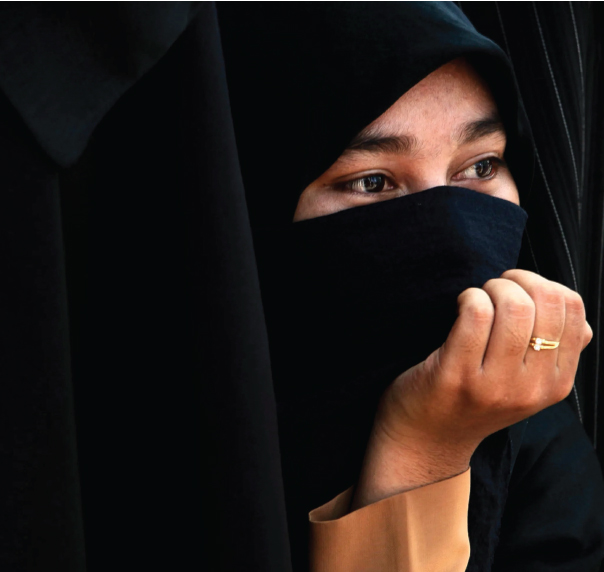
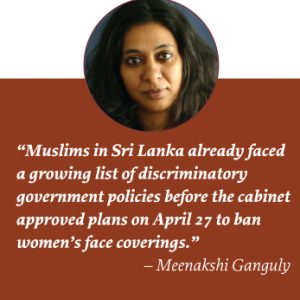
Sri Lanka’s cabinet has approved a ban on the burqa or full-face covering in public. Hundreds of Islamic schools have also been closed in the country. Recently, regulations were passed which allowed detention of suspects without trial for 24 months. Despite the government’s insistence that the moves and regulations are motivated by the country’s need for a comprehensive national security strategy, critics are seeing these measures as an expansion of the infamous Prevention of Terrorism Act (PTA). In the past, PTA has played an instrumental role in targeting minorities including Tamils and Muslims.
Sri Lanka has a history of devising and implementing laws and regulations in order to segregate, isolate and oppress minorities within the country. While such laws marginalize Tamils and Muslims, they further strengthen the Sinhalese majority at the expense of vulnerable communities.
Sinhalese constitute around 70 percent of the population. They believe that Sri Lanka is their land and belongs to them since antiquity. It is a place where Buddhism should survive and flourish. All other communities living in the country today, came as invaders and thus, do not belong there. They must either submit to the majority, or leave the land. Since its independence, Sri Lanka’s leaders have envisaged the country as a beacon of Sinhalese-Theravada Buddhism in South Asia.
The country’s post-independence discourse was heavily tilted towards this perception. Though this idea served the majority well, it alienated the minorities, especially Tamils, who form 11 percent of the population. Tamils have deep roots in Sri Lanka and have greatly contributed to the country’s cultural and economic development over the past centuries. Yet, the are treated as second-class citizens.
After independence, Tamils were targeted through discriminatory laws. But their persecution became increasingly fierce resulting in mob Sinhalese violence against their lives and livelihoods. The continued oppression, marginalization and outright violence against Tamils led to the establishment of The Liberation Tigers of Tamil Eelam (LTTE) in 1976. The LTTE was initially involved in sporadic clashes with the Sri Lankan armed forces. However, after a week of anti-Tamil violence by Sinhalese mobs in July 1983, the LTTE morphed into a full-scale insurgency. This led to the civil war that waged for more than two and a half decades.
The civil war ended in August 2009 with the decisive defeat of the LTTE but the state still continues to suffocate Tamil majority areas of the north-east with heavy military presence.
The majority of Sri Lankan Muslims speak the Tamil language but they had supported the state in its war against the LTTE. Once the Tamil threat was subdued, the state turned its guns towards the Muslims. Islamophobia became routine and state-sponsored anti-Muslim violence became commonplace. Buddhist monks carried out regular anti-Muslim campaigns with the blessings of the government.


The writer is a freelancer and an investment banker based in Karachi. He can be reached at syedatifshamim@hotmail.com
Leave a Reply