

Region
Jab Leaders
Bhutan, a Buddhist kingdom, emphasizes its citizens’ well-being over national prosperity.

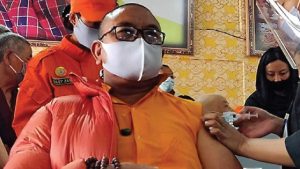
When the tiny Himalayan nation of Bhutan received 150,000 doses of the AstraZeneca coronavirus vaccine in January, they wanted to consult the stars first. Buddhist monks advised the government that the best time to start the immunization campaign was late March, and that a woman born in the Year of the Monkey would be a suitable choice. Ninda Dema, thirty years old, was elected as the first person to get the vaccine. She was given the shot by a nurse who was also born in the Year of the Monkey. The jab was given at a vaccine center in Thimphu, the capital, as Buddhist prayers were being chanted. “Let this small step of mine today help us all prevail through this illness,” she claimed, according to the country’s newspaper.
Choosing the best time to carry out the vaccine in the devout Buddhist nation was critical to ensuring locals had confidence in the jab. And the conclusions are self-evident. Bhutan has surpassed Israel, the United States, and Bahrain in terms of the percentage of adults who have been administered one dose of the vaccine since Ms. Dema was immunized.
Bhutan had vaccinated 93% of its adult population in just 16 days. The vaccination campaign in the nation started on March 27. According to the Ministry of Health, by April 8, 93% of qualifying adults had received their first dose. Officials said 472,139 people between the ages of 18 and 104 had been vaccinated as of that year, and they recommended those who were willing to do the same.
Bhutan had vaccinated 93% of its adult population in just 16 days. The vaccination campaign in the nation started on March 27. According to the Ministry of Health, by April 8, 93% of qualifying adults had received their first dose.
The landlocked country had been alerting about doctor shortages well before the pandemic was announced. The World Health Organization proposed a doctor-to-population ratio of 1:1000, which meant that every 1,000 people should have access to a doctor. According to this, Bhutan needed approximately 700 doctors and they only had 337. The nation relied on volunteers known as ‘desuups’’ to transport vaccine equipment across rugged terrain in order to roll out the vaccines. They also encouraged residents to continue wearing masks and socially distancing themselves.
Health Minister Dasho Dechen Wangmo characterized the initiative as a success in a remark,”sense of purpose that each of us is embracing to protect our country and the people we love.” She encouraged people to get vaccinated in order to defend themselves, their families, and King Jigme Khesar NamgyelWangchuck, “His Majesty the King has shared thoughts about taking the vaccine only after every eligible person in the country received their shots safely,” she remarked. “All of us must come forward, so that we make way for His Majesty to receive the vaccine as soon as possible.”
Bhutan’s rapid vaccine campaign has been attributed by Indian media to great political leadership who recognize the urgency of keeping ahead of the infection curve. Bhutanese Prime Minister Lotay Tshering, who is also a doctor, has overseen the release of 1,200 vaccine centers across the country. The government has deployed helicopters to transport vaccinations to mountain villages that are difficult to access by road. Health Minister Dechen Wangmo assured people that being vaccinated was their “sacred responsibility,” not just for the sake of their families, but also to protect the emperor, King Jigme Khesar Namgyel Wangchuck, who had vowed to put others ahead of himself. According to the Atlantic, Bhutan’s policy consisted of five main elements: engaged leadership, preparedness, responding quickly, building on internal strengths, and offering adequate assistance.
The leadership’s medical history also played a role. Lotay Tshering, a well-respected doctor before entering politics, had been actively involved in the pandemic since last year, moving rapidly to establish a national system to deter outbreaks. Implementing the gold standard for public health interventions involved detecting, testing, tracing, isolating, and treating events. In addition, the nation sought to improve the ability of healthcare professionals, hospitals, and labs, as well as to ensure the quality of critical health services. “We’ve been so focused on … epidemiology of this vaccine rollout, we’ve forgotten about the importance of strong leadership and fast, decisive actions, which is what we’ve seen happen in Bhutan,” Elizabeth Jackson, an experienced supply chain management and logistics from the School of Management & Marketing at Curtin University, told the ABC. One of the lessons we have learned from Bhutan is the importance of listening to orders and following directions when it comes to effective vaccine deployment.
Bhutan has also implemented lockdowns and just recently registered the first COVID-19 death. While the country has already been hailed for its rapid vaccination campaign, public health officials have cautioned that they have not yet reached the end of the track. The local population has been asked to be vigilant as COVID-19 incidents resurface around the world.![]()

The writer has done his Masters in Defence and Strategic Studies. He can be reached at daniyaltalat2013@gmail.com


Leave a Reply