



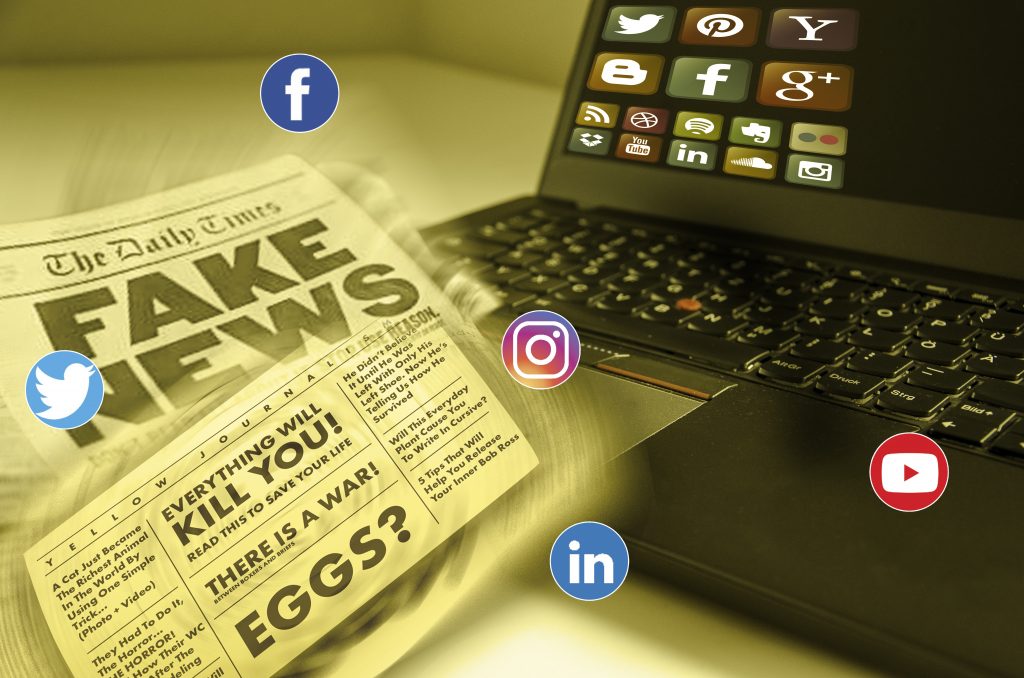
There’s no doubt that the world of fact-checking has experienced a boom over the last decade. But how do we describe fake news? Why has fake news become so common today? Is it so new? Why is it now all around? Are we any closer to truly understanding the phenomenon of misinformation, or how to stop it?
Fake news is a metaphor that has come to mean different things to different people. At its core, “fake news” is defined as those narratives that are false: the narratives themselves are made without any solid evidence, references, or quotations. Often such narratives are propaganda intended to confuse the reader or may be crafted for the sake of economic rewards as a click bait. For the last few years, fake news has spread via social media, partly because such narratives are posted online too freely and rapidly.
Fake and misleading news reports are not exactly recent. Fake news has existed for as long as there has been news, both intentionally and unintentionally. It has been a part of media culture since the invention of the printing press, long before social media. The period at the turn of the twentieth century in which yellow journalism was coined, the name of journalism in 1895 helped to drive the United States to war with Spain and was a strong highlight of the fake news stories.
Fake news calls for the success of three basic items. These comprise the fake news triangle collectively: it cannot extend to hit a potential audience without all of these considerations. It also examines how a group can successfully promote such campaigns through means and agendas, the use of social media, and online promotion platforms and services. These are components of what we term the “False News Triangle” which, in every news or public opinion initiative, we have considered to be the cornerstone of progress.
There is a plethora of unique perspectives into how various types of fake news are observed in different contexts. Fake news isn’t just about facts, it’s about stories. Stories can in effect be so potent that Imke Henkel of Lincoln University suggests that we can become more vulnerable to false assumptions and misconceptions by using a compelling narrative rather than objective consistency. Human beings are natural storytellers; it is fair to believe that stories have been an integral part of human lives in the thousands of years based on the dramatic scenes seen in cave paintings in France. When fake headlines are repeated, people believe them more.
 “This phenomenon will have the effect of strategically replicating myths to cause other people in the hope of manipulating them,” scientists have said. “Several such reports we have seen resurge in particular near the day of elections, but after that, they ceased to disperse suddenly.”

The writer is a freelance contributor. She can be reached at gulnaznawaz1551@gmail.com |
|
Cover Story
|
|
News Buzz
|
Update |
Leave a Reply