



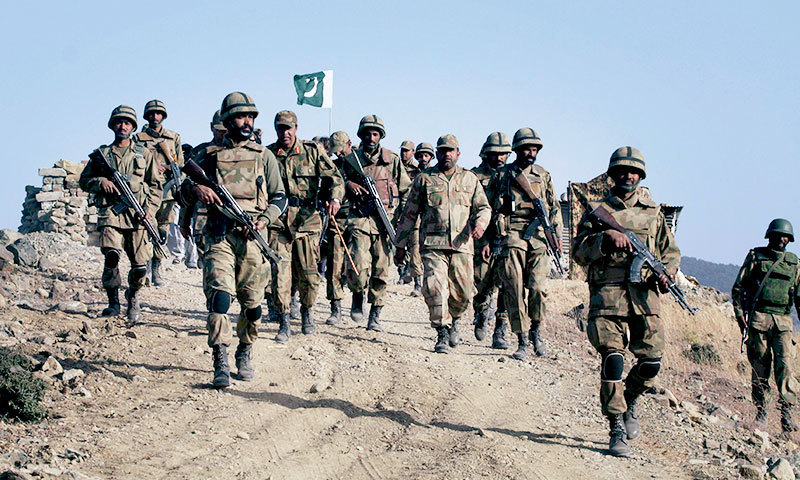
Ever since 2001, the Pakistan Army has been involved in constant operations to ensure the internal stability of the state. Army has been combating various militant groups specifically in the Federally Administered Tribal Areas (FATA) and all over Pakistan. Initially the target was Al-Qaeda, IMU, EPI, ISKP but not Taliban and Haqqani Network. Furthermore, in 2007 Tehreek e Taliban (TTP) emerged who were divided into 40 groups under the leadership of Baitullah Mehsud and were against Pakistan. They wanted to establish Caliphate by waging a war against the Pakistani government and military to overthrow them. All the militant groups were spread in the FATA region which is comprised of seven different agencies. The agencies include, Khyber, Orakzai, Bajaur, Mohmand, Kurram, North Waziristan and South Waziristan. Mostly, the militants were concentrated in North Waziristan and Khyber Agency.
Out of many operations one was Zarb-e-azab which means “strike of the sword of the Holy Prophet”. The operation Zarb-e-Azab was launched on June 15, 2014. It was a full scale military operation in the area of North Waziristan because that was a safe haven for the terrorist factions. The terrorist outfits disrupted Pakistan’s economy and caused huge humanitarian crisis. So the operation Zarb-e-Azb intended to “eliminate terrorists regardless of the hue and color”. The operation did not spare any militant be it good or bad Taliban. Even though the TTP itself proposed peace talks with the government but the situation in North Waziristan was so worse and the terrorist attacks were so frequent that Chief of Army Staff, Raheel Shareef took the oath to continue the operation till the last terrorist body fall.
North Waziristan was divided into three main areas. First was Data Khel which comprised of the Hafiz Gul Bahadur’s faction of Taliban who supported the Afghan Taliban. Second was Miran Shah which had Haqqani Network, Afghan Taliban and Al-Qaeda militants residing. Third was Mir Ali which was concentrated with TTP, ETIM and Punjabi Taliban. North Waziristan used to be a terror economy and bombs were literally being made and sold there. Moreover, the APS attack proved to be a turning point for Pakistan’s terrorism policy. Before APS, Army did not have a prominent reason to operate in North Waziristan because of the threat of backlash from the citizens and international world. However, after the APS attack Pakistan’s military, government as well as the entire nation were on the same page.
Operation Zarb-e-Azb resulted in a decisive blowback for the terrorist because before this operation the terrorists were out of control and dominating the environment nevertheless, during and after the operation Pakistan’s Army got into control of the area and wiped out any terrorist activity being carried out in the region of FATA. Army also conducted four military operation in Khyber Agency because all the militants or the so-called ‘jihadists’ what they believe themselves to be used to escape from North Waziristan to hide in Tira Valley. This valley is an extremely remote area however, Pakistan Army still managed to eliminate the troublemakers.
Zarb-e-Azb was a victorious operation because around 3500 terrorists were killed which bewildered and stunned their networks. Approximately 243 tons of IED was recovered by the 19000 intelligence based operations and 7,500 bomb factories were destroyed. Pakistan’s Army lost lives of 490 soldiers during the operation. After the operation was completed, all the displaced people settled in the IDP’s were safely returned back to their homes.
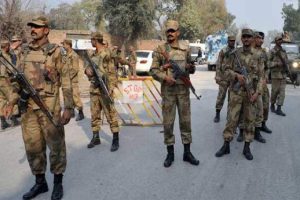 Even though the terrorist groups were wiped out of the FATA region but when General Qamar Javed Bajwa took over the office he scrutinized the situation after Zarb-e-Azb and came up with a plan which in other words is known to be, ‘Bajwa Doctrine’. The militants who were residing in the FATA region had their empathizers in other parts of the country as well mainly in the central Punjab, Sindh and Baluchistan. They are known to be the sleeper cells who are involved in minor attacks occurring countrywide. They are operated by their networks which are usually dwelled in Afghanistan and funded by RAW and MOSSAD. Bajwa decided to initiate an operation which not only clears out FATA but a cleansing nationwide. It came to be known as operation “Radd-Ul-Fassad”. It was launched on 22nd February, 2017 and the announcement was made by Inter-Services Public Relations (ISPR) which works as a media wing for Pakistan’s military. It was said, “This operation is aimed at steering Pakistan towards a stable and peaceful future by indiscriminately eliminating the remnants and residual/latent threat of terrorism from across the country consolidating gains of operations made thus far and further ensuring the security of the borders.”
When Zarb-e-Azb was going on many terrorists used to escape from the Pak-Afghan border to Afghanistan so during Radd-Ul-Fassad fencing of Afghan Border was started so that no militant can escape and they all remain inside Pakistan so the military can tackle with them. The fencing has covered 684 km out of 822 km which is about 83% and the project cost is around 70bn. The operation Radd-Ul-Fassad achieved around 75,894 Intelligence based operations during which 843 new border posts were established. A lot of sleeper cells were busted including 816 projects in FATA and thousands of militants were neutralized in which 1900 militants were killed. Radd-Ul-Fassad improved the security situation of Pakistan overall.
The internal stability of Pakistan can be calculated by making a comparison between the security situation before and after the military operations. In 2003 the target killings were 1762 and in 2018 only 5 were reported which is a 97% reduction in overall trend. Extortion was 2113 in 2003 and 7 in 2018 which is again 96% reduction. Kidnapping for ransom was reported to be 303 in 2003 and 27 in 2018 which is a 93% overall reduction.
This pretty much explains how the country’s situation has changed ever since military has started the operations to knock out the terrorist groups. Within years Pakistan has improved a lot previously it was even unsafe to go out and the bomb blasts were so frequent, a lot of Pakistanis gave up their lives. In fact, Pakistan lost a lot of wonderful soldiers too in the way to make Pakistan a better place. However, now our military has done a tremendous job which not only enhanced the country internally but also improved its image internationally. 

The writer is an undergraduate student of International Relations at Bahria University in Islamabad. Her key area on interest is regional cooperation, terrorism and divisions between Global North and Global South. She can be reached at kashafsohail26@icloud.com |
|
Cover Story
|
|
News Buzz
|
Leave a Reply |
Update |
A great Article. It really cements the fact that Pakistan is undoubtedly on a course towards internal and regional peace. I would like to further add that it was the heroics not of just the upper command rather the bravery and will of the lower echelons of the army and its young leadership that truly is the bearer of this success and further prosperity of our Motherland. Kudos to the writer who in simple terms yet analytically has summarised all the years of struggle and very correctly shed light on the positive changes we are seeing.