


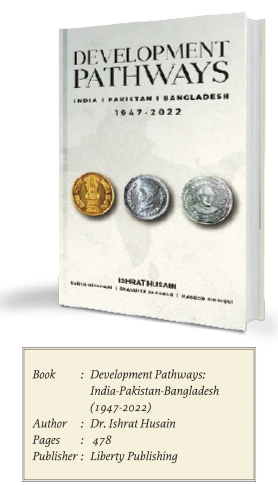
 Dr. Ishrat Husain’s profound insights, unparalleled academic and research acumen, cultivated over years of dedicated service to Pakistan, are vividly reflected in his latest literary endeavor, “Development Pathways: India-Pakistan-Bangladesh (1947-2022).” Dr. Husain’s extensive professional journey encompasses leadership roles in academic institutions, the banking sector, and advisory positions to Pakistan’s former prime minister.
His firsthand, practical experience, immersed in the intricacies of policy-making and decision-making processes across public and private sectors, has endowed him with the sagacity and practical proficiency needed for planning, implementation, analysis and prediction of a country’s economic, trade, and financial landscape. Within this book, his focus extends beyond one nation to encompass three countries—India, Pakistan, and Bangladesh—confronting comparable internal and external challenges.
This meticulously researched and fact-based work illuminates key factors that positively influenced the economic progress of their South Asian counterparts. Dr. Husain’s co-authors—Sarah Nizamani, a Research Fellow at the School of Economics and Social Sciences (SESS) at IBA, Karachi; Shagufta Shabbar, currently pursuing her Ph.D. from SESS, IBA; and Masood Siddiqui, a PhD scholar and researcher at IBA—contribute diverse perspectives to the book.
The decision by Dr. Husain and his co-authors to concentrate on India, Pakistan, and Bangladesh proves relevant, as these nations share a common geographical region and face analogous economic dilemmas. These challenges, including poverty, illiteracy, and an uncertain future, were exacerbated by Western academics and voices predicting a dark path for these countries.
The research-driven content of the book unveils specific decisions contributing to the economic growth and active participation of these three countries in the global economy. Topics covered include macroeconomic and fiscal policies, foreign direct investment, exports, domestic production, foreign exchange reserves, balance of payments, and external and domestic debt, among others, reflecting the health and status of a country.
In discussing India’s economy, Dr. Husain delves into the 1991 economic crisis, attributing it to a balance of payments deficit resulting from increased reliance on imports and other external factors. For Pakistan, he illuminates economic growth under various regimes, including those of General Ayub Khan, General Muhammad Zia-ul-Haq, and General Pervez Musharraf. During General Zia’s era, Ghulam Ishaq Khan played a crucial role in restoring the country’s economic trajectory. Dr. Husain also explores the factors influencing economic growth during General Musharraf’s tenure, marked by significant reforms from 2000 to 2006.
Dr. Husain scrutinizes the reasons behind the West perceiving Bangladesh as a basket case. Factors such as its vulnerability to natural disasters, limited food production capacity, and an underdeveloped industrial foundation contributed to this perception.
The book’s second part, “Economic Policies,” elucidates the structured changes occurring in the three countries, covering the performance of agriculture, industry, and services, along with monetary developments and inflation. Dr. Husain’s insights into India’s industrial sector reveal the fastest-growing areas, while, for Pakistan, he highlights the highest industrial growth period in the 1960s, with a rise of 11 percent.
“Development Pathways” is a must-read work, providing a comprehensive, fact-based, and data-driven perspective for students and professionals in business management, economics, and related fields of study. This book is a testament to the collective expertise and extensive research invested in revealing the economic, financial, trade, and socio-economic challenges faced by these nations over the past seventy years. By inquiring into historical contexts and scrutinizing policy decisions, the book discloses the intricacies of the past and presents the pathway for the future by offering valuable insights into the implemented policies, decisions made, and the subsequent consequences.
Leave a Reply