



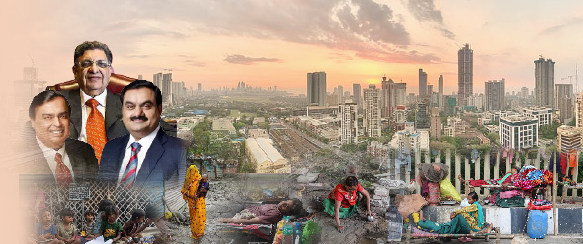
India, a land of rich cultural heritage and diversity, is a country of stark contrasts. While it boasts a burgeoning economy and is home to some of the world’s wealthiest individuals, a significant portion of its population grapples with poverty. The glaring gap between the rich and the poor in India accentuates the socio-economic disparities prevalent in the country.
Approximately 63 million people in India live below the poverty line, struggling to meet their basic needs. The juxtaposition is striking against the backdrop of India being the residence of some of the globe’s richest individuals. These billionaires wield immense economic power, contributing significantly to the country’s economic landscape and global influence.
The country grapples with a staggering income and wealth distribution gap, magnifying the socio-economic disparities. According to recent data, the richest 1% of India’s population holds more than four times the wealth of the bottom 70%. Additionally, a report by Oxfam revealed that in 2022, the wealth of India’s top 1% surged by 46% while the wealth of the bottom half of the population increased by merely 3%. This glaring inequality affects income distribution and widens the gap in access to essential services and opportunities. Another concerning statistic showcases that the top 10% of India’s population holds nearly 77% of the total national wealth, leaving a disproportionately small share for the remaining 90%.
As per official data, the average income of the top 1% in India is 39 times higher than that of the bottom 50% of the population. The World Inequality Database highlights that between 1980 and 2022, the income share of the top 1% doubled, while the income growth for the bottom 50% remained sluggish. Such disparities perpetuate a cycle of poverty, hindering access to education, healthcare, and other essential services for a significant portion of the population.
Furthermore, the COVID-19 pandemic exacerbated these inequalities, disproportionately affecting the livelihoods of the poor and marginalized communities, widening the income gap even further. Addressing this income and wealth distribution disparity is crucial for sustainable and inclusive development in India, necessitating comprehensive policies focused on redistributive measures, equitable opportunities, and social welfare initiatives.
Topping the list of the wealthiest people is Mukesh Ambani, the Chairman of Reliance Industries Limited. His wealth predominantly stems from the conglomerate’s diverse businesses, including petrochemicals, refining, telecommunications, and retail. Ambani’s innovative business strategies and visionary leadership have catapulted him to the pinnacle of India’s rich list.
Gautam Adani, the founder and chairman of the Adani Group, secures a prominent spot among India’s wealthiest individuals. His conglomerate spans multiple sectors, such as infrastructure, energy, ports, and logistics, contributing significantly to his wealth.
The co-founder of HCL Technologies, Shiv Nadar, holds a substantial position in India’s richest list. His wealth is derived from the IT services and solutions provided by HCL Technologies, which he nurtured into a global powerhouse.
Radhakishan Damani, a self-made billionaire, is known for his success in retail through his company Avenue Supermarts Limited, which operates the popular supermarket chain D-Mart.
Cyrus Poonawalla, the founder of the Serum Institute of India, is a pioneer in the pharmaceutical industry. His company is renowned for producing vaccines, contributing significantly to his wealth and global health initiatives.
Uday Kotak, the founder and CEO of Kotak Mahindra Bank, has established himself as a prominent figure in India’s banking and financial services sector, amassing substantial wealth through his innovative banking strategies.
Lakshmi Mittal, the chairman and CEO of ArcelorMittal, an international steel manufacturing company, has significantly contributed to India’s industrial and steel sector, solidifying his place among the country’s wealthiest individuals.
Sunil Mittal, the founder and chairman of Bharti Enterprises, has played a pivotal role in revolutionizing India’s telecommunications industry through Bharti Airtel, becoming one of the wealthiest individuals in the country.
Kumar Mangalam Birla, the chairman of Aditya Birla Group, oversees a conglomerate with diversified interests in various sectors such as metals, cement, textiles, and telecommunications, contributing substantially to his wealth.
Dilip Shanghvi, the founder of Sun Pharmaceuticals, is a stalwart in the pharmaceutical industry, leading his company to become one of India’s largest pharmaceutical companies and securing his place among India’s wealthiest individuals.


Sara Danial is a Pakistan-based writer/editor and can be reached at sara.amj@hotmail.co.uk
Leave a Reply