



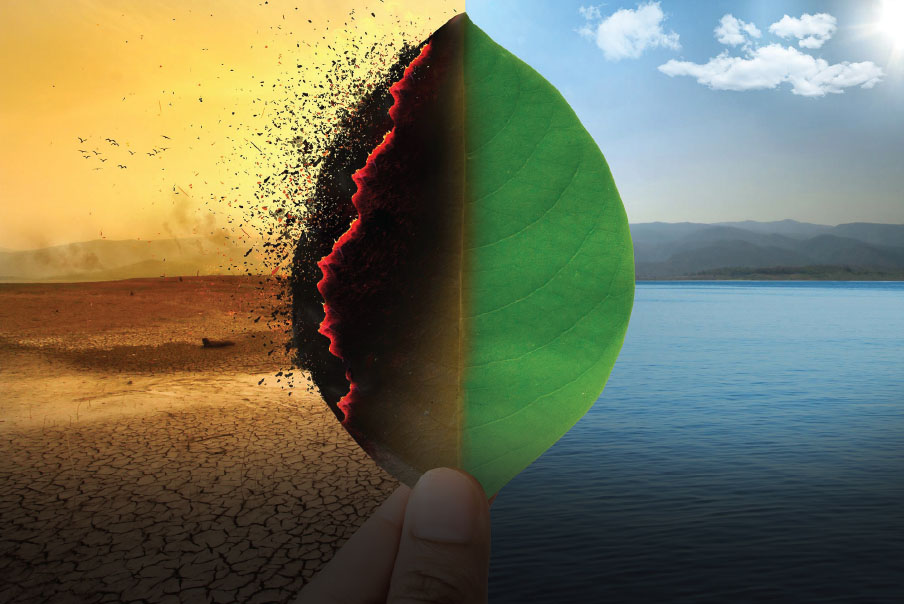
Humanity is facing chaotic situations in terms of the pandemic and environmental issues. After pervasiveness of the Coronavirus, the next suspicion can be changes in climate such as heat waves, droughts, rise in temperature, melting of glaciers and wilder weather, etc. There are lots of dogmatic theologies about changes in the climate for decades. History reveals that there are two major reasons of climate change: first, when the greenhouse effect was identified on paleoclimate changes: second, in the late 19th century, the eruption of volcanos discovered with respect to solar variation. Ample theories were drawn for noticing how climate has changed and even now exploration is looming.
Theories and assumptions have concluded that humans are responsible for this jeopardy. A scholar rightly called climate change a ‘perfect moral storm’. The key reasons behind climate change are maximum use of fossil fuels, deforestation and intense increase in agriculture. These causes are ultimately faced by the Homo sapiens. In the first half of the 19th century, the emission of greenhouse gases (GHG) began to spread and increased the temperature of the earth by almost 1.1 degree Celsius. The reason was the genesis of industrialization. No one wondered at that time that burning of fossil fuels was going to be a game changer in the 21st century. Later discoveries and disclosures found that human activities had ignited changes in climate.
According to the WMO’s State of Global Climate Report, 2020 has aggravated climate change indicators. The report reveals that emission of GHG, melting of glaciers, sea level rise and extreme hot weather are the main pivotal indicators and can increase the temperature of the earth by 0.2 Celsius. On the other hand, climate change can also affect socio-economic development, migration, food security and marine ecosystems. According to Dr. Nerem, “No one is terribly sure about what will happen by 2100, if the ice sheets really start to go, things could change dramatically”.
The Paris Agreement on Climate Change, is a treaty on climate change that was signed in 2016. The goal of this convention was to limit the excess of carbon emission and lessen the rise of temperatures by 2 to 1.5 Celsius. 196 countries need to submit a net zero report by 2050 along with plans to prevent global warming and related issues. In addition, COVID-19 has bought unwelcome dimensions to climate which are also under consideration in so many conventions these days. The research shows that humans need to gear up, this is the time to wake up and bring the tools to cope up. This is the year to work for the betterment of the world and for protecting the people from disastrous climate change. For functional ecosystem, along with governments, the masses have equal responsibility for curbing the menace.
 Nevertheless, there is always light at the end of the tunnel. If humans have destroyed the climate, they also can create it. The good news is that solutions have been made on real, technical and affordable bases. The foremost and primary solution to keep warming below is to switch from conventional to non-conventional sources. It has been anticipated that use of hundred percent renewables can cut carbon emissions to net zero by 2050. Therefore, it is highly important to saturate adaption. WMO secretary Prof. Taalas has stated, “One of the most powerful ways to adapt is to invest in early warning services and weather observing networks. Several less developed countries have major gaps in their observing systems and are lacking state-of-the-art weather, climate and water services”.

The writer is associated with the Sir Syed CASE IT University in Islamabad as program manager. She can be reached at sana.mohsin11@gmail.com
Leave a Reply