



India has consistently projected itself as the dominant conventional military power in South Asia, emphasising its numerical strength, sizable defence budget and growing inventory of seemingly high-tech weapon systems. However, a detailed analysis of the four-day war with Pakistan in May 2025 exposed significant shortcomings in the strategic decision-making of the Indian leadership, along with poor operational planning and structural inefficiencies within the Indian armed forces, revealing that India’s perceived conventional superiority is an overhyped self-image and an exaggerated claim. This has rendered India’s conventional defence posture increasingly questionable.
Despite huge investments in acquiring high-tech weaponry from its defence partners, India’s conventional military capabilities remain constrained by an overreliance on imported weapon systems, catalysed by the illusion of infallibility and invincibility, which undermine combat effectiveness.
India’s defence spending has seen a steady upward trend over the past decade. According to data released by the Stockholm International Peace Research Institute (SIPRI) in 2025, India ranked 5th among the world’s top military spenders, allocating approximately USD 86 billion for defence in 2024-25. India’s conventional military modernisation drive includes the procurement of advanced military platforms such as Rafale fighter jets from France, S-400 air defence systems from Russia, Apache attack helicopters and MQ-9B Predator drones from the US, and a range of Israeli platforms, including Heron, Hermes 450, and Harop kamikaze drones, as well as Air-LORA supersonic missiles.
While these acquisitions ostensibly enhance India’s warfighting capabilities, they also expose a structural dependence on foreign suppliers, including Russia, the US, France and Israel. This reliance not only complicates logistics and maintenance but also raises serious concerns regarding interoperability and sustainability of these systems during prolonged conflicts. A 2023 report by the Observer Research Foundation (ORF), titled Momentous Changes: Defence Reforms, Military Transformation, and India’s New Strategic Posture, underscored that India’s military modernisation is hampered by service-specific preferences, resulting in weak integration of weapons and intelligence systems and limiting the ability to conduct network-centric warfare.
At the operational level, India’s myth of conventional superiority in South Asia was shattered during the May 2025 conflict against Pakistan. Despite significant manpower and advanced weaponry, Indian forces failed to translate these into decisive battlefield outcomes. The four-day War, analysed extensively by the Pakistan-China Institute (PCI), exposed critical gaps in India’s joint warfighting capabilities, command-and-control structures, and real-time decision-making processes. Reports of coordination failures between the Indian Army and Air Force, coupled with ineffective utilisation of advanced platforms, point to systemic weaknesses that cannot be addressed solely through increased procurement.
The PCI report titled ‘16 Hours that reshaped South Asia: How Modi’s Miscalculation Led to Pakistan’s Primacy’ described the confrontation as “India’s most serious strategic setback since Nehru’s defeat in the 1962 war with China.”
Moreover, India’s military force structure, often invoked as evidence of its dominance, presents a misleading picture when assessed qualitatively. While India fields approximately 1.46 million active military personnel and maintains thousands of tanks and artillery systems, the effectiveness of these assets is diluted by issues of training, readiness and technological integration. The diversity of platforms sourced from multiple defence partners, including Russian S-400 systems, French Rafale jets, Israeli systems including Heron drones, Barak-8 long-range surface-to-air missiles (LR-SAM) and point defence Barak-I missiles for Indian naval ships, and the US surveillance assets, creates interoperability challenges, limiting the ability to conduct seamless joint operations.
A study titled ‘Technological Discord and Tactical Misjudgement: India’s Military Setback in the May 2025 Crisis,’ carried by The Small Wars Journal, noted that India’s diversified procurement from Russia, France, Israel and the US was intended to safeguard strategic autonomy but has instead produced “operational discord.” The Rafale squadrons experienced latency issues and radar inconsistencies due to France's refusal to transfer Gallium Nitride (GaN) technology under the 2016 deal, citing strategic sensitivity. This denial of technology transfer left Indian frontline fighter jets operating with gallium arsenide (GaAs)-based RBE2-AESA radars that are less effective at managing multiple targets. India’s air power, despite the induction of advanced fighter aircraft of Russian and French origin, continues to face challenges related to pilot training, maintenance cycles and fleet availability rates.
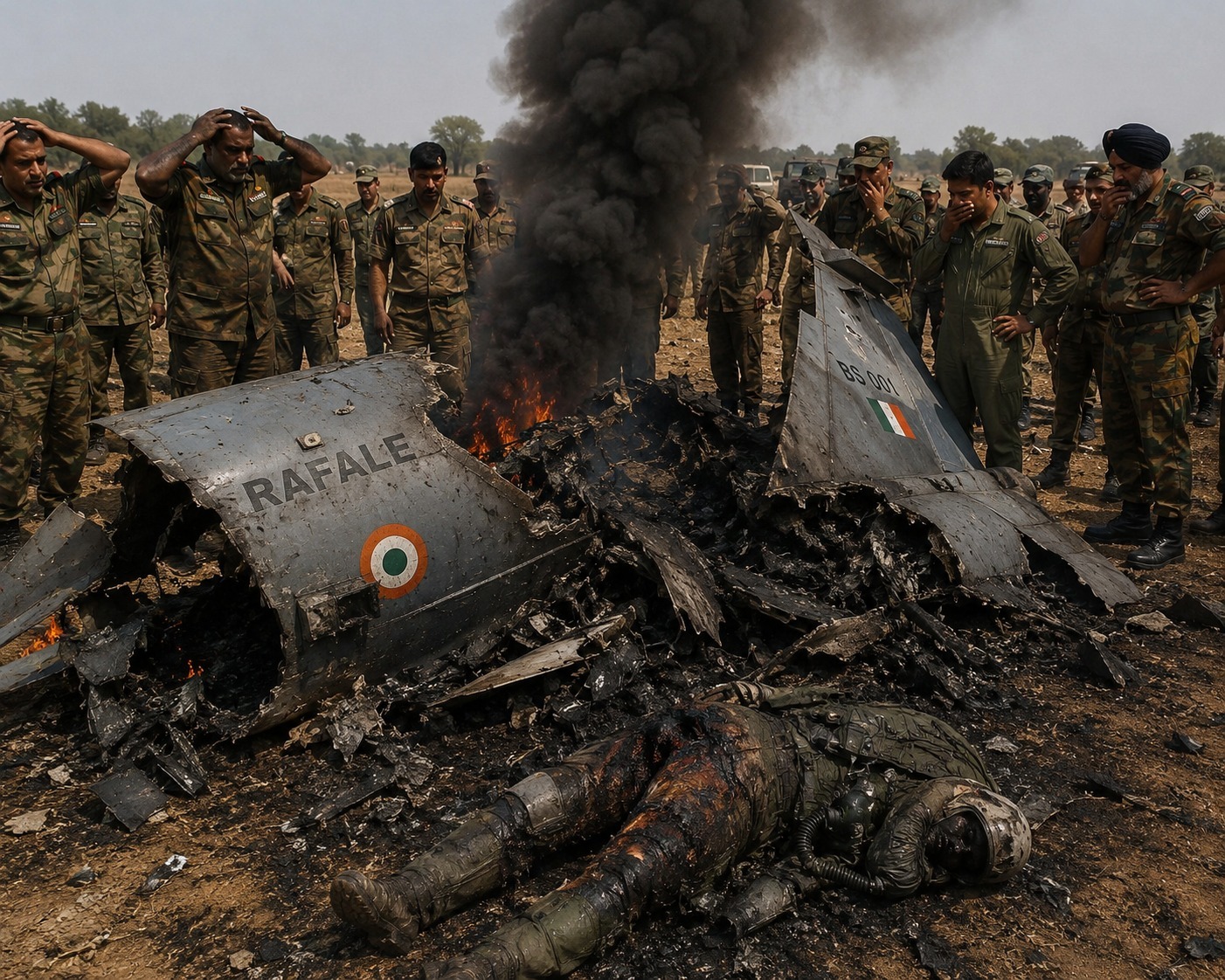
In the aftermath of the May 2025 conflict, French lawmaker Marc Chavent called for a comprehensive upgrade of the Rafale fighter jet’s SPECTRA electronic warfare system following its alleged failure during the clash, citing intelligence from NATO partners and assessments by US defence analysts that the SPECTRA suite failed to detect and jam PL-15E beyond-visual-range (BVR) missiles launched by Pakistan’s J-10C fighter jets. The conflict is now recognised as the largest aerial dogfight in South Asian history, in which the Pakistan Air Force (PAF) maintained its supremacy over the Indian Air Force (IAF) through superior training, technology and tactics. Pakistan shot down seven Indian fighter jets, including four Rafale, one Mirage 2000, one SU-30MKI and one Mig 29.
India’s naval capabilities, including its ambition to maintain a blue-water navy, further illustrate the gap between perception and reality. Although New Delhi operates two aircraft carriers and a sizable fleet of surface vessels and nuclear submarines, its ability to sustain extended maritime operations remains constrained by logistical bottlenecks and limited experience in high-intensity naval warfare. According to Hilal Magazine’s post-May 2025 conflict assessment, the Pakistan Navy’s successful implementation of Anti-Access/Area Denial (A2/AD) strategies restricted the Indian Navy’s freedom of manoeuvre, with Pakistani submarines serving as a powerful deterrent and denying the adversary confidence in its operations.
The rapid expansion of India’s defence partnerships is often portrayed as a force multiplier, capable of amplifying military effectiveness through access to foreign technology, logistics and training. However, these collaborations are primarily transactional and driven by the strategic and commercial interests of external powers rather than a coherent long-term vision for India’s self-reliance in defence. Defence agreements with countries such as Israel, France, Russia and the US have facilitated access to advanced technologies, including precision-guided munitions and unmanned systems. However, the integration of these technologies into India’s existing force structure as part of a network-centric system remains elusive, which led India to face a humiliating military defeat because of Pakistan’s integrated warfare response in May 2025.
India’s increasing focus on emerging domains such as cyber warfare, artificial intelligence, space-based assets and unmanned systems reflects an awareness of modern warfare trends. However, the operationalisation of these capabilities into a military doctrine is still in its nascent stage. Initiatives such as the development of a drone force and indigenous satellite navigation systems have yet to demonstrate their effectiveness in real combat scenarios. The gap between technological acquisition and operational deployment continues to undermine India’s overall military effectiveness. The ORF report notes that, while India’s Ministry of Defence has raised tri-service agencies for cyber, space and special operations, and new battle formations such as the “Rudra” and “Bhairav” units, reflecting a shift towards modular combat groups, similar past attempts at building jointness have delivered only limited results. The gap between India’s stated intent for theatre commands was first emphasised by Prime Minister Modi a decade ago, but the actual implementation underscores a persistent implementation deficit.
Crucially, India’s strategic culture and civil-military decision-making processes further weaken its conventional posture. Political interference, bureaucratic inertia and an over-centralised command structure often delay critical decisions during crises. This affects not only operational tempo but also the flexibility needed to respond to rapidly evolving battlefield dynamics. The tendency to rely on coercive posturing and escalatory rhetoric rather than a coherent military strategy exacerbates these vulnerabilities. The PCI report drew historical parallels, comparing India’s strategic miscalculation in attacking Pakistan to other infamous errors, including Hitler’s 1941 invasion of the Soviet Union.
The narrative of India’s conventional military superiority also fails to account for the evolving capabilities of regional actors and peer competitors, particularly Pakistan. Through focused investments in precision strike capabilities, integrated air defence systems and advanced conventional capabilities, Pakistan has demonstrated its ability to offset India’s numerical advantages. Pakistan leveraged the cohesive jointness of its military systems, including J-10C and JF-17 Block III fighters, PL-15 missiles, localised drone swarms and electromagnetic warfare tactics unified by a centralised Command, Control, Communications, Computers, Intelligence, Surveillance and Reconnaissance (C4ISR) framework. A secure and robust data link underpinned the achievements of the Pakistan Air Force (PAF), enabling situational awareness, network-centric warfare, real-time targeting, and seamlessly coordinated multi-domain operations. Pakistan’s victory in the May 2025 conflict serves as a stark reminder that technological sophistication, operational preparedness, skilled manpower and timely decision-making, rather than sheer size, determine battlefield outcomes in modern warfare.
In essence, India’s conventional military modernisation, while extensive in scale, does not automatically translate into effective combat power. The persistent gaps in doctrine, interoperability, and operational readiness continue to hollow out its much-hyped conventional military superiority. The portrayal of India as an unchallenged conventional hegemon in South Asia is therefore more of a myth than reality.
This myth, however, carries significant risks. By overestimating its capabilities and underestimating its adversaries, India may be inclined towards strategic miscalculations that could threaten regional and international peace and security. The persistence of this inflated perception, coupled with aggressive military posturing, increases the likelihood of conflict in a nuclearised region. To ensure peace in South Asia, it is imperative to reassess the unsubstantiated assumptions underlying India’s military myth critically and to recognise that unchecked ambition, marred by operational incompetence, can have far-reaching and dangerous consequences for the region and beyond.
Leave a Reply