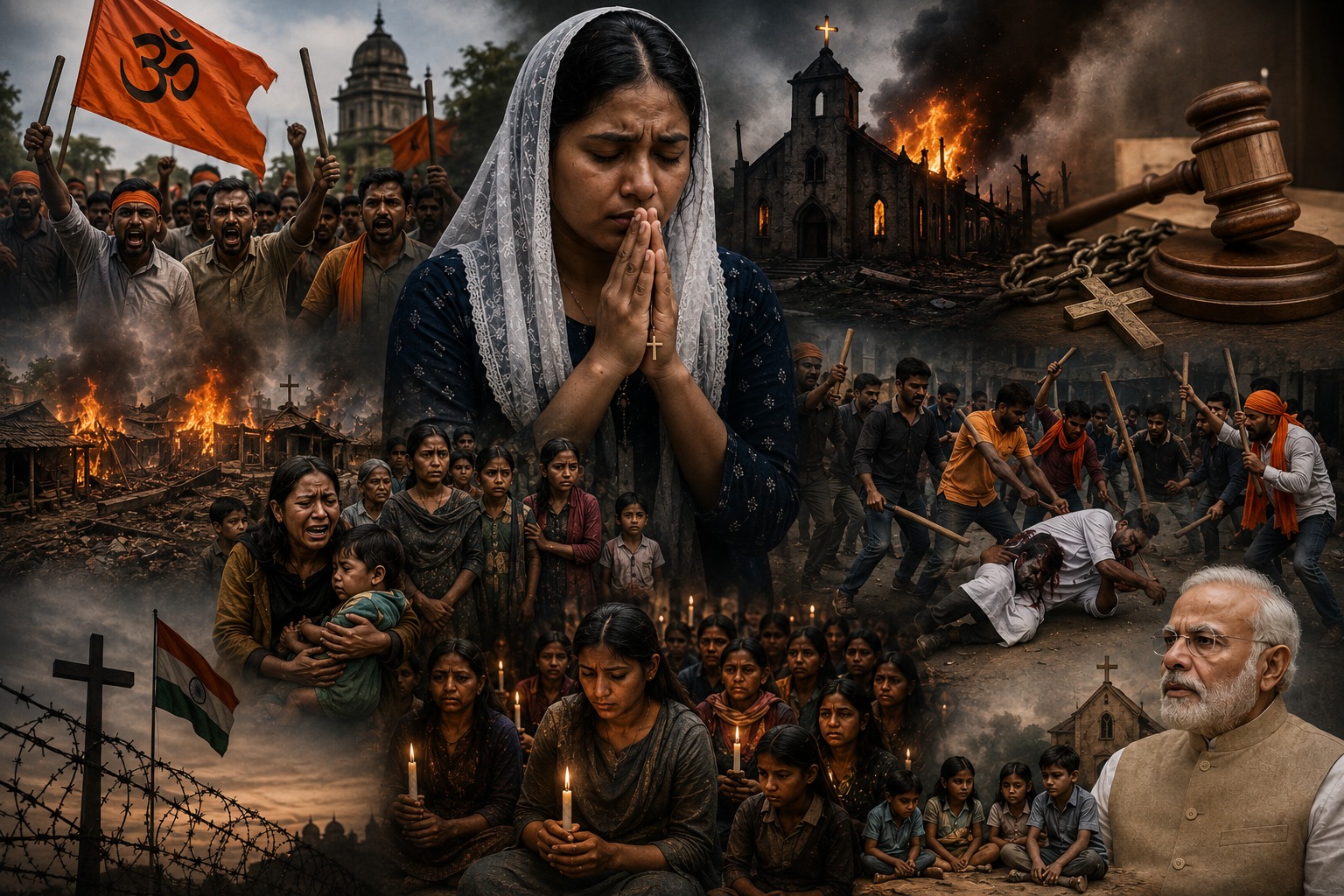
Discriminatory legal frameworks further intensify hostility towards Christians. Despite constitutional guarantees under Articles 25 to 28, which grant freedom of religion, several BJP-governed states have enforced stringent anti-conversion laws. In practice, these laws are often weaponized and misused against Christians, who are falsely accused of converting Hindus to Christianity without credible evidence. Ironically, these laws do not address the issue of forceful conversion of Christians to Hinduism carried out by BJP-linked vigilante groups, thus providing no protection to Christians.
As of 2026, twelve BJP-governed states had enacted such discriminatory laws. In March 2026, the legislative assemblies of Maharashtra and Chhattisgarh passed stricter versions of their anti-conversion laws titled “Freedom of Religion Bills," further tightening their scope. The new bills criminalize religious conversions carried out through force, fraud, allurement, misrepresentation, undue influence or marriage, with severe penalties including prison sentences extending from 7 to 20 years and fines amounting to millions of rupees.
Christian organizations and civil society groups warn that these laws could criminalize legitimate charitable and educational work done by many Christian organizations, such as running schools, hospitals, or relief programs. According to the US-based Progressive Christian Alliance, Chhattisgarh’s new law is about “systematically restricting and criminalizing the legitimate expression of minority faith, particularly Christianity.” The UK’s human rights organization Christian Solidarity Worldwide calls Maharashtra’s anti-conversion bill “not an isolated policy, but a sinister addition to a coordinated machinery that effectively criminalizes personal conscience and undermines India’s diverse social fabric.” It suggests these laws have deepened the economic and social vulnerabilities of Christians.
Moreover, on 24 March 2026, the Indian Supreme Court gave a ruling that people who convert to Islam or Christianity are no longer eligible for Scheduled Caste (SC) status and the reservations that come with it. As a result, they can lose access to job quotas, educational opportunities, and welfare schemes that are meant to address caste-based disadvantage.
Anti-conversion laws have emboldened hardline Hindu vigilante groups, instigating a climate of impunity. Christians accused of conversion activities are often subjected to harassment and assaults by extremist mobs. In an incident highlighted by USCIRF in its press release in January 2026, a Christian pastor named Bipin Bihari Naik was brutally assaulted by a mob in Odisha on 4 January 2026 while offering Sunday prayers. He was dragged outside, beaten, and humiliated under allegations of forced conversion. According to the USCIRF, “Vigilante mobs have repeatedly wielded allegations of forced conversion to justify the arbitrary detention and horrific attacks against religious minorities.”
Beyond legal marginalization, Christians in India are subjected to mob attacks during their cultural and religious festivals. On the eve of Christmas in December 2025, numerous incidents of vandalism, harassment and physical intimidation were reported across multiple states, including New Delhi, Madhya Pradesh, Assam, Uttar Pradesh, Kerala, Telangana, Chhattisgarh, Haryana, Gujarat and Uttarakhand. Groups linked to the ultra-nationalist RSS disrupted Christmas celebrations, further intensifying fear among Christian communities. On 23 December 2025, at a Christmas festival meal arranged for the disabled in the Jabalpur district of Madhya Pradesh, a BJP leader, Anju Bhargav, assaulted a blind Christian woman and insulted her by saying, “blind in this life and will remain blind in the next.” Ironically, during a visit to a church in New Delhi on 25 December 2025, Prime Minister Narendra Modi did not publicly condemn any incident, highlighting a stark contrast between his symbolic outreach and the ground realities of religious minorities in India.
India is also witnessing a surge in anti-Christian rhetoric propagated by BJP leaders, which is increasingly normalized within public discourse and often serves to incite violence against Christians. According to the Report 2025: Hate Speech Events in India, released by India Hate Lab, a project of the Center for the Study of Organized Hate, nearly 162 incidents of anti-Christian hate speech were documented across India in 2025, representing a 41 percent increase from the previous year. A significant proportion of these incidents occurred in BJP-ruled states. The report further identified Vishwa Hindu Parishad and Bajrang Dal, both affiliated with the RSS, as the leading organizers of such hate speech events.
For decades, India has boasted of being a secular state. However, religious discrimination and majoritarian politics have turned India into an exclusionary state where secular principles are eroding, and the politics of Hindutva extremism and terrorism are growing. According to the UK-based Release International Persecution Trends Report 2026, the situation for Christians in India may worsen in 2026. It warns that there could be an increase in arrests and violence against women, more Christians may face imprisonment, while others could be forced to leave their homes due to rising excesses and insecurity. It also highlights that “bans on religious activities such as evangelism, church gatherings and even private worship are likely to continue.”
The report reveals that many believers may struggle economically, as they could be excluded from jobs, markets, and agricultural opportunities, especially in a politically charged environment shaped by local and state elections.
To conclude, the Christian community in India faces a serious threat under the Hindutva-driven government led by PM Narendra Modi. The systematic marginalization of Christians and other minorities demonstrates that the “world’s largest democracy” is rapidly shifting towards a Hindu-majoritarian state. As Indian veteran journalist and writer Arundhati Roy argues, Hindutva is a political project that seeks to turn India into a Hindu state. According to the USCIRF, “In 2026, religious freedom in India remains on a downward trajectory, with the government tolerating particularly severe religious freedom violations”. This trajectory is likely to persist, as it is deeply entrenched within Indian society and continues to perpetuate structural violence against minorities, including Christians.





Leave a Reply