The China-Pakistan Economic Corridor (CPEC) is the flagship project of President Xi Jinping’s Belt and Road Initiative (BRI) and is the unmistakable symbol of this abiding friendship. It occupies a pivotal position in the development agenda of Pakistan. CPEC has immense strategic significance for Pakistan and has already helped Pakistan lay a strong infrastructure for subsequent development of our industry, agriculture and human resource. Pakistan is one of the earliest supporters and participants of the New Silk Road concept symbolized by the Belt and Road Initiative. We emphatically endorse the philosophy of BRI which seeks to transcend the artificial divides between the nations and lay bridges for closer economic integration for common benefit and well-being.
Pakistan became the third non-communist country, and the first Muslim one, to recognize the People’s Republic of China opening the way for other Muslim countries.
As a flagship project of the BRI, the China-Pakistan Economic Corridor has already achieved phenomenal success by laying a solid foundation of infrastructure in energy and transport sectors. Building upon this foundation, Phase II of CPEC would now focus on socio-economic development and poverty alleviation for robust, sustainable and inclusive growth for Pakistan and the whole region. The ever-increasing economic and trade integration between Pakistan and China has made our two economies increasingly inter-dependent, especially in the context of CPEC. This is a long-term bilateral economic project encompassing a vast array of short, medium and long-term projects. Despite the COVID-19 epidemic, there was no suspension of trade flows and transportation linkages between Pakistan and China. The overall impact of the pandemic on CPEC was too marginal and meagre to merit any serious thought.
The viral infection tested the effectiveness of the Chinese political system, endurance of the Chinese economy and resolve and determination of the Chinese people. The COVID-19 epidemic was also a test for Pakistan and China. As an Iron Brother and most reliable partner, Pakistan decided to stand by China in this hour of crisis and offered utmost help and assistance to our Chinese brethren to fight this epidemic. In a show of unanimous support and sympathy with China, the President paid a visit to China at the height of COVID-19 In his meeting with President of Pakistan. In his visit, President Xi Jinping beautifully summed up our bilateral cooperation when he remarked, “Fire is the test of gold”. Our friendship has truly emerged as gold from the fire of COVID-19 pandemic. The visit of the President was a reaffirmation of an unequivocal commitment that the strength of Pakistan-China ties remains unaffected by domestic challenges or adverse global upheavals.
Looking at the future, more robust, inclusive and all-encompassing relations between the two countries would not only serve their best interests but would also ensure peace and stability for the entire region. Both Pakistan and China are cognizant of the new and emerging challenges within and arising from economic-political and geo-strategic realignments. In view of these developments, both countries should aim to build a closer and more meaningful ‘Pakistan-China Community of Shared Future in the New Era’ in line with the principles set forth by the Treaty of Friendship, Cooperation and Good-neighbourly Relations between the People’s Republic of China and the Islamic Republic of Pakistan signed in 2005, the Joint Statement of November 2018 and other bilateral documents focusing on long-term development of relations.
Pakistan and China are both aware of their respective national challenges, and external variables in the form of global threats including unanticipated military conflicts, global recession or financial crises, disruptions in energy supply lines, or determined efforts by countries, individually or within broad coalitions, to halt regional and inter-regional connectivity through BRI, coupled with unilateralism, protectionism and unilateral coercive measures. Pakistan and China are also mindful of common regional issues such as widespread unemployment, changes in rainfall patterns and river flows, sea level rise, the melting of the Himalayan glaciers that feed most Asian continental river systems, and the increasing scarcity of the fresh water resources and should try to cooperate in these areas to address these issues.
In this context, it is important that both countries should aim to raise the existing level of “All-Weather Strategic Cooperative Partnership” to new heights with comprehensive regional and global partnership and strategic interaction and alignment, to meet the challenges of the new era, while adhering to the development goals and aspirations of the two people through a comprehensive and forward looking plan of action. It is also important to carefully study China’s strategy for socio-economic development and poverty alleviation and draw lessons from it.
In view of the emerging geostrategic and geo-economic considerations, it is imperative for Pakistan and China to strategize for the next several decades. In my view it would be crucial for Pakistan to agree on a framework for Cooperation till at least 2050. China, from a regional and global influencer, will become a major power in the new international order by 2050. By 2035, China’s GDP will be about $30 trillion, accounting for 25% of the world’s GDP. With the realization of the “China Dream”, it is expected to accomplish great rejuvenation by 2050 and reclaim its historical position in the global system as a millennial civilization with a long-term strategy for achieving inclusive growth and sustainable development in the region and beyond. It is important to set out clear goals and expectations, to be translated into a concrete road map and coherent strategy for balanced human, social, and economic development that would substantially contribute to regional peace and stability
Conflicting alignments of the over three dozen littoral states, the Indian Ocean is critical to global trade, security, geopolitics and geo-economics. As countries compete for influence in its crowded waterways, how will the new power dynamics play out? The U.S-China competition and Pakistan-India rivalry are issues that are gaining significance and urgency by the day. This competition will further endanger the stability of the region, which is significant for global maritime trade. This growing interest of the major powers and the U.S.-China competition in IOR [Indian Ocean Region] has serious implications for Pakistan. As the dynamics of world politics change, the IOR has become the real theatre of competition between the Western powers and China, and let me add, Russia, to the mix. It has become an integral part of international power dynamics. This needs a coordinated Pakistan-China strategy to counter.
The U.S. House Speaker Nancy Pelosi’s visit has also triggered a new round of tensions, increased suspicions and made the danger of a military conflict over Taiwan far greater than at any time since the China-U.S. rapprochement in 1971. There is a dangerous situation brewing in the Taiwan straits since the visit of the U.S. House Speaker, which the Chinese see as a deliberate provocation by the U.S. It has added another element of uncertainty, instability and chaos in the already worrying and unpredictable flux in the world order prevalent these days.
In order to save the world from yet another devastating conflict, both the U.S. and China need to reaffirm the basic principles of their long-held and shared understanding over Taiwan and adhere to the one-China policy as enshrined in the UNGA Resolution. The danger of a military conflict would be disastrous as China is now almost at par with the U.S. and is a far more formidable military adversary then before. It is also a fact that such a confrontation would throw up challenges for countries who are already situated in turbulent region and are desirous of maintaining good and stable relations with both the U.S.A. and China. It is, therefore, in the interest of humanity that such a devastating conflict is avoided by both sides. Maintenance of peace and security in the South China Sea is the collective responsibility of all parties.

Campaigning!
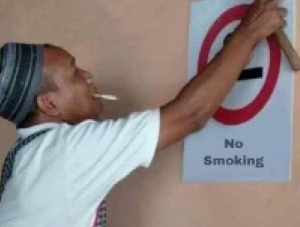 The manner, in which this man is campaigning against smoking, is the same as the one adopted by many governments to campaign against corruption.




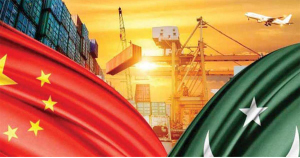 Last year Pakistan and China celebrated 70 years of cooperation and friendship between two iron brothers. In the same year, the Communist Party of China (CPC) celebrated 100 years of its creation and China proudly achieved the first centennial goal of the elimination of extreme poverty, perfected 5G technology, landed a rover on Mars, landed on the dark side of the moon, won the peoples war against COVID-19 and emerged as the only country with a strong bounce back of economy showing impressive positive growth.
Leave a Reply