

Larkana
Mismanaging a Disaster
Pakistan today faces one of the worst natural disasters of its existence but administrators hide behind shortage of resources while politicians play their own games.

“No country deserves this fate, but particularly not countries like Pakistan that have done almost nothing to contribute to global warming.” - UN Secretary-General António Guterres
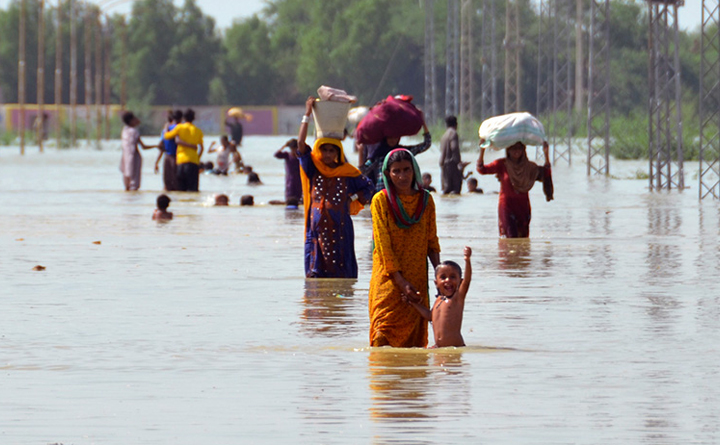
This year the monsoon rains in Pakistan have been more than a natural annual occurrence as they have hit the country with such intensity that over half of it is inundated. The rains and subsequent flash floods have literally wreaked havoc, affecting more than 33 million and killing hundreds of people (over 1300 were dead as of 8 September, 2022). Besides, in this devastation, about 2 million houses have collapsed; almost 800 thousand cattle heads have perished; thousands of acres of cash crops have been destroyed, and thousands of kilometres of roads have also been swept away. The numbers are constantly on the rise as new areas of devastation are discovered. To put the losses in economic terms, the cost for this destruction has been initially estimated to be over $10 billion.
Given the scale of the disaster, it warrants extraordinary measures both from federal and provincial governments. However, sadly the performance of the governments has been quite abysmal as their response to the catastrophe has been grossly inadequate, uncoordinated, and ineffective. While the Balochistan government can be partly excused for its poor performance because of its scarce resources, other governments such as Sindh, Punjab and KPK have truly let their people down.
Those in northern Sindh have been left to fend for themselves. The apathy of the PPP leaders, including Bilawal Bhutto Zardari, Murad Ali Shah, Manzoor Wassan and Nasir Shah has been quite evident in these days. They have failed the people of the province. Initially, they were unable to rescue the stranded individuals. Now when people are sitting under the open sky, there are little visible efforts at providing relief to them. Very few ration bags and tents have been distributed. In many cases, these items were given to the MNAs and MPAs for onward distribution but they favoured their relatives, sycophants and influential people.
The performance of other provincial governments has also been no different. The harrowing footage of five stranded men, who were reportedly brothers, being washed away by gushing flood waters in Charsadda, when a helicopter failed to arrive to their rescue, even after 4 hours of waiting should reveal the performance of the KPK government.
There were also harrowing scenes of hotels and houses being simply razed to the ground by the rushing water, like a house of cards. One person said he had stayed in one of those hotels very recently and couldn’t believe they were so flimsily built. The destruction came because the construction was right along riverbanks even on river beds. They pity is that the greedy owners and concerned authorities were never ready for such an eventuality.
The result was that thousands of people were pushed to the roads and embankments, under the open skies. They did not have access to safe drinking water and not much else to survive on. Many of them were living on what they got from charitable organisations, relatives, social workers and activists who launched campaigns to collect donations. But the aid provided by individuals and organisations was not enough and what was badly missed was the absence of the state’s efforts.
Instead of taking responsibility, the federal and provincial governments expressed their inability to cope with the crisis on their own. This forced Foreign Minister Bilawal Bhutto and Prime Minister Shahbaz Sharif to repeatedly appeal to the international community to step in and help Pakistan.
To many, and rightly so, the abnormally heavy rains were nothing but a clear manifestation of what climate change means. Although Pakistan contributes less than one per cent of the world’s combined greenhouse gas emissions, it is the eighth most vulnerable country in the world. The neighbouring countries such as Afghanistan and India are also vulnerable. But the situation for them is not as bad as it is for Pakistan.
People are quite indignant at the governments’ inefficiency to deal with such disasters. They believe that the enormous destruction could have easily been averted, or at least the losses minimised.
This is not the first time that Pakistan has faced such large scale devastation because the country has already witnessed destruction from floods and monsoon rains in past years. The super floods of 2010 are a case in point. But we have not learnt any lessons. In fact, we as a nation have lagged behind as our administrators have failed to take necessary measures such as increasing the storage capacity to store surplus water, and clearing the obstructions standing in the pre-existing natural course of rivers and tributaries.
As is customary, the civil authorities run to the armed forces for help in men and materials. The National Disaster Management Authority (NDMA) and the Provincial Disaster Management Authority (PDMA) don’t seem to figure anywhere and all that is visible is NGOs and the soldiers.
People are quite indignant at the governments’ inefficiency to deal with such disasters. They believe that the enormous destruction could have easily been averted, or at least the losses minimised to a large extent, had the government delivered. All that the people got was crass mismanagement on the part of authorities. This was certainly not a “divine calamity” as propagated by some politicians.
Some even express resentment at the authorities’ failure to build dams and other water reservoirs. Building dams across the country has always been sorely needed. However, those who are demanding more water reservoirs today overlook the fact that this time it is actually the dams which have multiplied the devastation. For example, several dams in Balochistan could not sustain the water pressure due to faulty infrastructures which simply collapsed, thereby wreaking havoc. It is because of these collapsed dams that significantly large parts of Balochistan and north-western Sindh were submerged by the water. So, building dams is not the only solution to our problems as the quality of infrastructure is also equally significant. Hence, the presence of dams with improper infrastructure is more dangerous than their absence.
The devastation should be a last reminder for Pakistan to correct its course. It is about time authorities realized that their failure to take necessary measures would risk the future of the country. Pakistan can no longer afford disasters like the present one. If this sort of apathy continues, Pakistan will soon turn into a vast wasteland.
It is true that the country is under-resourced to tackle disasters and the fast-multiplying population (nearly 25 crores) is making things more difficult. At present, the country needs about 10 billion dollars to carry out relief and rehabilitation work. The international community and intergovernmental organisations must help Pakistan to not only deal with the present crisis, but also assist it in developing strategies to avert such climate-induced catastrophes in the future. The developed world must also take responsibility for this because of their greenhouse gas emissions and it is now incumbent on them to step forward and help Pakistan. ![]()

The writer is a freelance columnist based in Larkana. He can be reached at sjatoi831@gmail.com


Leave a Reply