



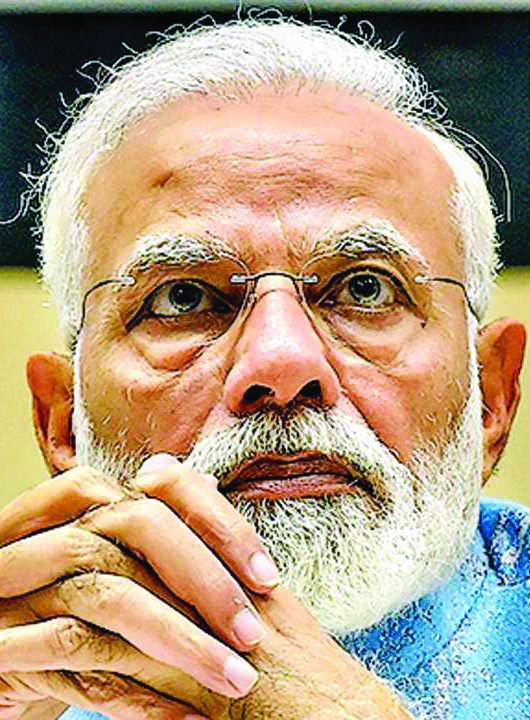
 “Achey din aane wale hain” was the Hindi slogan of the Bharatiya Janata Party for the 2014 Indian general election. The slogan was coined by the BJP's Prime Ministerial candidate Narendra Modi to convey that a prosperous future was in store for India if the BJP came into power. Narendra Modi, then running for prime minister, had come forward in 2014 promising liberation. But five years later, with Mr. Modi seeking re-election, villagers looked at him with a mix of disgust and resignation. The prime minister has drawn praise for paring India’s legendary bureaucracy. He has altered perceptions that his country was hostile to business. But he has failed to spur significant economic growth, in part because of his disappointing record in reviving stalled infrastructure projects. The prime minister has championed rail, road and electrical links as a means of furthering development across a country of 1.3 billion people.
Although road-building has proceeded aggressively, infrastructure overall has fallen short. During 2018, investments in new projects slumped to their lowest level during Modi’s tenure, according to the Center for Monitoring Indian Economy, an independent research organization in Mumbai. For starters, India is experiencing its most severe economic slowdown in three decades. At the World Economic Forum in Davos, Switzerland, India’s commerce minister assured global economic influencers that India’s economy was “poised to take off.” This rings true only because the vaunted Indian economy appears to be bottoming out, with no place to go but up. But there is a second, more worrisome reason for the lack of buzz. Modi’s ruling Bharatiya Janata Party has long propagated two core ambitions: building a culturally Hindu-centric nation and aggressively advancing India’s economic development.
India’s present economic woes are multifaceted. The country’s gross domestic product may grow at 5 percent in the current fiscal year. It’s the most sluggish pace in 11 years. Growth has slowed to such an extent that the International Monetary Fund has slashed its estimate for global growth based on India’s subpar performance. India’s investment cycle remains moribund, with the number of stalled capital investment projects nearly at a record high. Inflation has spiked to nearly 7.5 percent, fueling concerns of “stagflation” and scuttling hopes that India’s central bank will cut interest rates. Layered on top of this financial crisis is a consumption slowdown, partially precipitated by an overly complicated new nationwide goods and services tax that has snarled small businesses, resulting in severe revenue shortfalls. The ill-advised 2016 gambit to “demonetize” the economy by invalidating high-denomination currency notes in a quixotic attempt to curb “black money”, wreaked further havoc on India’s outsized informal sector. Together, these measures are partly responsible for a decline in household consumption for the first time in 40 years, according to government data.


The writer is a legal practitioner and columnist. He tweets @legal_bias and can be reached at shahrukhmehboo4 |
|
Cover Story
|
|
Special Editorial Feature
|
Region
|
|
News Buzz
|
Update |
Leave a Reply