Malé
India Out!
The Maldives should be wary of the manner in which India is increasing its influence in the region.
There are no two opinions about the fact that India wants to stamp the South Asian region with its hegemonic impact. It feels justified in doing so because it has the world’s largest population or is at least close to it and has one of the largest land masses in Asia and the world. To top it off, it is encouraged by world powers in its hegemonic ambitions. This is why it is trying to extend its sphere of influence beyond its own borders.
The Maldives is one of the regions, with proximity to India, where it desires to establish its influence. However, a campaign has taken root in the Maldives to expel Indian influence from the country.
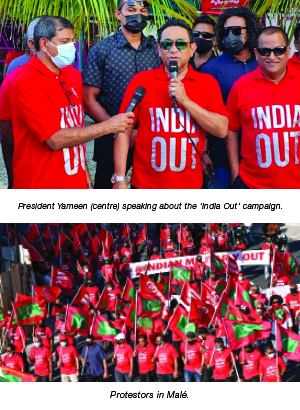
On November 12, 2021, thousands of protesters took to the streets of the Maldivian capital, Malé, calling for an end to the Indian military presence and interference in the domestic affairs of the country. The crowd chanted “Indian military out,” making it one of the largest ever political protests in the country. Similar protests were also witnessed elsewhere, including Fuvahmulah City, where thousands gathered on November 14, 2021. Despite the Maldivian government’s efforts to ignore and downplay the protesters’ demands, the hashtags “India out,” “Indian military out,” and “Defend Maldives” have since become leading trends on social media in the Maldives.
More and more people and political parties in the country have now joined the “India Out” campaign, which is led by former president Abdulla Yameen. He contends that the campaign is aimed at ensuring the independence of the Maldives. Yameen’s involvement in the growing “India Out” movement could see a rise of anti-India and nationalistic sentiments in the Maldives ahead of the country’s 2023 presidential election. In these circumstances, government crackdowns that see protesters arrested or injured in clashes with security forces could also draw further support for the opposition, even in urban areas.
Under the current President Ibrahim Mohamed Solih, the Maldivian government has also signed a secret agreement with New Delhi, allowing for Indian military personnel to be stationed in the Maldives, enjoying full diplomatic immunity and tax exemptions.
President Solih’s unprecedented tilt towards India and the very fact that he has compromised the sovereignty and integrity of the Island nation through secret defence agreements are the developments that have triggered the “India Out” movement.
Pakistan has helped the Maldives in various fields such as education, defence, and commerce unconditionally, while letting them maintain their free will and sovereignty in conducting their internal affairs.
The Solih government was quick to condemn the “India Out” campaign, reaffirming the Maldives’ policy priorities regarding India as an important neighbour and strategic development partner. Security forces were instructed to deal with “India Out” campaigners with a heavy hand, but despite this the campaign has gained momentum. This was evident from the fact that in June 2021, India’s High Commission in Malé asked the Maldivian government to take steps to protect the High Commissioner and diplomatic personnel from “malicious” and “personal” articles in the local media. The letter further emphasized ensuring the safety of its diplomats and action against the spread of misinformation about India in the local media. In July 2021, security at the Indian embassy was strengthened after bomb threats circulated on social media.
Pakistan and the Maldives are two important countries of South Asia. Both enjoy cordial bilateral relations. The religion in both states is Islam. Both countries are members of the Organization of Islamic Cooperation (OIC) as well as members of the South Asian Association for Regional Cooperation (SAARC). Pakistan was among the first few countries to recognize the Maldives as a sovereign state in 1965. Ever since, Pakistan has helped the Maldives in various fields such as education, defence, and commerce unconditionally, while letting them maintain their free will and sovereignty in conducting their internal affairs. Since both states have had interpersonal contacts spanning centuries, the Islamic identity and sovereignty of the Island nation is of utmost importance to Pakistan.
It is clear that by installing a pro-Indian puppet regime in Malé, India is converting the Maldives into an Indian satellite state. By securing military bases in the Maldives, apart from controlling the sea lanes of communication in the Indian Ocean, Indian policymakers are now thinking of having a nuclear strategic footprint in the archipelago. Similarly, India is also working on an agenda of creating political unrest and secessionist movements in the country. This is aimed at providing an excuse to New Delhi to have a permanent presence in the region, which could ultimately lead to the absorption of the Maldives into an Indian Union, as India did in the case of Indian Illegally Occupied Jammu and Kashmir and Sikkim. India’s nefarious designs for the Maldives could have far-reaching consequences for the security and stability of South Asia.![]()

This article is condensed from a piece written by Vice Admiral (R) Wasim Akram for Hilal, Pakistan. He can be reached at waseemakram55@hotmail.com


Leave a Reply