



 There are no two opinions about the fact that India wants to stamp the South Asian region with its hegemonic impact. It feels justified in doing so because it has the world’s largest population or is at least close to it and has one of the largest land masses in Asia and the world. To top it off, it is encouraged by world powers in its hegemonic ambitions. This is why it is trying to extend its sphere of influence beyond its own borders.
The Maldives is one of the regions, with proximity to India, where it desires to establish its influence. However, a campaign has taken root in the Maldives to expel Indian influence from the country.
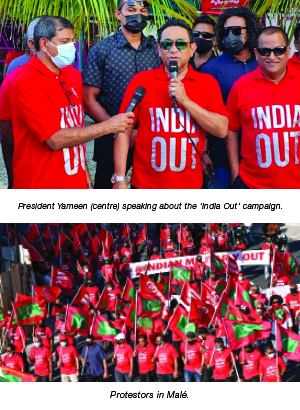
On November 12, 2021, thousands of protesters took to the streets of the Maldivian capital, Malé, calling for an end to the Indian military presence and interference in the domestic affairs of the country. The crowd chanted “Indian military out,” making it one of the largest ever political protests in the country. Similar protests were also witnessed elsewhere, including Fuvahmulah City, where thousands gathered on November 14, 2021. Despite the Maldivian government’s efforts to ignore and downplay the protesters’ demands, the hashtags “India out,” “Indian military out,” and “Defend Maldives” have since become leading trends on social media in the Maldives.
More and more people and political parties in the country have now joined the “India Out” campaign, which is led by former president Abdulla Yameen. He contends that the campaign is aimed at ensuring the independence of the Maldives. Yameen’s involvement in the growing “India Out” movement could see a rise of anti-India and nationalistic sentiments in the Maldives ahead of the country’s 2023 presidential election. In these circumstances, government crackdowns that see protesters arrested or injured in clashes with security forces could also draw further support for the opposition, even in urban areas.

This article is condensed from a piece written by Vice Admiral (R) Wasim Akram for Hilal, Pakistan. He can be reached at waseemakram55@hotmail.com
Leave a Reply