



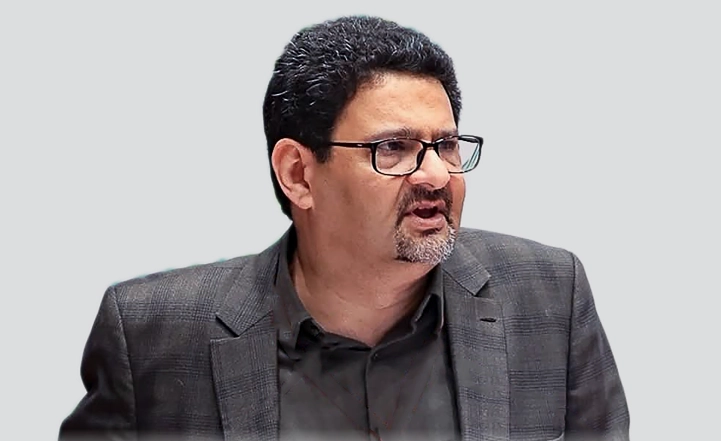
Dr. Miftah Ismail holds a PhD in Public Finance and Political Economy from the Wharton School of Business, University of Pennsylvania. He is a professional economist, worked at the International Monetary Fund (IMF), and has served in leading positions with various public and private companies, such as Sui Northern Gas Company Pakistan, Pakistan International Airlines Corporation, Punjab Board of Investment and Trade, Ismail Industries Ltd, Candyland Confectionery, and Astroplastics (Pvt) Limited. He is the president of Karachi American School, a member of the Advisory Committee of the Institute of Business Administration (IBA), Karachi, and its visiting faculty member.
SouthAsia: How would you assess Pakistan’s current economic situation, and what are the key challenges the government must tackle?
Dr. Miftah Ismail: The biggest issue with the current economic situation is that the average Pakistani has become poorer over the last three years, and per capita GDP has also declined yearly. This means that the purchasing power of Pakistanis has gone down, which is the biggest challenge this government must address. It has to try to reduce unemployment and increase the average income.
Q: Do you think Prime Minister Shehbaz Sharif’s economic policies are taking Pakistan in the right direction? Where do you see room for improvement?
A: Shehbaz Sharif’s government is not taking Pakistan in the right direction. Yes, we do have economic stability that we did not have three years ago but that’s mainly because firstly the international oil prices have come down and thus the pressure on our current account is reduced and secondly because the high interest rates maintained by the State Bank over the last two years have reduced aggregate demand and also diminished the demand for imports. In this curtailed demand scenario, therefore, macroeconomic stability has been achieved. Still, the country’s people are getting poorer every year, and a lot needs to be done in terms of structural reforms before we can again embark on a growth strategy. The growth strategy, along with much-needed reforms to bring about growth, is where Shehbaz Sharif’s government has completely failed this country.
Q: Pakistan’s debt continues to rise. What steps should the government take to manage and reduce this burden effectively?
A: Pakistan’s debt has been going up for the last few years under various governments, including the PPP, the PML-N and the PTI and now under the PDM-led government and unless and until we make structural changes including for instance reducing the share of money that goes to the provinces through the NFC award and unless we decrease the size of all governments, we will not be able to reduce our expenses and hence we will not be able to reduce the overall deficit, which contributes to our debt every year. The fact that we’re already taxing our corporations at 61%, the fact that we’re already taxing our individuals at 38.15% and our business individuals at 49.5% suggests that there is not much room to increase tax rates, and so the only thing left now to do is to try and reduce government expenditures. Still, the government is unwilling to do this.
Q: Inflation is a major concern for Pakistanis. What are the primary causes, and how should the government address them?
A: There are two causes for the recent inflation in Pakistan. One is the rapid devaluation of the Pakistani rupee against the dollar, which made imports more expensive, and the second is an increase in international commodity prices, especially oil prices. Then, of course, between September 2022 and February 2023, we kept the rupee artificially inflated at 229 or 230, and then, when we had to let go. The rupee went to 270 a dollar, and the government could not manage it properly. The dollar went to Rs 310, bringing in a lot of inflation as high as 38% in some months. But now the rupee is stabilised, so commodity prices have decreased, which has helped. So, the question remains: why was the rupee devalued against the dollar so rapidly? To find the answer, you have to go back to the fact that we have had deficits over so many years, and we’ve been printing money to fund those deficits, and if you print money, of course, the value of your rupee will go down, and this then reflects in the exchange rate. Also, we tried to stop exchange rates from naturally devaluing, but once you stop it for a little while, you can only hold it for so long, and then when you have to let it go, the rupee value plunges.
 Q: What key economic reforms are necessary for long-term stability in Pakistan?
Leave a Reply