



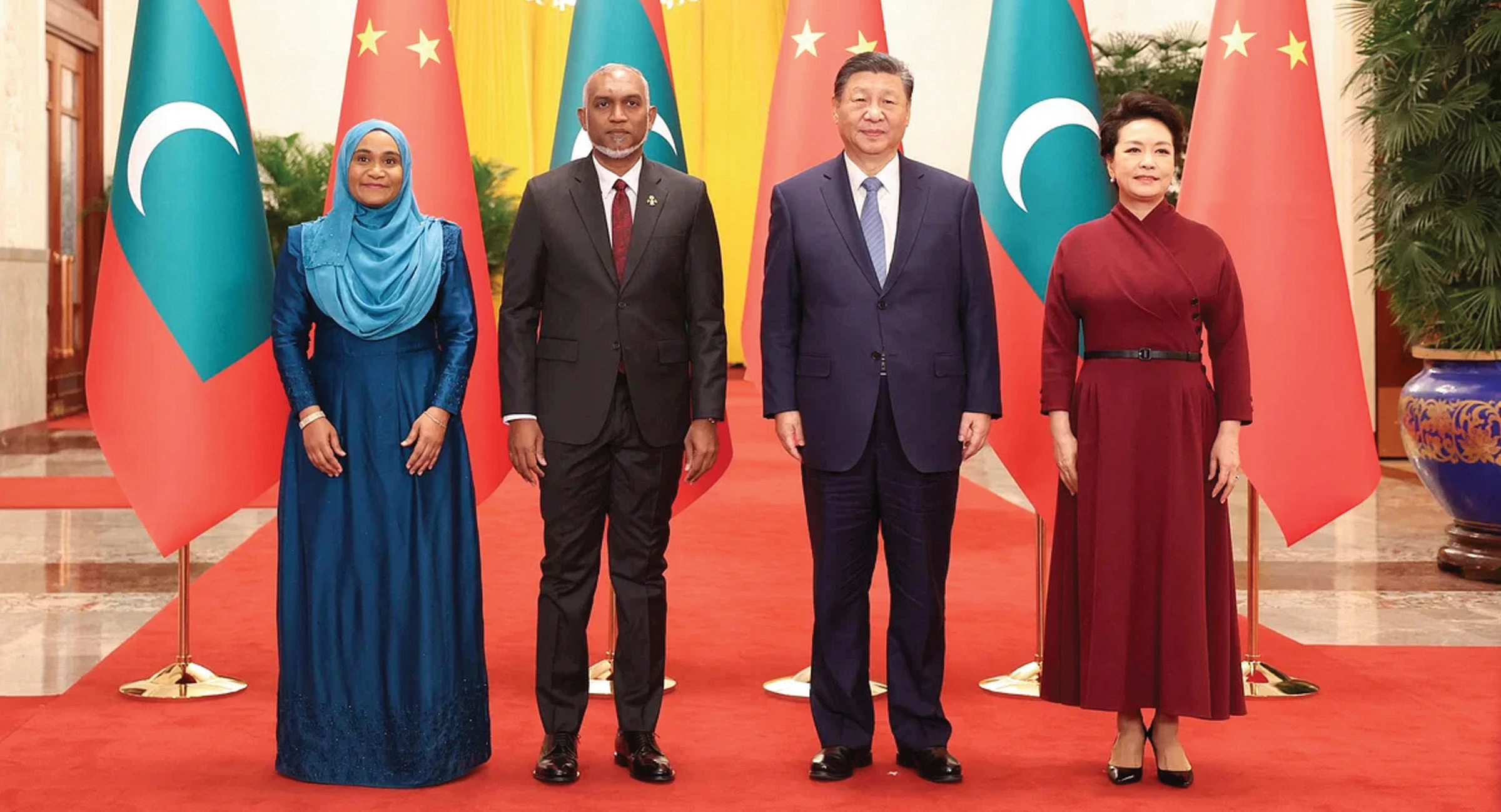
The Maldives, located in the Indian Ocean, has long been where internal politics and foreign relations are inextricably linked, influencing the country’s growth trajectory. Since attaining independence from Britain in 1965, the Maldives has pursued a foreign policy based on the ideals of sovereign equality, non-interference, and diplomatic problem-solving, cultivating cordial relations with countries across the world.
However, the situation has shifted in recent years, with economic problems, geopolitical conflict, and new leadership affecting the country’s foreign policy. Economic success, powered chiefly by its thriving tourist sector, has been a pillar of Maldives’ growth, contributing considerably to government revenue.
Nonetheless, the country has faced economic issues resulting from global market changes, health catastrophes like the COVID-19 pandemic, and the impending threat of climate change. In the face of these problems, the Maldives has become more reliant on foreign funding to maintain its growth pace, resulting in rivalry among big donors to become the country’s preferred partners in massive infrastructure projects.
China’s strategic participation is central to this struggle, and it has made significant investments in important infrastructure projects in the Maldives. While these initiatives offer local advantages, such as constructing the first ocean bridge connecting Malé to other islands, they have also raised regional concerns, notably in neighbouring India. India, a long-standing friend of the Maldives, has expressed concern about China’s rising influence in the area, fearing a shift in the balance of power that may jeopardise its strategic interests.
The Maldives’ foreign policy environment has shifted dramatically as successive administrations struggle to balance domestic interests and regional factors. Former President Abdulla Yameen had a China-centric policy, embracing Chinese investment despite widespread worries about debt and suspected corruption. In contrast, his successor, President Ibrahim Mohamed Solih, pursued the “India-First Policy,” which aimed to deepen ties with India and get funding for infrastructure projects. However, widespread dissatisfaction with unfinished projects and alleged Indian intervention in internal matters contributed to Solih’s electoral loss in 2023. Amid these upheavals, the Maldives is led by President Dr. Mohamed Muizzu, who took office in November 2023.
Muizzu ran his campaign on a platform of strong promises and slogans, such as “India out,” which claimed that hundreds of Indian soldiers were stationed across the Maldives. Asserting that the previous government was complicit in handing over a significant portion of the southern economic zone to Mauritius, another pledge was to reclaim what was believed to be Maldivian territorial waters that Mauritius had taken; in reality, this was the outcome of an International Tribunal on the Law of the Sea (ITOLS) ruling that gave the Maldives a larger share of the disputed maritime area. It was said that a letter written by President Salih to the President of Mauritius led to this agreement.


The writer has done his Masters in Defence and Strategic Studies. He can be reached at daniyaltalat2013@gmail.com
Leave a Reply