Interviews with older generations of the fishing community show their trust in the state that the community kept for their economic livelihood while maintaining a positive attitude toward resettlement orders by first the colonial government and later the national government from their original locations to peripheral coastal areas, allowing city development. They mention that it was a positive development, and they did not see much to lose since they were given some compensation or basic infrastructure. Moving out, however, has made them politically excluded from the development equation. The fishing community has original settlers and migrants from Sindh, Balochistan, Kutch, and Gujrat. Thus, these neighbourhoods carry clear ethnic divisions.
A lopsided distribution of resources in varying locations indicates a lack of political support and marginalization experienced through cultural representation and access to decision-making bodies of government and organizations. Structural barriers, including a lack of political involvement, have developed practices of diminished autonomy and choices available to community members, given their identity.
The process of peripheralization of the fishing community highlights their marginalization of the basis of identities, associations, culture, and environment. Questions of sustainable management of water resources have emerged as forthcoming issues of climate change, pollution, and waste management. The state of fishing communities and their numerous issues have exacerbated their economic situation, adding a layer of complexity to the above. Their strategic location must be acknowledged to see them as primary stakeholders that must be a part of solutions or any process oriented to address the above, gaining direct benefit through any upgrade process of up-gradation.
The sustainable management of water resources is a global issue increasing in scale due to several factors. These include population growth, urbanization, pollution, unsustainable water resources management practices, and climate change, among other things.
Broadly, fishing communities can be classified as situated on mainland coastal, riverfront, and islands. At the same time, there are many common issues related to environmental degradation and fishing practices; the communities on the island face particular problems due to their detached location.
Catching small fish has become a cheap source of chicken feed and is allowed through policy, leading to significant environmental degradation. The involvement of women in the fishing sector has also been reduced, given the developing changes and increased hardships associated with the activity with a meagre income.
Mainland Fishing Communities
To understand the relationship of communities and their built environment to natural water sources, a research study was undertaken by the Architecture and Planning Department of NED University, Karachi. Visits made to stated locations showed that the neighbourhoods of fishing communities all have similar stories to tell, and the built environment shows their struggle of living with limited infrastructure and hardships.
Availability of sweet drinking water is one of the primary and significant issues some face, particularly for fishermen's neighbourhoods immediately adjacent to the coast, like Kakapir village, Ibrahim Hyderi, Sualehabad, and Baba and Bhit Islands. Increased taxes and growing expenses constitute a significant challenge for these communities whose income remains a minuscule amount for extensive hard labour work. Old community neighbourhoods settled from pre-Independence, including those who received support and compensation from the British, consisting of better consolidated pucca (solid) housing at Ibrahim Hyderi and Lyari.
The people in Khadda Lyari and Ibrahim Hyderi were resettled by the British in the early 1900s when they were asked to move from the Kharadar area, the oldest area of Karachi, as they reorganized the port access and link to the river. Fishermen neighbourhoods in Lyari consist of concrete multi-storey construction carrying amenities and infrastructure like community halls or jamat khanas, fish markets, schools, colleges, and medical facilities, showing previous government support.
Community halls in these neighbourhoods are social nodes that organize cultural and economic activities, including fish net making, preparation for fishing season, weddings, and other community celebrations. Generally, fishing communities are close-knit, and the halls play an essential role in the political, economic, and socio-cultural life.
Machee Miani is Karachi's oldest fish market street that has continued with its function since pre-colonial times. Karachi was then called Mai Kolachi and Kolachi Jo Goth, as a fishing village. Given its geographical form, Ibrahim Hyderi formed a natural fish harbour, forming a jetty for fishermen’s boats. Majeed Motani from Ibrahim Hyderi, who works actively for the Pakistan Fisherfolk Forum, narrated the story of his grandparents who lived in Kharadar. ‘At the site of Memon Masjid was a graveyard of fishermen; the masjid was built in the colonial period. There were ports of fishermen stretching from the mandir at Native Jetty to where the Beach Luxury Hotel is today. Both Muslims and Hindus worked in the fishing profession. Most fishermen were Muslims, while the fish traders were Hindus’, said Motani.
When the British took over Karachi, work on the railway started, and the fishermen were resettled from Kharadar to Lyari, Khadda, or Ibrahim Hyderi, which is today the largest locality, with 180,000 people contributing to fishing. The railway work did not affect other old fishing neighbourhoods like Salehabad, Baba and Bhit Islands. The British also employed some for ship cargo movement, trading, and fishing.
The association of the community elders carries strong memories and oral narratives tying in locational belonging and a strong sense of local identity having an ancestral link to the city. Their narratives include watching the city's growth from what they knew and belonged to what it has become today, with a growing sense of detachment. The fishing community has remained stubbornly stable and non-progressive, while the city has developed financial relations and stakes for many other stakeholders. Despite their indigeneity, their poverty largely brings out the paradox of development. The development and growth of the city do not necessarily support communities living within, even those with strong associations. Evolutionary changes documented in interviews of the community include a significant difference in the role of women from active workers in the fishing profession to a secondary income source unrelated to fishing. While they worked at making fishing nets by hand and dried fish after it was caught when there was no refrigeration, their work is no longer valid given machine-made nets and refrigeration. While fishing expenses have increased, structured with little autonomy for fishermen, the environment has deteriorated, the profession is under stress, and ethical concerns have unfortunately become less critical given the commercial, self-centred approach that addresses their desperation.
Neighbourhoods like Kakapir and Sualehabad, of fishing communities mainly consist of a mix of kucha and pucca housing, incremental in nature, consisting of some plastered and some non-plastered walls, concrete roofs with more than one story to corrugated tin roofing.
The attitude of the fishermen to formal education, particularly the young boys, is a significant setback to the progress of the community. Change in attitude towards girls' education in the community is a positive development, given their day-to-day struggles. This, too, is undertaken by some families. Yet, as well put by Latif Dorai from Lyari, the community cannot progress with limited education, where the men dominate the culture and attitude.
Island Fishing Communities
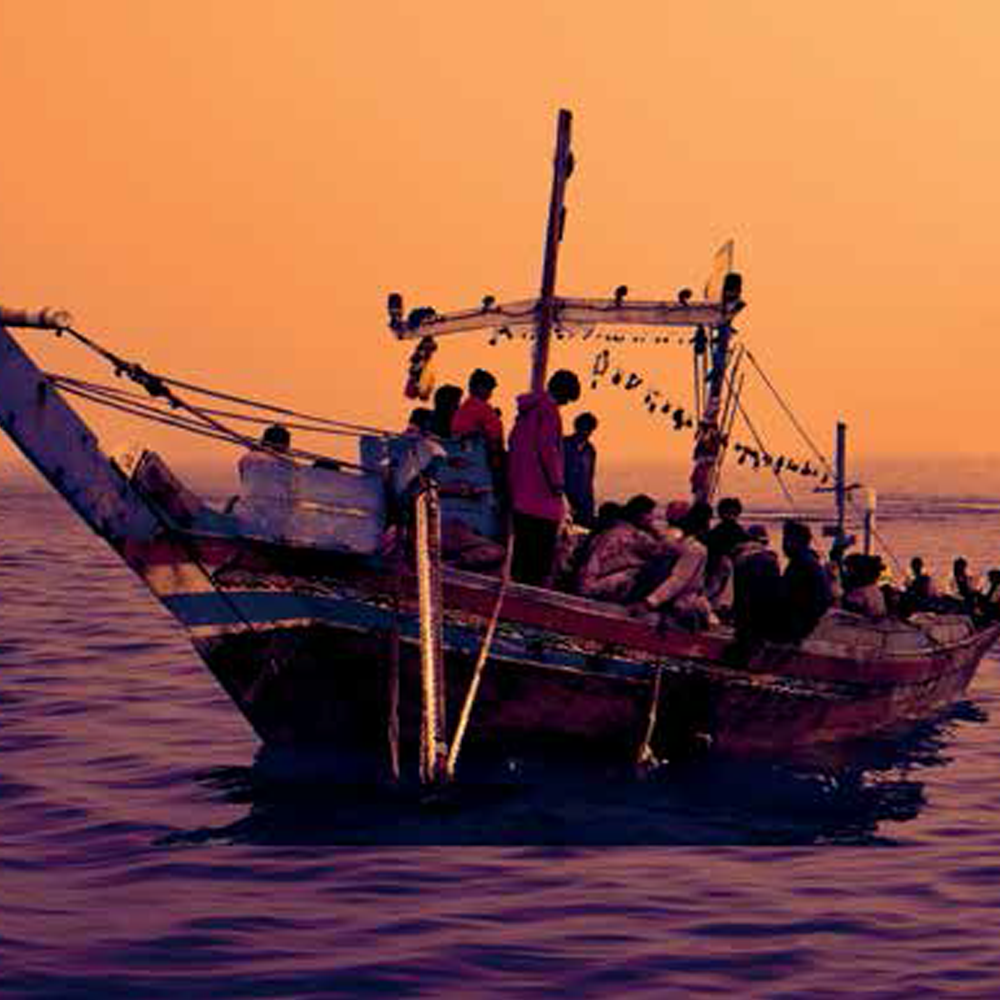
Husain Raza from Baba Island is almost 100 years of age. He is a retired boat captain locally, Nakhuda or Nakhuwan. He relates to the time when the population of Karachi was about 50,000, as narrated to him by his grandfather. This was in 1949. He proudly took out a newspaper clipping saved carefully in a plastic covering, showing his grandfather having caught a gigantic 40 ft. long whale. He was a small child at this time. Prime Minister Liaquat Ali Khan came to see the fish at the auction. The incident is spoken about with an enormous sense of patriotism and belonging to place.
The expenses are on the rise, making boat ownership dependent on middlemen who become partners by giving loans and demanding a share in earnings for each trip to sea. Boat rental and the increased distance required to get fish all add to the expenses that must be borne. Husain’s son is a captain now who owns a boat. He bought his boat for 3.5 lac rupees, in which he only has a percentage share. The remaining amount has been borrowed from an investor in the fisheries. A fifty percent share of the income on the total catch is prescribed to be given each time to the investor. The rest is divided so that the two parts of the share go to the captain, and the rest is equally divided among the crew members on the boat. Thus, the crew members make no more than Rs. 2000/ and as little as Rs. 500/ after a long trip. Usually, for a day trip of about 7 to 10 fishermen, they will arrange a fish feed of about Rs. 10,000, motor oil for the boat of about Rs. 10,000, and Rs. 5000 for their food and other supplies. So, about Rs 25000 is the total expenditures against which the catch is variable.
The fishermen have little way of determining or participating in the rates at which the fish is sold. The rates of fish vary as this is auctioned at Karachi Fish Harbour, varying from Rs. 40,000 to 1 lac for 1 tonne, as of 2021. Lack of organization and inefficient management of incoming and outgoing fishermen and loads of fish result in fish losses at the harbour. A limited number of jetties and the crowding of the boats to access the harbour is ad-hoc, lacks organization, and is consequently highly loaded with traffic in the fishing season. There is no demarcation of incoming and outgoing boats. According to the fishermen, they often spend more than half a day or an entire day in queue at the harbour. Up-gradation of the fish harbour is a major pressing requirement that can enormously improve access to the dock and services for outgoing fishermen, and reduce hassle for access to the auction hall, save time and fish loss. There are also cases where the boat owners act as middlemen, selling the fish when it comes to the bay and paying meagre wages to the fishermen themselves. Seldom can they take home some fish that they catch.
While recalling his experience as a captain, Husain previously could have a significant amount of fish caught even from the edge of the island. Now, his son goes far away in the sea, as much as 15 miles, but cannot get the same amount of catch. The deep-sea trawlers are a significant cause of this issue. Not only do they catch fish in large quantities, but their mechanically produced nets are so fine that they also catch the young breeding fish. Thus wiping the ocean floor entirely off the fish life. It, therefore, takes much longer to fish a reasonable quantity, and sometimes they return completely empty-handed, too. The fishing nets present an ethical and ecological concern for the marine habitat.
The nature of fishing as a livelihood has a fluctuating character; sometimes, the catch is good, while at other times, there is no catch. During the fishing season, people from different areas, including regions like Manchar and other deteriorating lakes, come to coastal areas for fishing.
The coastal waters around Karachi are enormously affected by the extent of untreated waste that is dumped into it. According to WWF, about 400 million gallons of untreated wastewater from Karachi is discarded in the sea daily. Besides the trawler deep-sea fishing using machine-made nets, pollution significantly affects the marine population.
Hussain was an expert boat captain. He has experience steering the sailing boat and knows all the different types of wind directions in the sea, which helps him sail the boat in the right direction. But now, with technological advancement, his son uses GPS to steer their motorized vessel to move in different directions. Technology can fail in times of need, reflects Husain wisely.
Fishing settlements on Baba and Bhit Islands are more than 400 years old. The population consists of the Kuchi community and Sindhi-speaking fishermen. Bhit Island was comparatively better in infrastructure and planning than Baba Island. Bhit Island has brick-paved roads and underground water and sewage pipelines. The Karachi Water and Sewerage Board (KWSB) has laid a water line down, but the pipes are not running. There is a significant issue regarding the availability of sweet water. People on the islands buy water for their utility and drinking purposes. For a gallon of about 10 litters, they pay about Rs. 100. The water source is near a temple beside Port Grand on the mainland. People fill drums from there, transport them to the Island through service boats, and then sell them among houses on the Island. Items of daily use are brought in, while solid waste from the Island (KMC) is transported to the city via service boats. Irregularity in waste disposal, however, causes pollution. Careless attitudes toward increased casual use of plastic in bottles and wrappers cause pollution. A management plan for sorting dry and wet, reuse, and recycling could reduce the garbage pile—the various bodies of government and community work in a fragmented manner, barely coordinating. Reverse Osmosis (RO) plants were present near several of these neighbourhoods. Each has functioned for two years and then shut down due to lack of upkeep. These plants have cost a considerable amount of money, and the sustainability in management and maintenance makes them less worthy. Can there be local solutions to this issue of water filtration? Some search over the internet shows landscape development methods that can act as buffer filtering and beautifying naturescapes around water sources, polluted nalas, and lakes. Landscape development carries enormous potential to cater to the current environmental pollution issues, where local people could be trained for upkeep and maintenance.
The Islands are dependent on the city. Sustainable management of resources needs to be explored to reduce costs and dependence.
There were two main schools on Bhit Island, one government and one private. There is no graveyard on the Island, so if a person dies, he has to be taken to the two main graveyards in the city, Moach Goth and Mewa Shah. The Island generally lacks necessities. Although a gas pipeline is laid down with the help of the inhabitants, people experience long hours of gas load shedding.
Stories and narratives from the community also highlighted how the fishermen have become victims of commercialization and capitalism. Commercial fishing has conquered their domain and left them poorer. Poverty is driving them to cut corners often, break the trust of community members they work with, and engage in petty theft due to desperation.





Leave a Reply