



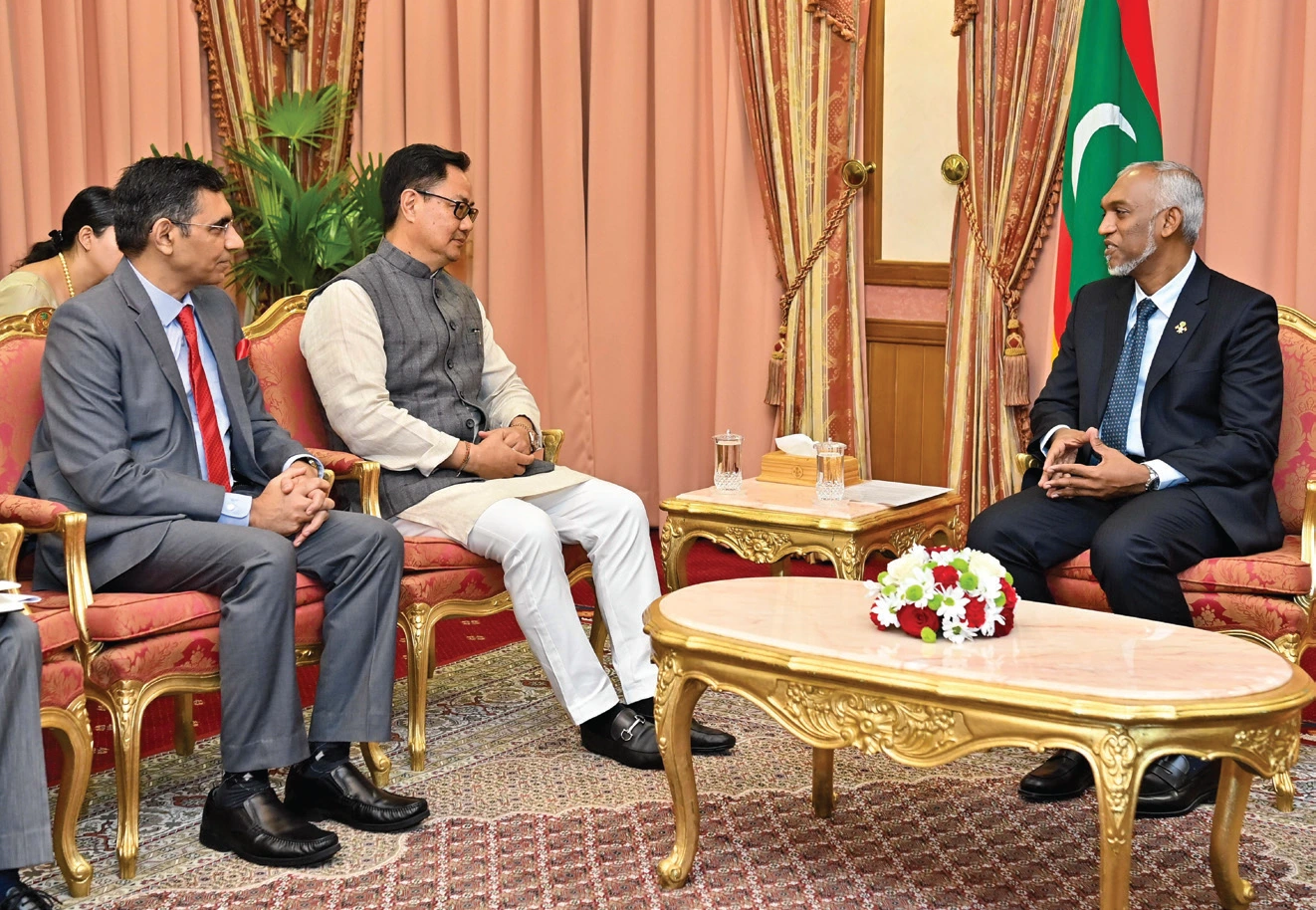
Union Minister Kiren Rijiju met President of the Maldives Mohamed Muizzu.
The relations between India and the Maldives are based on various factors, encompassing historical, geographical, cultural, economic, and strategic dimensions.
The fundamental bases of India-Maldives relations include the following:
Geographical Proximity
The geographical proximity of the Maldives to India in the Indian Ocean fosters a natural interest in maritime security and cooperation. Both nations share concerns about the security of sea lanes and the broader stability of the Indian Ocean region.
Historical and Cultural Ties
India and the Maldives share historical and cultural ties that date back centuries. Cultural affinities, historical trade, and exchanges have created a deep and enduring relationship.
Economic Cooperation
Economic cooperation is a significant aspect of the relationship. India has been involved in various developmental projects in the Maldives, supporting infrastructure development, healthcare, and capacity building.
Diplomatic Engagement
Regular high-level visits and diplomatic engagements between leaders of both countries have helped strengthen relations. Dialogues and consultations on regional and global issues contribute to mutual understanding.
Defence and Security Cooperation
Defence and security cooperation form an essential part of the relationship. Both nations have collaborated on maritime security, counterterrorism, and regional stability issues.
Trade and Investment
Bilateral trade and investment contribute to economic ties. India and the Maldives engage in business, and India is an important economic partner for the Maldives.
Humanitarian Assistance and Disaster Relief
India has provided humanitarian assistance and disaster relief to the Maldives during natural disasters. Such cooperation enhances mutual trust and solidarity.
People-to-People Contacts
Cultural exchanges, educational collaborations, and tourism contribute to people-to-people contacts. These interactions help foster understanding and goodwill between the citizens of both nations.
Shared Concerns
Both countries share climate change, environmental sustainability, and regional security concerns. Collaboration on common challenges strengthens the foundation of their relationship. These bases collectively contribute to a multifaceted and cooperative relationship between India and the Maldives. It’s important to note that the dynamics of international relations can evolve, and geopolitical changes and regional developments may influence the specifics of the relationship.
Brief Background
India and the Maldives are neighbours sharing a maritime border. Strategic, economic, and military cooperation have been friendly and close. New Delhi continues to contribute to maintaining security on the island nation. The financial aid provided by India exemplifies the enduring and trustworthy bond between India and the Maldives. The aligned principles of India’s “Neighbourhood First” and Maldives’ “India First” policies have synergistically worked to protect the interests of the people of both countries.
Moreover, this assistance serves as a testament that India remains steadfast in supporting the government and people of the Maldives in the days to come. It represents India’s second-largest ongoing plantation infrastructure endeavour, following the $500 million ‘Greater Malé’ Project, to link the capital with three adjacent highlands through a 6.74-kilometer-long sea bridge.
Thus, historically and even today, India has played a significant role in assisting the Maldives in areas such as infrastructure development, healthcare, and capacity building. Both countries have engaged in regular high-level visits to strengthen diplomatic ties. Additionally, India has been involved in various developmental projects in the Maldives. Maritime security and cooperation in the Indian Ocean region have been critical focus areas. Both countries share concerns related to naval threats, such as piracy and the need for collective efforts to ensure the security of sea lanes.


The writer is Professor and Head of the Department of Political Science as well as Dean, Faculty of Social Sciences at the Bhupendra Narayan Mandal University in Madhepura, Bihar. He can be reached at rajkumarsinghpg@gmail.com
Leave a Reply